Palazzo Dalla Rosa Prati: A Neoclassical Palace in Parma


Site at a Glance
- Rating
- 4.6
- Popularity
- Low
- Country
- Italy
- Primary era
- Early Modern
- External website
- Open
- Eras represented
- Medieval, Early Modern
- Civilizations
- Holy Roman Empire
- Site type
- Domestic
- Remains
- Elite Residence
On this page12 sections
History
Palazzo Dalla Rosa Prati is a historic palace in Parma, Italy, with medieval origins and a present neoclassical appearance created during a major renovation in the second half of the eighteenth century. Standing beside the Baptistery of San Giovanni at Piazza Duomo, it developed through the changing fortunes of the Adami, Prati, and Dalla Rosa families.
Medieval Origins
The palace is documented by 1222, when it belonged to the Adami family. Salimbene de Adam, a major medieval chronicler associated with Parma and a member of the family, was born there. This early connection places the building within the medieval history of the city and gives it a recorded association with one of Parma’s prominent historical figures.
The Prati and Dalla Rosa Families
In the fifteenth century, the noble Prati family acquired the palace. Its members later received the title of marquises of Collecchio in the seventeenth century. During the government of Ranuccio I Farnese, the duke of Parma, Marcello Prati’s daughter married the marquis Pier Luigi Dalla Rosa. Pier Luigi joined his wife’s family name to his own, establishing the Dalla Rosa Prati lineage.
The building was completely renovated in the second half of the eighteenth century. This work gave the principal façade the ordered neoclassical form that characterizes the palace today, while its earlier history remained tied to the families who had owned it.
Restoration and Present Use
In the early twenty-first century, while the palace still belonged to descendants of the historic owner family, it underwent major restoration. Part of the interior was converted into a luxury residence containing seven equipped suites and meeting rooms. The building currently contains offices, a private residence, and a luxury residence.
Remains
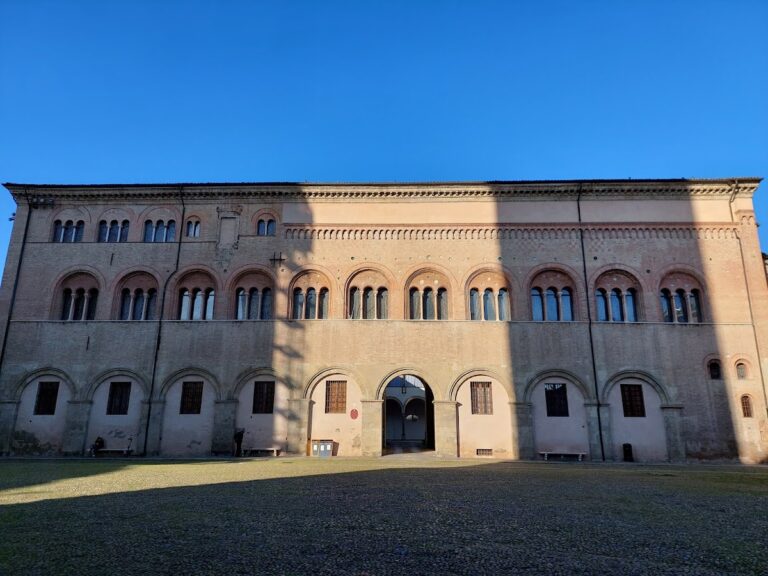
Palazzo Dalla Rosa Prati stands at the corner of Strada al Duomo and Vicolo al Battistero, beside the Baptistery of San Giovanni. The palace extends from this corner toward the neighborhood behind it and is arranged around a small central courtyard. Its principal façade is asymmetrical but formally ordered, combining a high base, regularly framed windows, and an imposing entrance portal within the composition established by the eighteenth-century renovation.
Façade and Entrance
Principal Façade
The façade facing Piazza Duomo rises above a high base finished in imitation rustication, a surface treatment that resembles large blocks of masonry. Framed windows mark the ground floor, while a horizontal string course separates it from the principal floor. The windows on that level follow a similarly ordered arrangement, and the openings of the uppermost floor are smaller.
Entrance Portal
The large entrance portal is the façade’s most prominent feature. Two pilasters flank the opening and support a classical horizontal band decorated with triglyphs, regularly spaced three-part ornaments. Above it, a small balcony with an elegant wrought-iron railing adds a refined accent to the entrance composition.
Courtyard and Principal Floor
Atrium and Courtyard
A long atrium leads from the entrance to the internal courtyard. Opposite the entrance, the courtyard has a portico surmounted by a double open gallery, creating the principal architectural focus of this interior space.
Decorated Hall
On the principal floor, the main residential and ceremonial level of an Italian palace, a richly decorated hall retains wall ornament covering its interior surfaces. The decoration is probably attributable to the eighteenth-century artist Benigno Bossi. Its vaulted ceiling contains a central fresco of the Allegory of Justice, painted by Domenico Muzzi.
Paintings and Interior Collection
The palace formerly contained a group of valuable paintings, mainly works from the Parma school. Among them was Madonna and Child with Saint Catherine by Girolamo Mazzola Bedoli. The ducal government purchased the paintings in 1851, and a substantial part of the group is now displayed in the National Gallery of Parma.
Nearby sites