Baptistery of Parma: A Romanesque-Gothic Baptismal Church in Italy


Site at a Glance
- Rating
- 4.5
- Popularity
- Medium
- Country
- Italy
- Primary era
- Medieval
- External website
- Open
- Eras represented
- Medieval
- Civilizations
- Holy Roman Empire
- Site type
- Religious
- Remains
- Baptistery
On this page18 sections
History
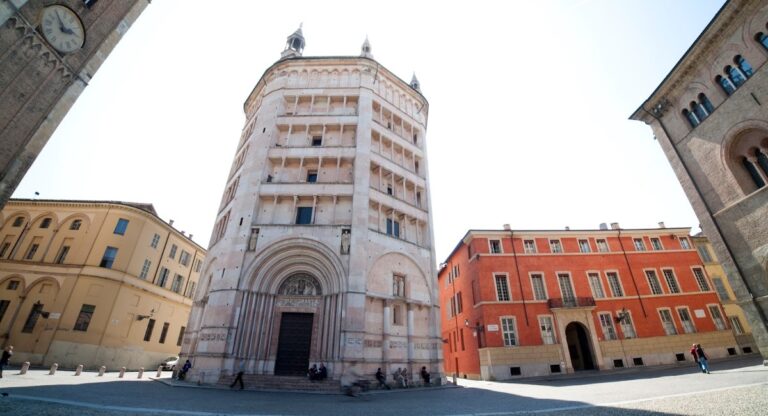
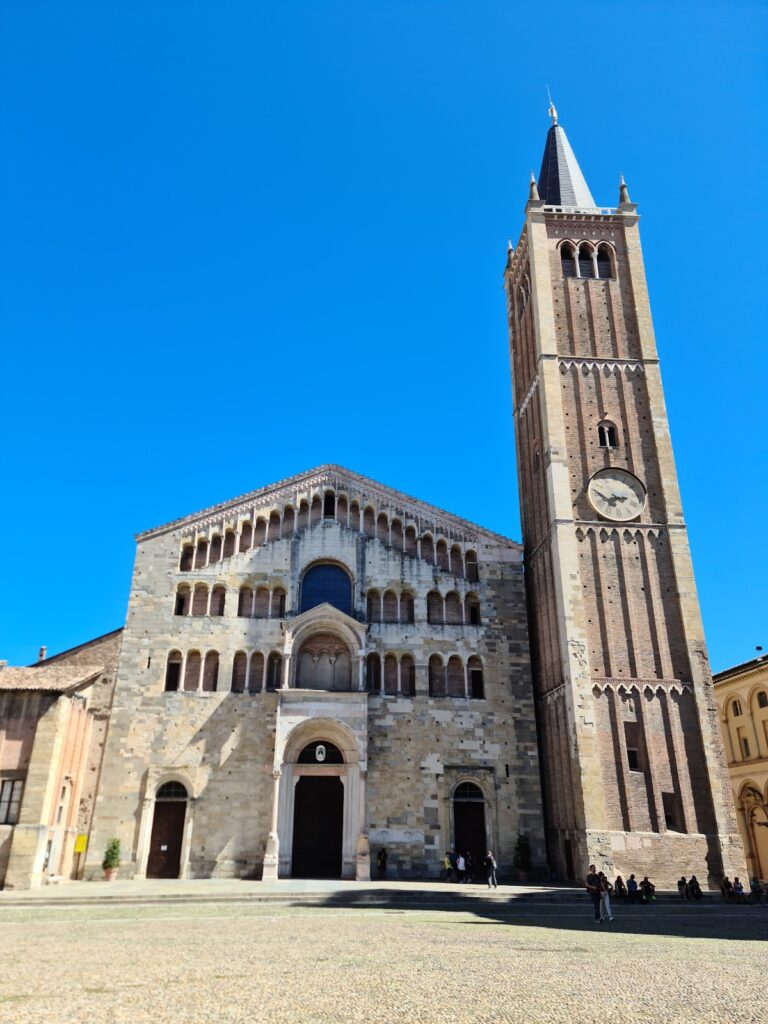
The Baptistery of Parma is a medieval Catholic baptistery and church in Parma, Italy, dedicated to Saint John the Baptist. Begun in 1196 and completed around 1270, it is a major monument in the transition between Romanesque and Gothic architecture. The building stands beside Parma Cathedral and the episcopal palace, and its altar gives it a role beyond baptism alone.
Commission and Early Construction
The city commissioned Benedetto Antelami, a Lombard sculptor and architect active around the turn of the thirteenth century, to create the baptistery. An inscription in leonine verse on the architrave of the northern Portal of the Virgin states that he began the work in 1196. The project also involved strong civic participation. Salimbene de Adam wrote that his parents sold houses so the building could be erected on their sites, while his father placed commemorative stones in its foundations.
The lower structure was sufficiently advanced for baptisms by Holy Saturday, 9 April 1216. Salimbene later stated that he was baptized there in 1221, when the building stood beside his family home. A major earthquake struck on 25 December 1222, causing fears that the unfinished walls could collapse. Salimbene recalled that his mother worried the baptistery might fall onto their house. The walls were probably not yet secured by a vault at that stage.
Interruption and Completion
Political hostilities involving Guelph Parma and the imperial alliance of Ezzelino da Romano, lord of the Trevisan March and Verona, interrupted construction and the supply of the coloured marble used for the facing. Work on the upper parts resumed in 1249. Antelami appears to have directed the first phase, approximately from 1196 to 1216, when the structure reached about 14 metres and its first exterior gallery was completed. A temporary flat roof stood at the cornice beneath the planned dome.
Antelami apparently left the building site after this first phase, although it is uncertain whether he departed for other work or died then. The project continued under the Campionesi masters, builders and sculptors from the area around Campione. Between 1260 and 1270 they completed the ribbed interior dome and added three more exterior gallery levels. At the beginning of the fourteenth century, a fifth blind gallery, a renewed roof, and pinnacles were added; a central pinnacle was later removed.
The baptistery was solemnly consecrated on 25 May 1270 in the presence of the bishops of Emilia. During the medieval period, the Maggiore Canal passed beneath the building and supplied its baptismal basin. Later Gothic alterations changed aspects of the original design. Archaeological analysis indicates that the projecting ribs inside the dome were added to a structure not originally designed for them, while the portals were made more widely splayed and received additional columns. Several sculptures were repositioned during the Campionesi campaign.
Later Interior History
The interior paintings deteriorated because many had been executed in tempera rather than a fully durable fresco technique. Paint began to detach from the walls, prompting restoration and consolidation campaigns that used injections and infiltrations to secure the painted surfaces. The building remains associated with the Roman Catholic Diocese of Parma, and its altar continues to serve baptisms and Masses.
Remains
Exterior Form and Sculpture
The baptistery is a tall, truncated-tower-like structure with a centralized octagonal plan. Its exterior is faced chiefly with pink and reddish Verona marble, a coloured stone from the region of Verona. The contrasting tones create changing effects of light and shadow across the octagonal mass. The lower level has three round-arched, splayed portals. The five other sides contain large blind semicircular arches, each with a central small column. Above this base are four tiers of open, architraved galleries, followed by a final band of blind pointed arches. A roof with eight shallow slopes is concealed behind a balustrade, and small pinnacles crown the corners.
Most of the exterior sculpture is concentrated on the octagonal base. Each side without a portal has a large blind arch framed by a horizontal architrave and supported by two half-columns on a high plinth. Their capitals include Corinthian forms and water-wave patterns devised by Antelami as references to baptism. A nearly continuous zoophore, or sculpted frieze of animals and fantastic creatures, runs around the lower marble facing. Its 75 low-relief panels include animals, sea monsters, centaurs, sirens, unicorns, dragons, griffins, birds, zodiac signs, and human figures such as agricultural workers. One section on the south side remains unfinished. Together, the reliefs address human life, nature, human vices, and the possibility of redemption.
Portal Sculpture
Portal of the Virgin
The northern Portal of the Virgin opens toward the piazza shared with the cathedral. Its architrave carries the inscription naming Antelami and recording the beginning of the work in 1196. The outer jambs contain the genealogical trees of Jacob and Jesse. Jacob’s tree includes his twelve sons and Moses at its summit, while Jesse’s tree presents twelve kings of David’s line and a small white-marble figure of Mary at the top. The inner jambs and the underside of the architrave contain the Tree of Peridexion.
In the lunette, the Virgin and Child are shown with the Adoration of the Magi and Joseph’s dream. The lintel presents episodes from the life of John the Baptist, including the baptism of Christ in the Jordan, Herod’s banquet, and the beheading of the Baptist. The archivolt contains twelve figures representing institutions of Israel involved in messianic prefiguration, including prophets, kings, judges, legislators, and sages. Above the portal are the archangels Gabriel and Michael, while nearby niches contain David with Nathan and Solomon with the Queen of Sheba. These sculptures are attributed to Antelami.
Portal of Judgment
The western Portal of Judgment is the most important of the three portals in liturgical terms because the altar lies directly opposite it inside. Its lunette shows the Redeemer, or Christ in glory, displaying the wounds of the Crucifixion. The cross is formed from branches resembling the Tree of Life. Around Christ, the archivolt contains the twelve apostles and two angels sounding trumpets before the Tree of Life. The lintel depicts the resurrection of the dead at the sound of the angels’ trumpets, and Saint Paul appears at the extreme left of the lunette.
The jamb reliefs represent the works of mercy and the parable of the workers in the vineyard. They show welcoming a pilgrim, washing feet, feeding the poor, giving drink to the poor, feeding a chained prisoner, and clothing a poor person. The portal’s imagery forms part of the building’s wider association between baptism and salvation.
Portal of Life
The southern Portal of Life was used by catechumens entering to receive baptism. Its lunette depicts the legend of Barlaam and Josaphat. A man clings to a tree while a dragon threatens him, a beehive or honeycomb hangs above, and two rats gnaw the tree below. The imagery presents the dangers of worldly life and the spiritual salvation associated with baptism. The sun and moon, accompanied by personifications of day and night, represent the passage of time. A floral frieze fills the archivolt, while prophets and symbolic animals derived from bestiaries occupy the jambs and architrave.
The three portals therefore present different subjects within a shared religious programme. The northern portal centres on the Adoration of the Magi, the western portal on the Last Judgment, and the southern portal on the legend of Barlaam and Josaphat. Together they relate the building’s entrances to baptism and salvation.
Interior and Dome
Central Space and Dome
The interior forms one tall space. Its sixteen-sided configuration repeats the external octagon and is divided by sixteen arcades into sixteen curved niches. Thirteen niches contain paintings and three contain doors. The niches lighten the walls and have been described as forming the symbolic shape of a flower.
The dome measures 23.25 metres in diameter and is divided into sixteen sectors by sixteen tubular ribs of pink Verona marble radiating from the centre. Each rib ends in a column superimposed on columns descending to the floor. The projecting ribs were added during the Gothic development of the building. The dome paintings were executed rapidly in tempera rather than true fresco, and their authorship and date remain uncertain. They have been attributed either to Byzantine-influenced masters active in the 1260s or to a workshop directed by Grisopolo, who described himself as a painter of Parma and worked toward the end of the thirteenth century.
The painted programme is arranged in six concentric horizontal bands. From the top downward, they show the red heaven of eternal love; the blue starry Empyrean, the highest divine heaven in medieval Christian cosmology, and the heavenly Jerusalem; the twelve apostles and the four evangelists; Christ enthroned with the Virgin and John the Baptist among prophets; episodes from the life of John the Baptist and four saints; and scenes from the life of Abraham with the four elements, the four seasons, and the Virgin.
Niches and Interior Tympana
The sixteen lower niches contain paintings made between the thirteenth and fifteenth centuries by painters from Emilia, mostly as votive works. The niche behind the altar contains the Baptism of Christ, the only niche painting attributed to the painters of the dome. The Master of Bianchi painted a 1302 Virgin and Child enthroned between a bishop and a pope. He also created the votive fresco of Bishop Gerardo Bianchi, with the Virgin and Child, John the Baptist, an angel, and Bishop Bianchi. Saint Catherine and Saint George killing the dragon are attributed to Buonamico Buffalmacco and date approximately from 1330 to 1336. Other niche paintings are attributed to Niccolò da Reggio and Bertolino da Piacenza.
The tympana above the niches combine sculpture and painting. Their subjects include Christ in glory with the symbols of the evangelists, angels acclaiming Christ or overcoming dragons, the Presentation in the Temple, the heavenly Jerusalem, saints and Doctors of the Church including Ambrose and Jerome, David making music among musicians and dancers, the Annunciation, the Flight into Egypt, and scenes with angels, saints, the Christ Child, archangels, and the four elders of the Apocalypse. Reliefs representing zodiac signs appear above the tympana, including Virgo, Capricorn, Aquarius, Aries, Taurus, Gemini, and Leo.
The angels in the interior tympana were added later and were not originally intended for their present positions. The six principal tympana above the three doors, inside and outside, are regarded as sculptures belonging to Antelami’s original project. The internal tympanum above the altar, showing Christ Pantocrator, or Christ as universal ruler, with the four evangelists’ symbols and two angels, was probably installed later and may have been intended for another location.
Months and Seasons
High-relief sculptures of the months and seasons stand on the floor of the first interior gallery between the small columns. Their present arrangement includes August, autumn, September, October, November, December, January, February, March, April, May, spring, June, and July. Several associated zodiac figures have been removed, and the cycle is incomplete. The sculptures show people engaged in seasonal agricultural work, with carefully rendered tools, plants, and fruits. Their realistic treatment also includes classical references in hairstyles, clothing, and symbolism. They may originally have been intended for the principal portal of Parma Cathedral, but the work was interrupted, perhaps because of Antelami’s death or early departure.
Baptismal Furnishings
Altar and Central Font
The altar occupies the eastern apsidal niche and is made of Verona marble. Its frontal low relief shows John the Baptist between a priest and a Levite. The altar remains in use for baptisms and Masses.
At the centre of the building stands an octagonal Verona-marble baptismal basin raised on two octagonal levels. The inner basin has four lobes. Its arrangement provided a dry position for the officiant while catechumens stood in the surrounding water for baptism by immersion, a rite for which an octagonal plan traditionally evoked renewal and the eighth day of resurrection and new creation.
Second Baptismal Font
A second font stands in the south-western area and was intended for baptism by affusion, in which water is poured over the person being baptized. Its Verona-marble basin dates to 1239 and carries a broad vegetal frieze containing birds. The basin is supported by a lion-shaped column bearer carved from darker red Verona marble, a difference that may indicate the support was reused.
Painted Cycles
The lower dome band contains scenes from the life of Abraham, including Lot’s flight from Sodom, pursuing horsemen, warriors capturing two figures, Abraham’s meeting with Melchizedek, the sacrifice of Isaac, the appearance of three angels, Abraham’s banquet for them, and the destruction of Sodom. Another band presents the life of John the Baptist, from the annunciation to Zechariah and Elizabeth and John’s Nativity through his preaching, baptism of Christ, arrest, martyrdom, and the events at Herod’s banquet. It also includes John’s departure into the desert, his identification of Jesus, and a miracle of Jesus before the Baptist’s disciples.
Saint Martin, Saint Sylvester, Saint Ambrose, Saint Augustine, Saint Gregory, and Saint Jerome appear in this zone. Another band shows the Redeemer, John the Baptist, the Virgin, Saint John the Evangelist, and prophets including Isaiah, Jeremiah, David, Solomon, Ezekiel, Hosea, Daniel, Amos, Obadiah, Moses, Balaam, and Habakkuk. The apostolic band includes Peter, Andrew, James son of Alphaeus, Matthew, James son of Zebedee, Philip, Bartholomew, Barnabas, Simon the Zealot, Thomas, Thaddeus, and Paul, together with the four symbolic creatures of the tetramorph, the traditional group associated with the four evangelists.
Nearby sites