Schloss Mühlgrub: A Renaissance Castle in Pfarrkirchen bei Bad Hall, Austria


Site at a Glance
- Rating
- 4.6
- Popularity
- Low
- Country
- Austria
- Primary era
- Early Modern
- External website
- Open
- Eras represented
- Medieval, Early Modern
- Civilizations
- Habsburg, Holy Roman Empire
- Site type
- Military
- Remains
- Castle
On this page11 sections
History
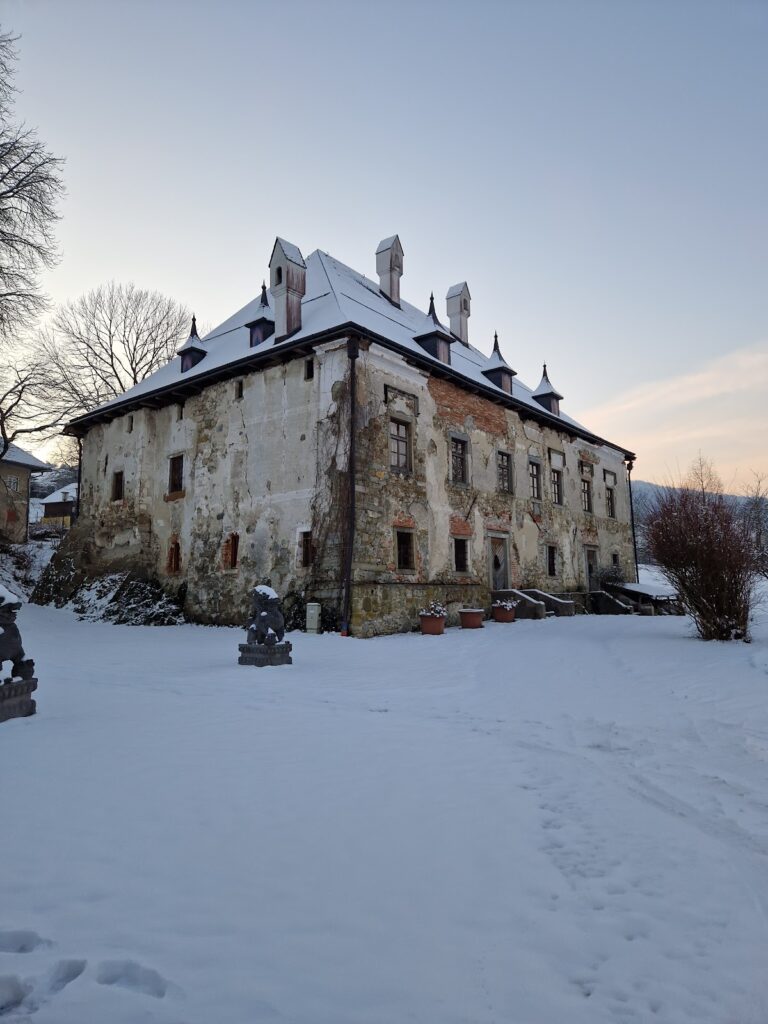
Schloss Mühlgrub is a historic castle in Pfarrkirchen bei Bad Hall, Austria, developed from the medieval manor of Grub and remodeled in the Renaissance period. The manor was held as a fief from Kremsmünster Abbey, a Benedictine monastery in Upper Austria, and appears in a 1299 estate register that recorded landholdings, rights, and obligations. It was known simply as Grub until 1415, when ownership changes gave rise to the name Mühlgrub.
From Grub to Mühlgrub
The estate was associated with the Asperger family of Aspertgerhof. The last Asperger, Wolfgang, held one half of the property, while his relative Hans Pucher owned the other. Wolfgang’s daughter Barbara inherited her father’s share after marrying Hans Mühlwanger. In 1415, Hans Mühlwanger purchased the remaining half, bringing the whole estate under his control and establishing the name Mühlgrub.
Under the Mühlwanger family, the manor was transformed into a Renaissance castle. Hans Mühlwanger sold it to Hanns Greimatschmied in 1529. Greimatschmied’s heirs transferred it to Hieronymus Prändl von Weissenbach in 1544, and the property passed to the Wuecherer family six years later.
Seventeenth-century ownership
Christoph Strutz, who served as iron superintendent and provincial land clerk of Upper Austria, acquired Mühlgrub from Georg Wuecherer in 1601. Hans Fenzl of Steyr succeeded Strutz in 1615. In 1633, Fenzl’s daughter Elisabeth received the estate and brought it into her marriage with Wolfgang Jakob von Katzianer.
Siegmund Ferdinand von Katzianer sold the lordship to Veit von Gera in 1658, but Veit died in the same year. His heirs transferred Mühlgrub to Schlierbach Abbey in 1659. Schlierbach, a Cistercian monastery in Upper Austria, retained ownership until 1876.
Industrial use and wartime damage
Gottlieb and Anna Pepöck purchased the estate in 1876. Their successor, Hans Haager, established a brewery at Mühlgrub in 1891, and brewing continued until 1986. During the 1970s, the site also became the location of the world’s largest bottling plant for Schartner Bombe, a carbonated beverage brand.
The castle suffered severe damage during the Second World War. Its second flank tower was not rebuilt afterward. The property is currently owned by Country Home Style.
Remains
Hilltop complex and courtyard
The extensive castle complex stands on a hill above the Sulzbach. Its main building forms a four-winged arrangement around a rectangular inner courtyard. The courtyard is paved and rises slightly toward the side with the rear tower. Wrought-iron grilles protect the windows, adding a defensive element to the surviving historic fabric.
Towers and entrance
A 1674 engraving by Georg Matthäus Vischer, an Austrian cartographer and engraver known for detailed views and maps, depicts Mühlgrub with seven towers. Two towers are preserved within the castle complex today.
Square tower
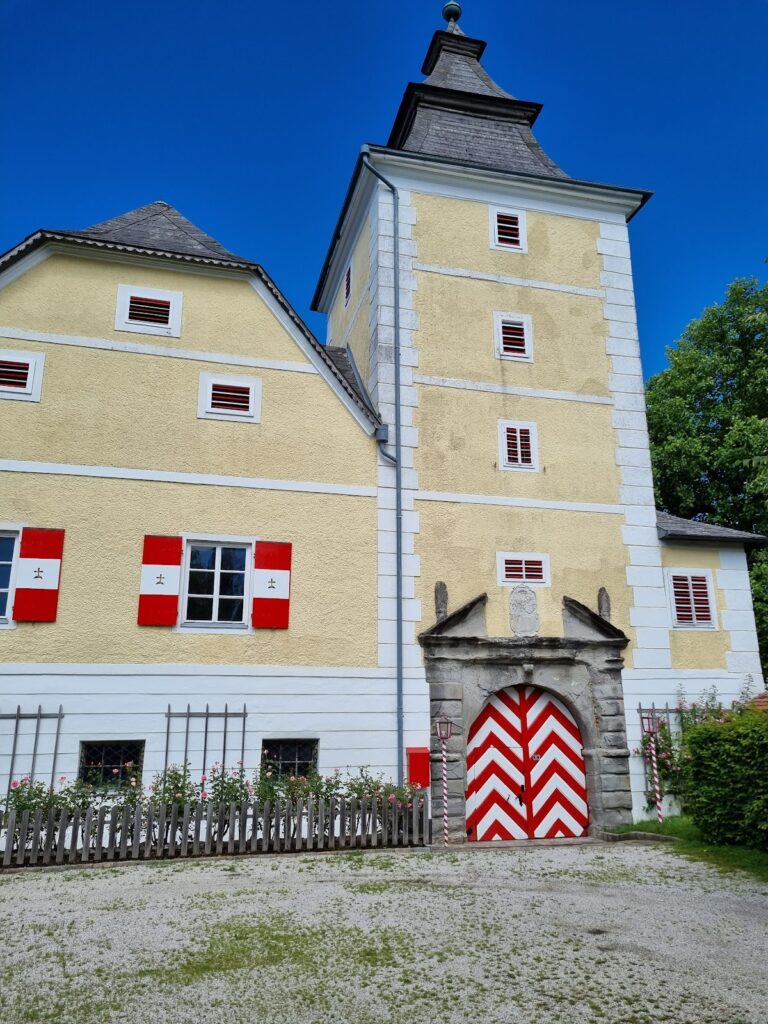
A tall square tower is incorporated into one of the castle wings. It is capped by a pyramidal roof and forms one of the principal vertical elements of the four-winged structure.
Round entrance tower
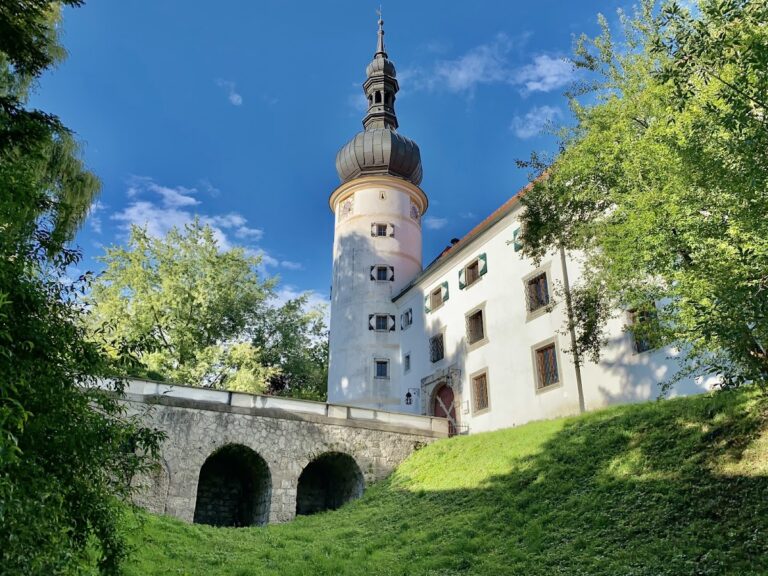
At the left corner in front of the entrance stands a projecting round tower with a conical roof. It formerly had a matching companion, forming a paired approach to the castle entrance.
Portal and gate hall
Access to the castle is through a round-arched portal built from large stone blocks. The portal opens into a gate hall, which leads onward to the rectangular inner courtyard.
Brewery buildings
Two ancillary buildings from the original ensemble remain associated with the site. They were used for brewery operations until brewing ended in 1986, preserving a physical connection between the historic castle estate and its later industrial function.
Nearby sites