Schloss Remseck: A Neo-Gothic Castle in Germany


Site at a Glance
- Rating
- 3.5
- Popularity
- Very Low
- Country
- Germany
- Primary era
- Modern
- Eras represented
- Medieval, Modern
- Civilizations
- German, Holy Roman Empire
- Site type
- Domestic
- Remains
- Castle
On this page9 sections
History
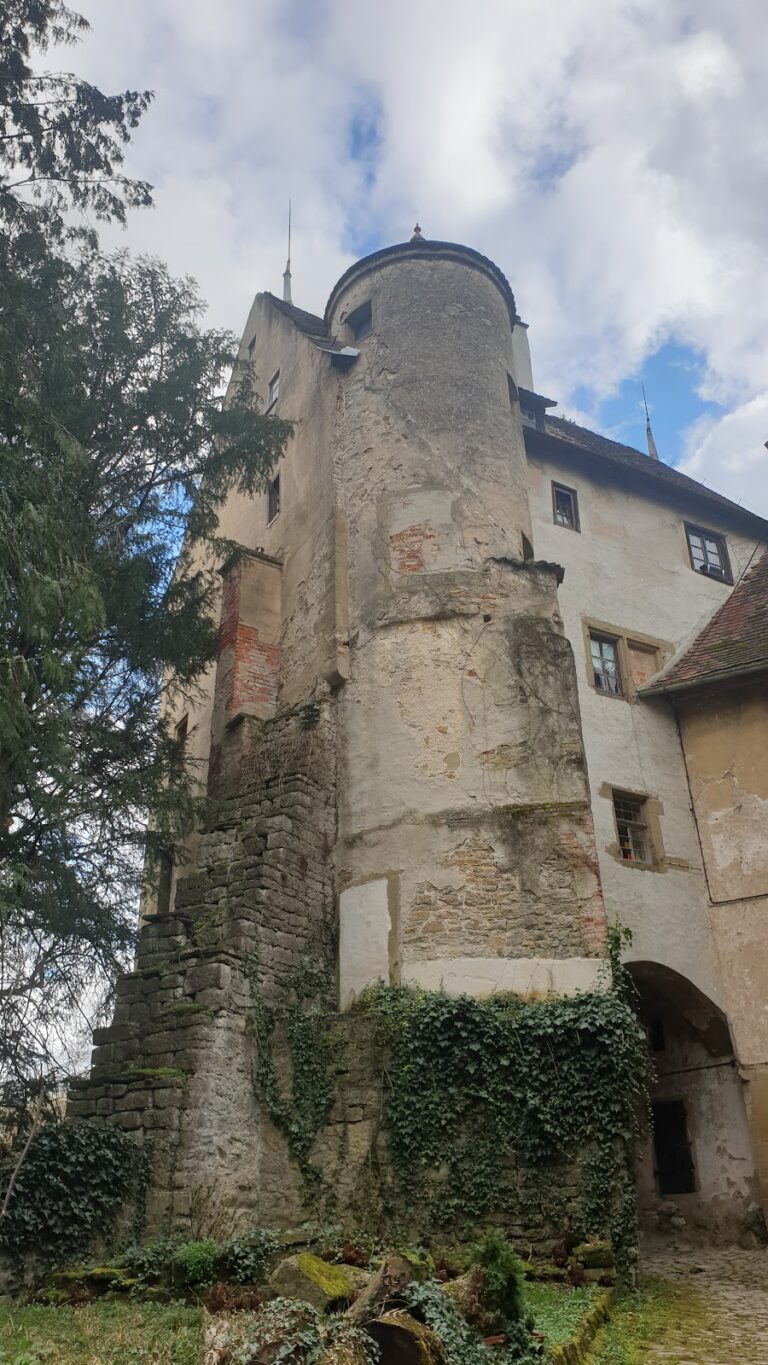
Schloss Remseck is a Neo-Gothic castle in Germany, located in Neckarrems above the confluence of the Rems and Neckar rivers. Major Franz von Grimm built it in 1841–1842 on the site of Burg Rems, a medieval fortress whose position on a hill spur gave it a defensive role.
Burg Rems and Württemberg
Burg Rems was built toward the end of the eleventh century by Henry IV, a German king and Holy Roman Emperor. By 1268, it belonged to Württemberg, a historical state and ruling house in southwestern Germany, and served as a border fortress. At that time, the Aldingen estate on the opposite bank of the Neckar was not part of the County of Württemberg.
The Württemberg counts Ulrich II and Eberhard of Württemberg frequently stayed at the castle. During the conflict between Count Eberhard and Henry VII, a later Holy Roman Emperor, Burg Rems was destroyed at the beginning of the fourteenth century. Members of the Nothaft family later served as Württemberg garrison members there and rebuilt it.
Burg Rems eventually lost its importance and was demolished in 1576, although its keep, the principal fortified tower of a medieval castle, remained standing. The unused tower collapsed in 1792.
The nineteenth-century castle
Franz von Grimm replaced the former fortress with Schloss Remseck in 1841–1842. The new building followed the Neo-Gothic movement, a nineteenth-century revival of medieval Gothic forms such as pointed arches and strong vertical emphasis. The complex included a farmyard, barn, stable, and large garden. Grimm sold the property again in 1863.
The estate then passed to Count Edzard zu Inn- und Knyphausen, who came from Celle, and his wife Fanny Pauline, a daughter of Karl Weiprecht Reinhard von Gemmingen. From 1967 to 1991, Anton zu Inn- und Knyphausen and his wife Brita Gustavsson-Knyphausen operated an art gallery in rooms of the castle.
Municipal identity and later ownership
When Aldingen, Hochberg, Hochdorf, Neckargröningen, and Neckarrems merged in 1975, Schloss Remseck lay approximately at the geographical center of the new municipality. With effect from 1 July 1977, the municipality, previously called Aldingen am Neckar after its largest district, was renamed Remseck am Neckar after the castle. The property remained with the zu Inn- und Knyphausen family until 2003, when Rüdiger Stihl, a son of Andreas Stihl, acquired it and had it completely renovated. The castle, its ancillary buildings, and the surviving remains of Burg Rems are protected as historic monuments. Some publications also call the building Schloss Neckarrems.
Remains
Castle and former fortress
Schloss Remseck
The present castle occupies a limestone hill spur called Remseck in the Neckarrems district of Remseck am Neckar. The nineteenth-century Neo-Gothic complex consists of the main castle together with its associated farmyard, barn, and stable. It stands above the meeting of the Rems and Neckar, on the same elevated ground that held the earlier fortress.
Burg Rems remains
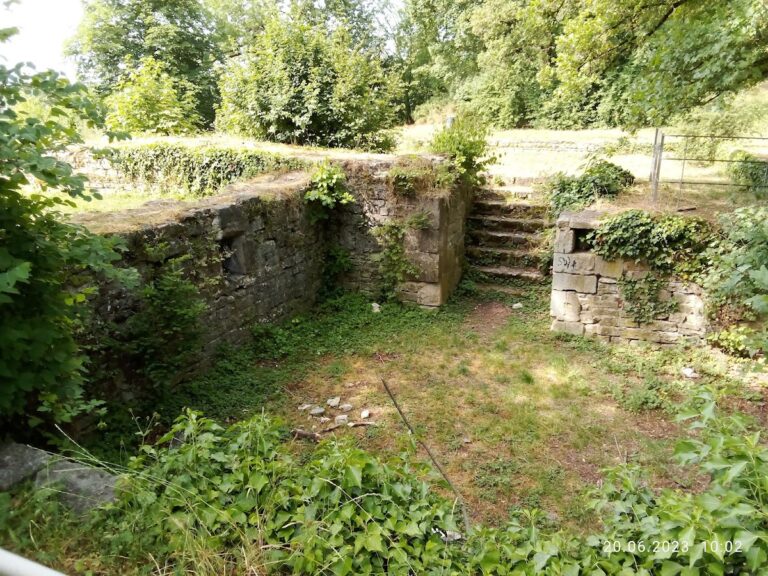
The earlier Burg Rems stood on the limestone spur between the two rivers. Its surviving elements are described as wall remains, preserving a physical trace of the medieval fortress on which the later castle was built.
Landscape park
After the property passed to Count Edzard zu Inn- und Knyphausen, the castle park was laid out across approximately two hectares as an English Romantic landscape park. This garden style uses irregular planting, winding paths, open views, and natural-looking scenery rather than a strictly geometric arrangement. Stuttgart garden inspector Gustav Adolf Wagner designed the park; his authorship is indicated by his signature on original plans preserved at Schloss Remseck.
Nearby sites