Church of San Ferdinando, Naples: A Baroque Jesuit Church
Site at a Glance
- Popularity
- High
- Country
- Italy
- Primary era
- Early Modern
- Eras represented
- Early Modern, Modern
- Civilizations
- Italian, Kingdom of Naples, Kingdom of the Two Sicilies, Spanish
- Site type
- Religious
- Remains
- Church
On this page16 sections
History
Jesuit foundation and building campaign
The Church of San Ferdinando is a Catholic church in Naples, Italy, founded by the Jesuits for the worship of Saint Francis Xavier. Its seventeenth-century design is Baroque. Construction received substantial financial support from Catalina de la Cerda y Sandoval, wife of Pedro Fernández de Castro, Count of Lemos and viceroy of Naples from 1610 to 1616. A viceroy governed a territory on behalf of a monarch.
Three designs were developed for the church. The Jesuit priest Agatio Stoia prepared the first, which was not built, although some of its proposals were retained. Architect Giovan Giacomo di Conforto produced a second design. Cosimo Fanzago, an Italian Baroque architect and sculptor, developed the final project using ideas from the earlier plans. It was approved on 15 December 1635 and is traditionally attributed to him.
The foundation stone was laid on 2 February 1636, and the first part of the church was consecrated in 1641. Building work stopped more than once. In 1655, work was interrupted after a proposal to alter the dome because it obstructed the view of the city from Castel Nuovo. The church opened to the public around 1665. Work continued into the eighteenth century, with 1759 conventionally treated as the end of the building campaign.
Rededication and later use
In 1767, the Jesuits were expelled from the Kingdom of Naples, and the church passed to the Constantinian Knights, members of a religious-military order associated with Saint George. They dedicated it to Saint Ferdinand III of Castile, a medieval king later canonized as a Catholic saint, in honor of Ferdinand IV, the Bourbon king of Naples. The Knights retained the church until the French occupation in 1801.
From 1827, the church belonged to the Archconfraternity of Our Lady of the Seven Sorrows, a Catholic devotional association. Its members included representatives of the Bourbon royal house and, from 1861, the House of Savoy. In 1853, Ferdinand II of Naples oversaw a restoration. The Bourbon family had especially favored the church, which became known as the “church of nobles and kings.”
Royal and civic memory
The church is also called the “church of artists” because funeral services for well-known Neapolitan performers were held there, including Achille Lauro, Sergio Bruni, Roberto Murolo, and Mario Merola. A Sunday Mass is traditionally celebrated in Latin according to the older Catholic rite. The church is included within the UNESCO World Heritage listing for the Historic Centre of Naples, inscribed in 1997.
Remains
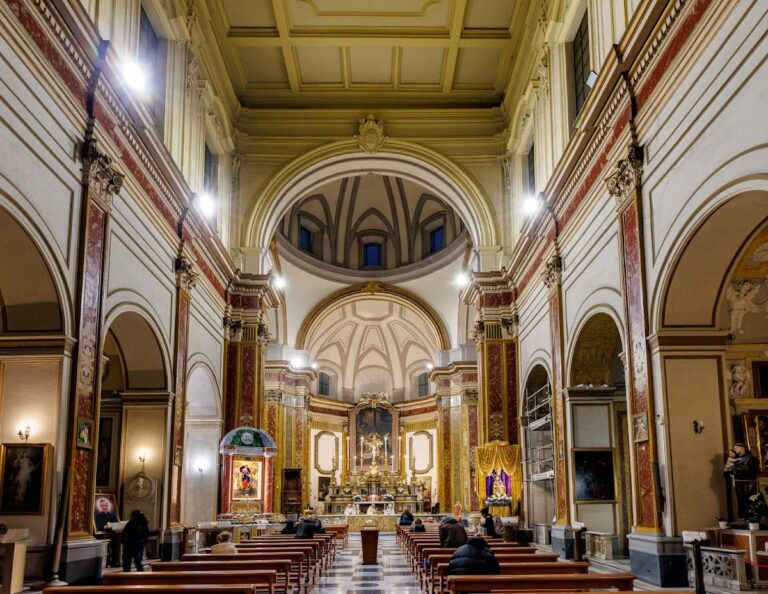
The church has a cross-shaped plan, with a single nave lined by side chapels, a crosswise arm called the transept, a deep sanctuary end called the apse, and a dome above the central crossing. Its exterior and richly decorated interior combine stone, marble, plasterwork, paintings, and sculpture.
Facade and entrance
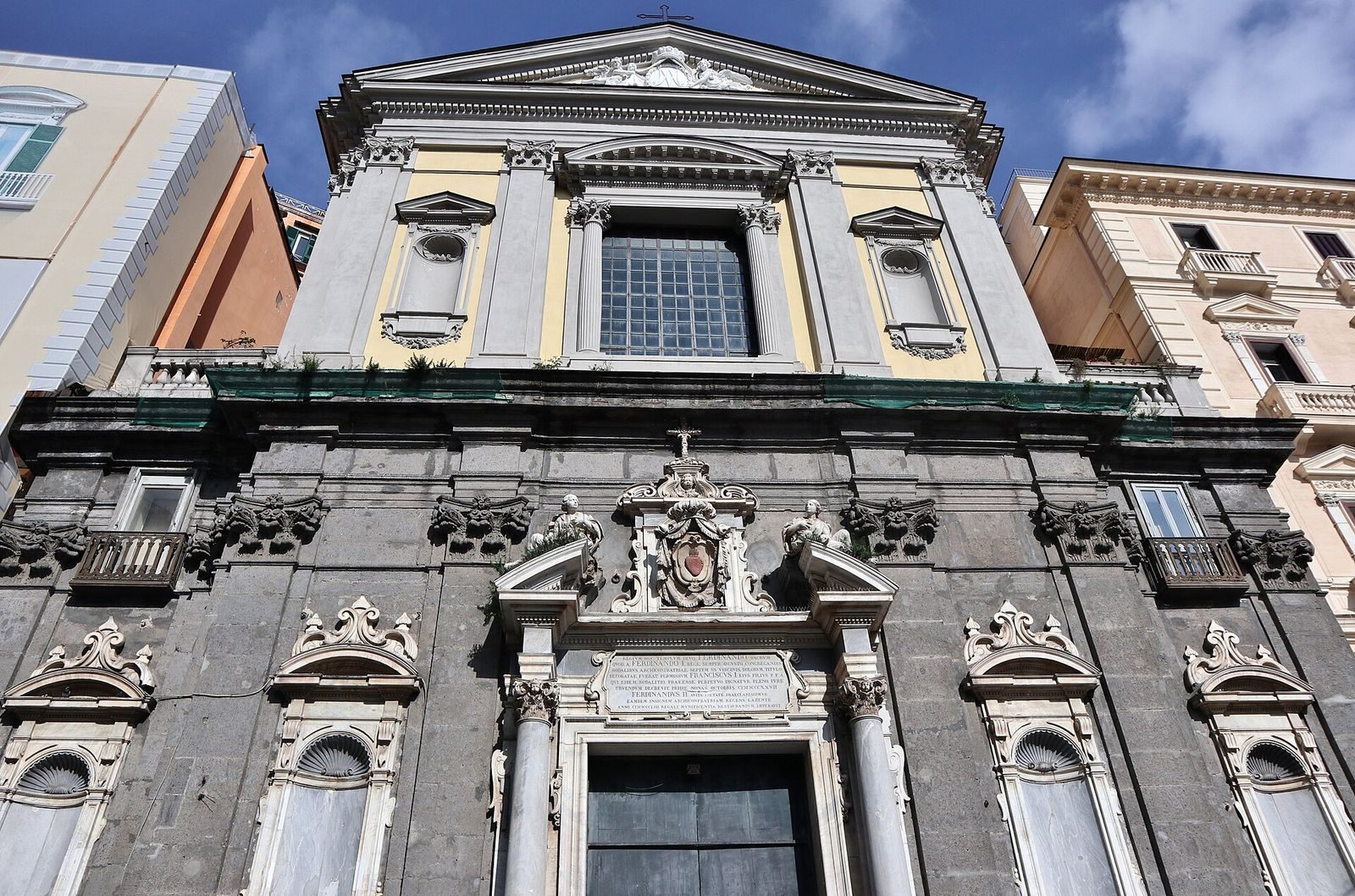
Fanzago designed the lower façade, which combines dark piperno, a volcanic stone, with white-marble frames around the entrance and niches. Shallow wall supports divide its surface. The upper part was finished between 1738 and 1759. During Naples’s late-nineteenth-century urban-renewal works, its curved side forms and balustrade were removed and replaced by a classical triangular pediment. A Baroque design also included an exterior iron gate with stone piers, probably designed by Francesco Antonio Picchiatti. The gate was removed during the renewal works, probably after damage connected with construction of the Galleria Umberto I. The confraternity’s coat of arms remains above the entrance.
Nave and painted decoration
Plan and furnishings
Marble and stucco plaster decorate the side chapels, which are screened from the nave by iron-and-brass gates. The marble walls are mainly gold-yellow, pink, and white, with beige and small areas of black. Striped pilasters carry sculpted white capitals, or column tops, that contribute to the strongly Baroque interior. Two marble holy-water basins designed by Fanzago stand near the entrance. Filippo Pardo completed the marble floor in 1748. Two organs occupy galleries above the arches of the final chapels on either side of the nave, while a pulpit at the last pillar on the left dates from the nineteenth century.
Paintings and ceiling
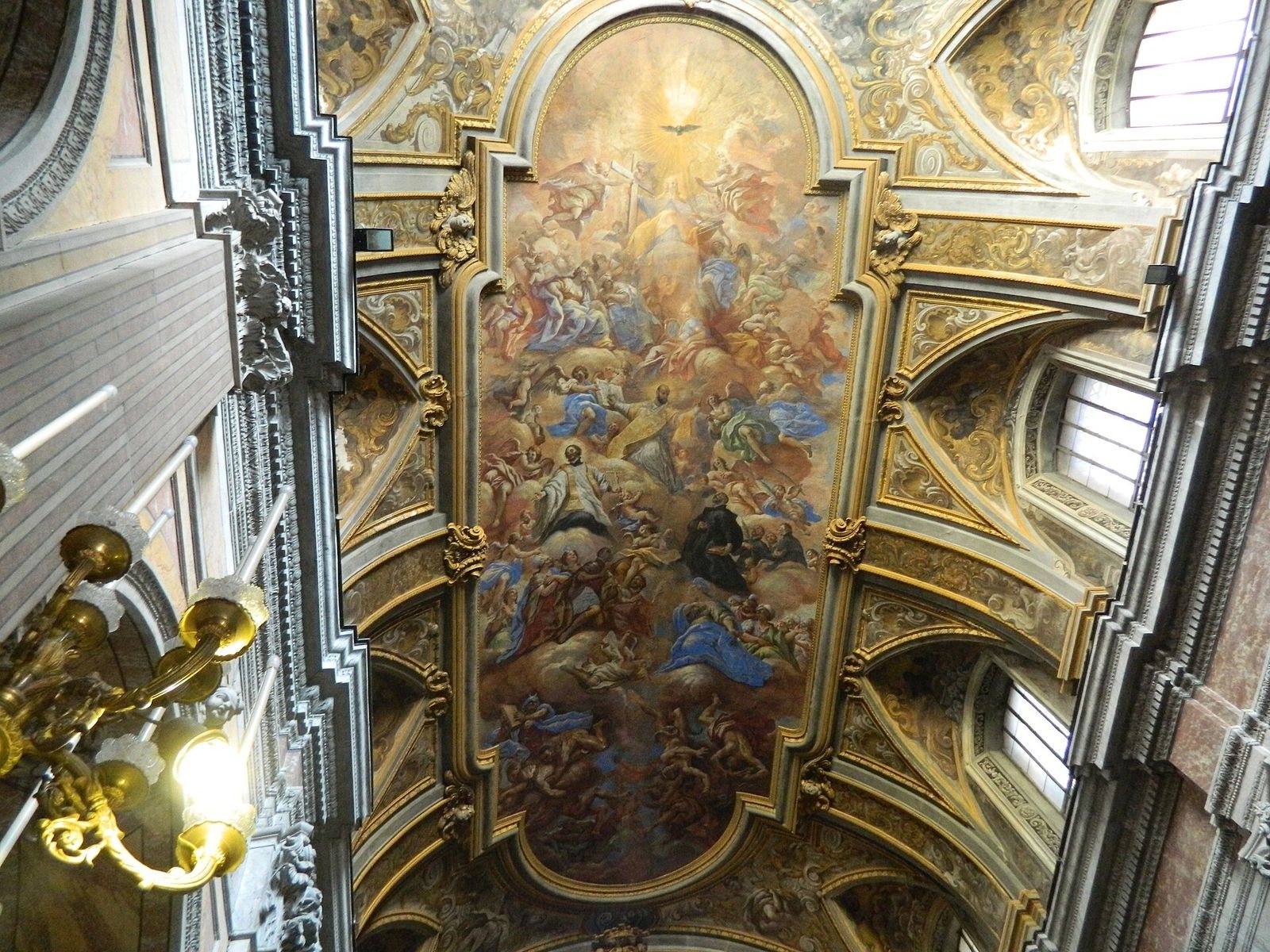
On the inner entrance wall, Paolo De Matteis painted Saint Francis Xavier in ecstasy and the saint embracing a crucifix. His large ceiling painting, made between 1695 and 1698, depicts the Triumph of Religion over Heresy. It includes the Jesuit figures Ignatius of Loyola, Francis Xavier, and Francis Borgia, three Japanese Christians martyred for their faith, and Muhammad falling with the Quran. Gennaro Greco added further ceiling decoration late in the seventeenth century.
De Matteis’s original dome painting, showing the glory of Jesuit saints, was lost during work associated with the Galleria Umberto I. Giovanni Diana replaced it in the early twentieth century with allegorical figures and angels. Four figures by De Matteis survive on the curved supports beneath the dome. They represent Faith, Hope, Charity, and Justice.
Chapels and transept
Side chapels
The chapels contain paintings and statues by several Neapolitan and Italian artists. Works include a painting of the Japanese Jesuit martyrs attributed to Pietro da Cortona and a wooden Saint Rita in a glass-fronted case. Other paintings show the Holy Family with Saint Anne and Saint John, by Giovanni Battista Rossi, the Virgin and Child appearing to Saint Aloysius Gonzaga, by De Matteis, and Saint Stanislaus Kostka, by Nicola Maria Rossi. The chapel sculpture includes wooden figures of Saint Andrew Avellino, Our Lady of Sorrows, and Saint Joseph with the Child. Giacomo Farelli painted the Nativity of the Virgin and the Annunciation.
A painting of Saint Bartholomew by Jusepe de Ribera once attracted crowds. The viceroy Duke of Osuna was reportedly impressed by it, commissioned another painting from Ribera, and gave that work to the church.
Left transept
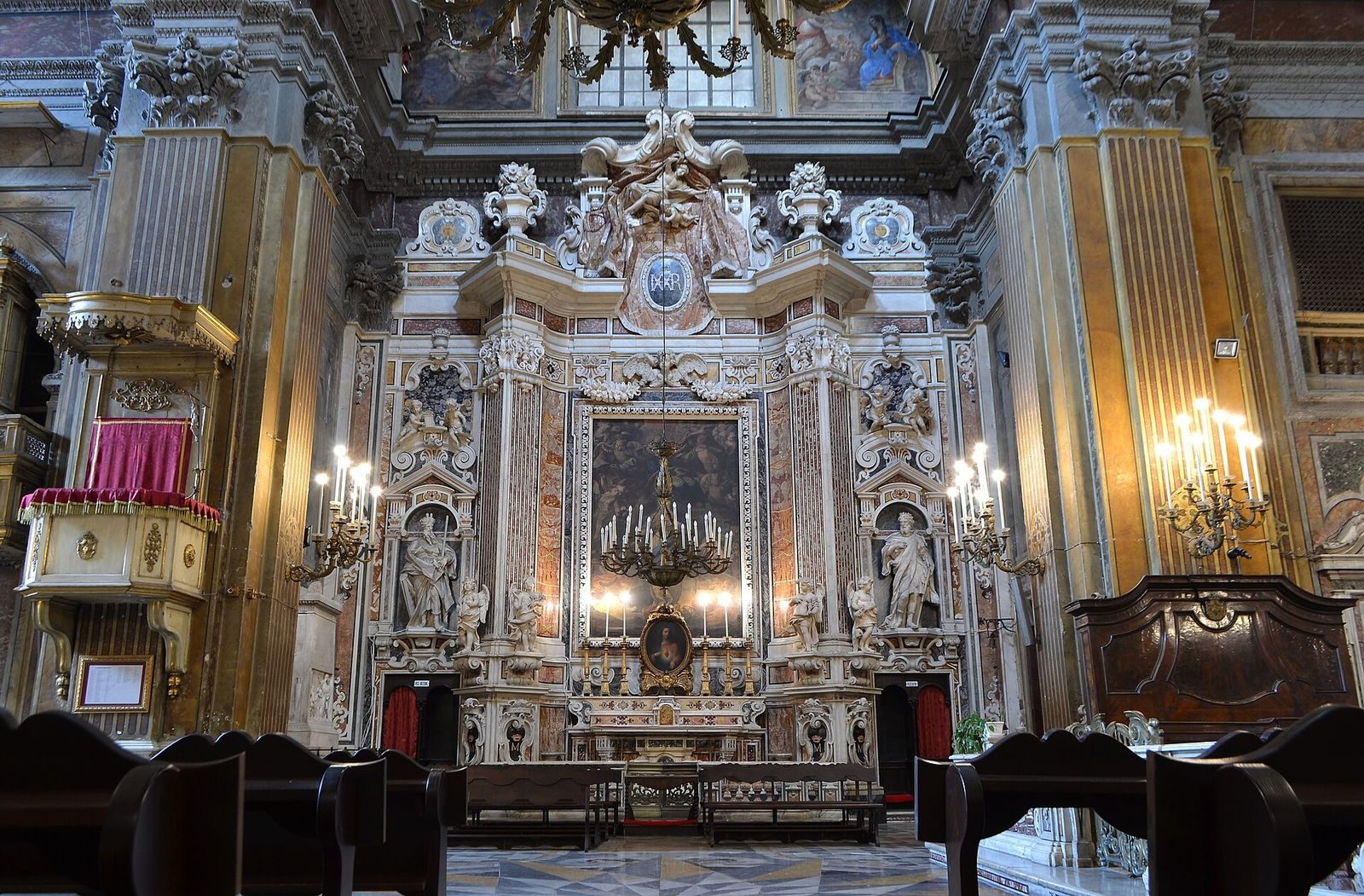
The left transept altar has multicolored marble decoration designed by Domenico Antonio Vaccaro and a painting of the Immaculate Conception by Cesare Fracanzano, from the first half of the seventeenth century. Its marble figures include David and Moses. Lorenzo Vaccaro began the statue of David, and his son completed it. Four angels carrying symbols of the Immaculate Conception stand before the altar. De Matteis’s paintings show Xavier preaching in India, the Nativity, and the Annunciation on the left side of the transept; the opposite group depicts the glory of Ignatius, his writing of the Spiritual Exercises under the Virgin’s inspiration, and his dispatch of Xavier to India.
The left transept wall holds the nineteenth-century tomb of Lucia Migliaccio, Duchess of Floridia and second wife of Ferdinand IV. Tito Angelini made the monument.
Right transept
Angelini also made the tomb of archaeologist Michele Arditi, around 1834, on the right transept wall. The altar on this side holds Francesco Antonio Altobello’s painting of Ignatius’s vision of Jesus on the cross, made in the second half of the seventeenth century. Eighteenth-century angels by Giuseppe Sanmartino occupy nearby niches and carry symbols of Saint Francis Xavier. Wooden statues of Saint George and Saint Ferdinand, also from the eighteenth century, are attributed to Angelo Viva.
Apse and sacristy
High altar and apse paintings
Vaccaro designed the Baroque high altar, which his assistants Pietro Nicolini and Francesco Colella made in 1742–1743. The late-nineteenth-century painting of Saint Ferdinand behind it replaced an earlier image of the same saint by Antonio Sarnelli. Sarnelli’s canvas had taken the place of Luca Giordano’s Saint Francis baptizing Indigenous people, commissioned around 1680 and now held at the Museo di Capodimonte. Giordano’s work had replaced Cesare Fracanzano’s painting of Saint Francis Xavier baptizing people in India, which in turn had been commissioned after a painting by Salvator Rosa was rejected.
Above the altar is an anonymous oil painting, made in the mid-nineteenth century, of the Risen Christ appearing to the apostles. De Matteis’s flanking scenes show Xavier observing Queen Isabella’s body and the saint building a church. A painting on the curved surface of the apse depicts Xavier protecting Naples from famine, plague, fires, and shipwrecks.
Sacristy
The sacristy contains works from the destroyed church of San Luigi di Palazzo. Among them are Farelli’s Dream of Saint Joseph, Presentation of Mary in the Temple, and Visitation of Mary to Elizabeth, as well as two paintings by an unidentified artist.