Palazzo Carmagnola: A Fifteenth-Century Renaissance Palace in Milan

Site at a Glance
- Rating
- 4.8
- Popularity
- Very Low
- Country
- Italy
- Primary era
- Medieval
- Eras represented
- Medieval, Early Modern, Modern
- Civilizations
- Italian
- Site type
- Domestic
- Remains
- Palace
On this page11 sections
History
Palazzo Carmagnola is a fifteenth-century Renaissance palace in Milan, Italy, built under the Visconti, the ruling dynasty of Milan at the time. It began as a lesser residence and later became a ducal property, a municipal seat, government offices, and the home of the Piccolo Teatro di Milano.
Visconti Residence and Carmagnola
The original palace was built by the Visconti in the early fifteenth century as a subordinate residence, less elaborate than their principal homes. In 1415, Filippo Maria Visconti, Duke of Milan, gave it to Francesco Bussone, known as Carmagnola. Bussone was a condottiere, a professional military commander who served rulers or states under contract. He radically renovated the palace between 1420 and 1425.
After Carmagnola was beheaded in Venice in 1432, ownership passed to his daughters. In 1465, the palace hosted the ceremony in which Genoa pledged complete allegiance to Francesco Sforza against Savoy. Sforza was the military commander who became Duke of Milan and founded the Sforza dynasty.
Sforza Ownership and Renaissance Embellishment
In the final years of the fifteenth century, Lodovico il Moro, a later Sforza ruler of Milan, claimed the palace. He obtained it through confiscation after the death of Pietro II Dal Verme, who had inherited it from his mother, Luchina Bussone, one of Carmagnola’s daughters.
Major works followed, including the completion of the palace with colonnades comparable to those of the Monastery of Santa Maria del Lentasio. In 1497, Lodovico transferred the building to Cecilia Gallerani, his mistress. During her supervision, Bramante and Leonardo da Vinci took part in its embellishment. Bramante was a leading Renaissance architect and painter, while Leonardo was an artist, engineer, and architect active at the Milanese court.
French Control and Civic Uses
After French forces entered Milan, the palace came under French control. In 1505, Carlo d’Amboise, the French governor of Milan, sold it to Francesco Bebulco, the official responsible for ordinary revenues.
From 1605, the building also served as a public granary. In 1714, some rooms were adapted for the offices of the Banco di Sant’Ambrogio, a Milanese public banking institution. Further work began in 1770 to adapt the palace for the Civic Archives under the direction of the historian Giorgio Giulini. In 1773, the Tribunale di Provvisione, a municipal administrative court, moved there from Piazza Mercanti.
Municipal and State Administration
In 1786, the palace became the Broletto Novissimo and replaced the Broletto Nuovo as Milan’s municipal seat. A broletto was a civic or governmental complex in medieval and early-modern northern Italian cities. During the Napoleonic period, the building housed the Departmental Prefecture, an administrative office or jurisdiction governed by a prefect, and underwent further renovation.
After Italian unification, an exchange between the Municipality and the State in 1861 transferred Palazzo Marino to municipal use and assigned Palazzo Carmagnola to state property offices. This change led to further alterations. Between 1890 and 1893, the wing facing Via Rovello was rebuilt and its facade renewed during the construction of Via Dante. The work sought to retain the character of the main courtyard, although the courtyard was reduced.
From 1910, after the demolition of the former Monastery of Bocchetto, the palace also housed the Stamp and Registry Office, which had previously occupied rooms in that religious complex. An agreement between the City and the State in 1927 to 1931 returned Palazzo Carmagnola to the ownership of the Municipality of Milan. From 1937, restoration and adaptation prepared it for the recreation rooms of the municipal employees’ recreation centre.
Wartime Occupation and the Piccolo Teatro
During the Fascist period, the basement housed the regime’s counter-espionage services. From 1943 until 26 April 1945, the Legione Muti, commanded by Francesco Colombo, occupied the building.
In 1947, Ernesto Nathan Rogers and Marco Zanuso adapted Palazzo Carmagnola for the Piccolo Teatro di Milano. Paolo Grassi and Giorgio Strehler founded the theatre that same year. The palace remains in use by the theatre, while municipal offices occupy some of its upper floors.
Remains
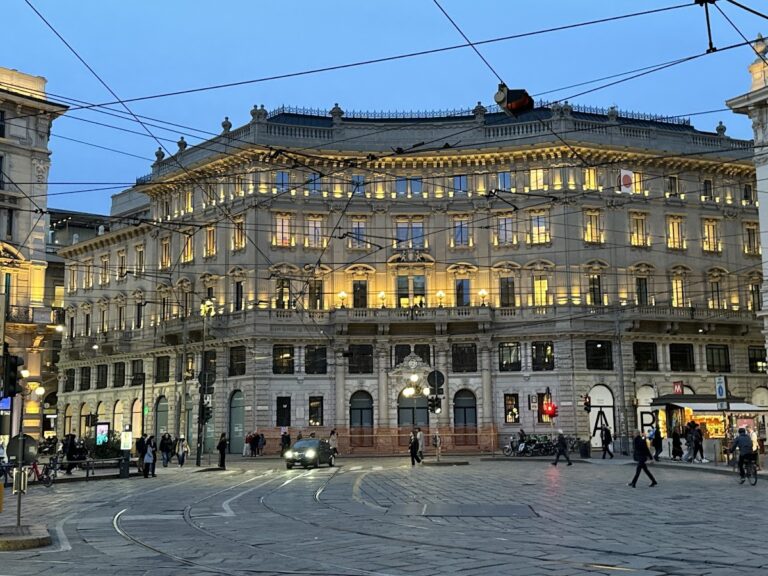
Palazzo Carmagnola stands at 2 Via Rovello and retains parts of its fifteenth-century fabric within a building altered repeatedly over the centuries. It is described as a Renaissance palace with a nineteenth-century front. The rebuilding of the Via Rovello wing and facade between 1890 and 1893 reduced the main courtyard, while the surviving courtyards preserve elements of the earlier architectural arrangement.
Courtyards and Porticoes
Fifteenth-Century Porticoes
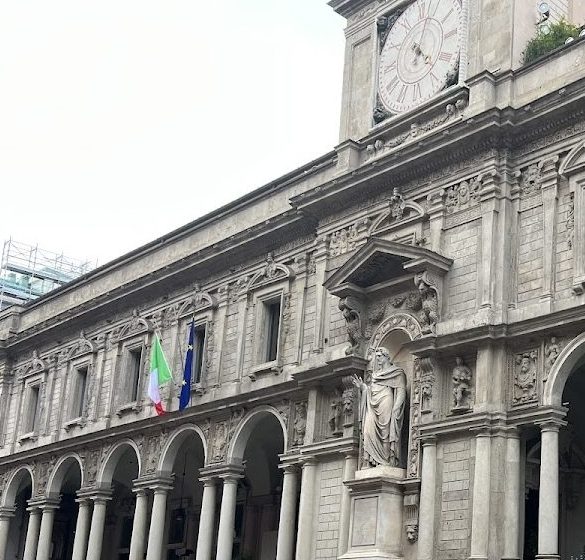
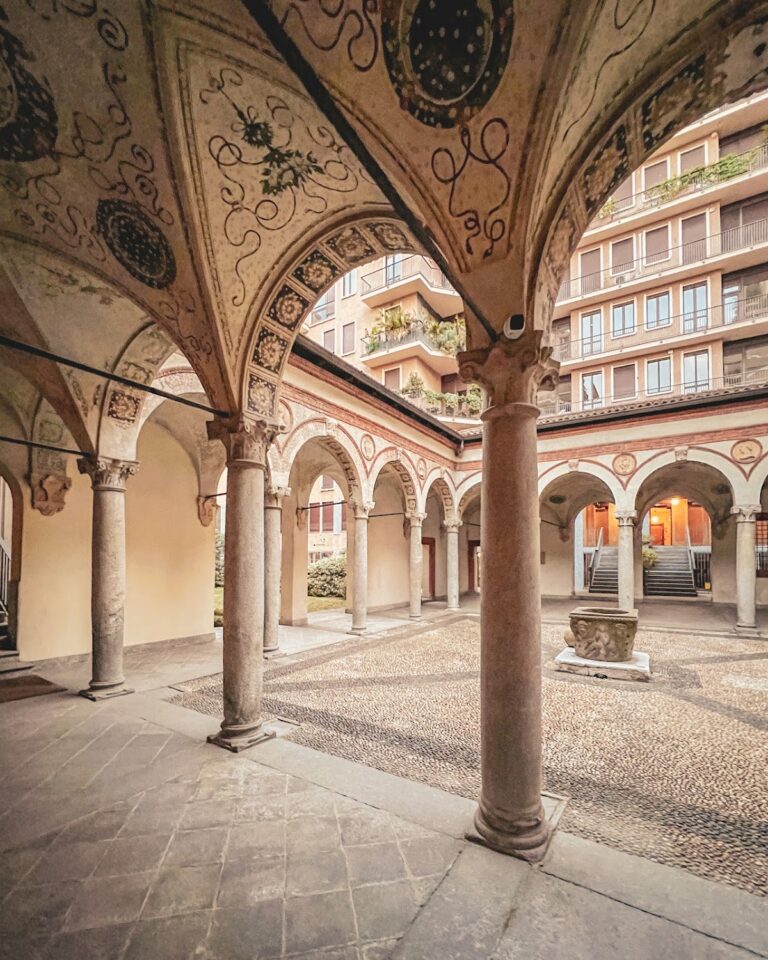
Among the surviving elements are the porticoes of one of the two courtyards, together with their capitals carved in marble. These features belong to the palace’s fifteenth-century fabric and preserve the refined character associated with its aristocratic and ducal phases.
Six-Arch Courtyard
A porticoed courtyard with six arches belongs to a reconstruction attributed to the beginning of the sixteenth century. The late-fifteenth-century works also introduced colonnades comparable to those of the Monastery of Santa Maria del Lentasio. A distinctive sundial was designed on the ground of the second courtyard and is attributed to Leonardo.
Painted Decoration
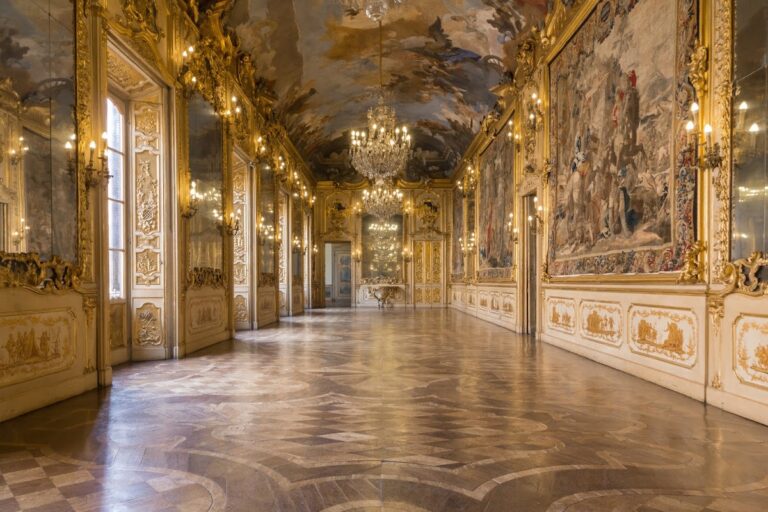
The most recent restoration brought to light frescoes from the late fifteenth century. They are attributed to interventions by Bramante and Leonardo da Vinci and provide surviving evidence of the decorative work carried out during the palace’s Renaissance embellishment.