Falnuée Castle: A Medieval Castle-Farm Complex in Belgium


Site at a Glance
- Rating
- 4.2
- Popularity
- Very Low
- Country
- Belgium
- Primary era
- Medieval
- Eras represented
- Medieval, Early Modern
- Civilizations
- Holy Roman Empire
- Site type
- Domestic
- Remains
- Castle
On this page11 sections
History
Falnuée Castle is a former seigneurial residence and farm in Belgium, built around a thirteenth-century keep at the confluence of the Orneau and Ligne rivers. Its position lay near the boundary between the Duchy of Brabant and the County of Namur, giving the site a defensive role before it became a landed lordship and later an agricultural estate.
Medieval origins and the lordship
The place was known by several names, including Faunwez, Faunoué, and Villers-sur-Onon. Falnuée may derive from the Latin word fagus, meaning beech. Because of its low-lying strategic position, a keep was probably built around 1285, during the second half of the thirteenth century. The first written mention of the site dates from 1343, when the keep served as a lookout post within the defensive system of the County of Namur.
At the beginning of the thirteenth century, Falnuée contained allodial lands, meaning property held without feudal obligations. These lands later came into the possession of Henri de Falnuée. William I, Count of Namur, granted Henri fishing rights on the Orneau, the Ligne, and the Ripjoux. On 31 March 1344, Henri rendered homage to the Count of Namur. His possessions and rights thereby became a fief, a lordship held under obligations to a superior lord, and Falnuée became a landed lordship.
The local lord exercised low justice in property and other civil disputes, while the Count of Namur remained the high lord. High justice covered serious crimes and carried greater judicial authority. The landed lordship comprised nearly 120 bonniers of farmland and 45 bonniers of woodland. In the Namur region, a bonnier measured about 9,461 square metres. Local peasants owed the lord a setier of oats and a hen at Christmas.
Changes in ownership and jurisdiction
On 10 April 1456, Jean, an illegitimate son of the Count of Namur and lord of Trivières, acquired the fief through seizure. His descendants held the domain until the middle of the seventeenth century. In 1651, Agnès de Davre, Lady of Mielmont, acquired the landed lordship. It then passed to the De Franquen family and, in 1715, to Pierre Roose, Baron of Leeuw and Lord of Spy. By the middle of the eighteenth century, the Coloma family possessed it.
The high lordship of Mazy, Monceau, and Falnuée followed a separate line of succession. In 1626, Philip IV, the Spanish king who also held the title of Count of Namur, sold this authority with a right of repurchase to François-Lamoral de Sainte-Aldegonde, Baron of Noircarmes, for 4,600 florins. The purchaser’s daughter sold it to Charles Pellissonnier in 1680. In 1726, a granddaughter of Pellissonnier married into the Meldeman de Boure family, which retained the high lordship until its abolition after the French annexation of the Southern Netherlands and the suppression of the Ancien Régime.
From fortified site to agricultural complex
Falnuée lost its military importance during the territorial unification pursued by Philip the Good, Duke of Burgundy. He became Count of Namur in 1429, Duke of Brabant in 1430, and Count of Hainaut in 1433. As the southern lordships were brought together under Burgundian rule, fortified towers and castles were adapted into more comfortable residences.
The last high lord of Mazy, Monceau, and Falnuée was Major General Albert-Eugène de Meldeman, who died in 1814 and was buried in the church of Bossière. After his death, the castle-farm was used exclusively for agriculture. The buildings were listed for protection in 1976. The complex and its surrounding land were acquired in 1987 by Ferme-Château de Falnuée, after which they were adapted as a sports centre and golf course. This conversion allowed much of the complex to be restored. The former residence became a hotel-restaurant and is also described as a golf clubhouse.
Remains
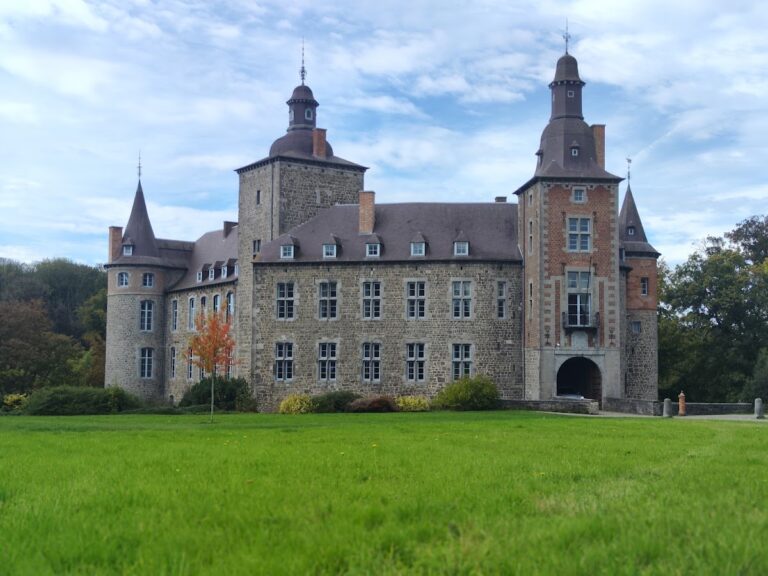
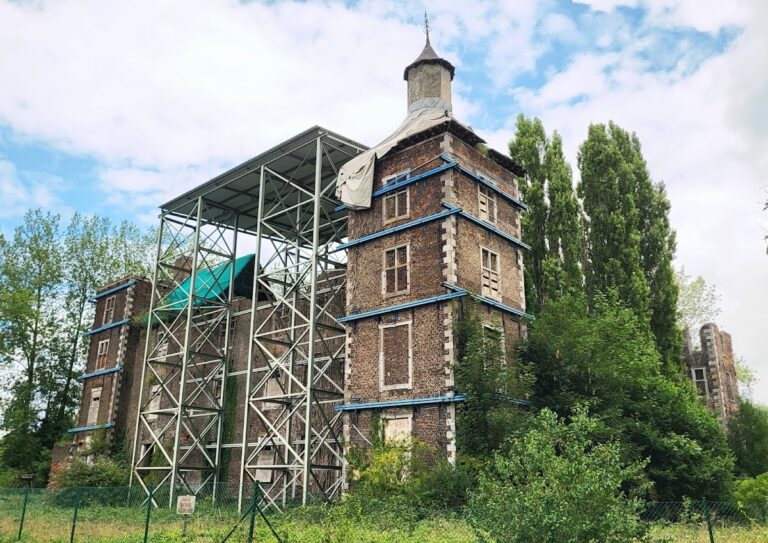
Falnuée survives as a castle-farm complex combining a former seigneurial residence with agricultural buildings. Its principal elements belong to several periods, including a thirteenth-century keep, a seventeenth-century manor house, and an eighteenth-century tower and stables. The complex stands where the Orneau and Ligne rivers meet, while its former agricultural buildings and surrounding grounds now form part of the Falnuée golf course.
Medieval and residential buildings
Thirteenth-century keep
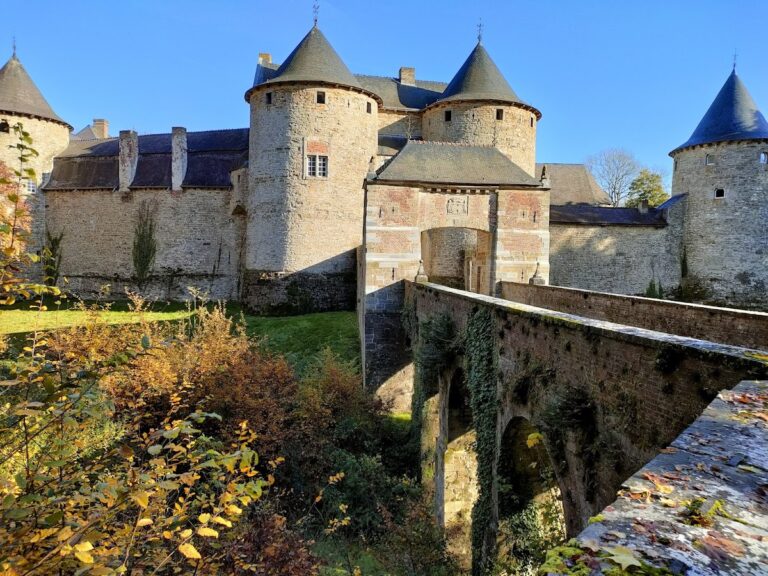
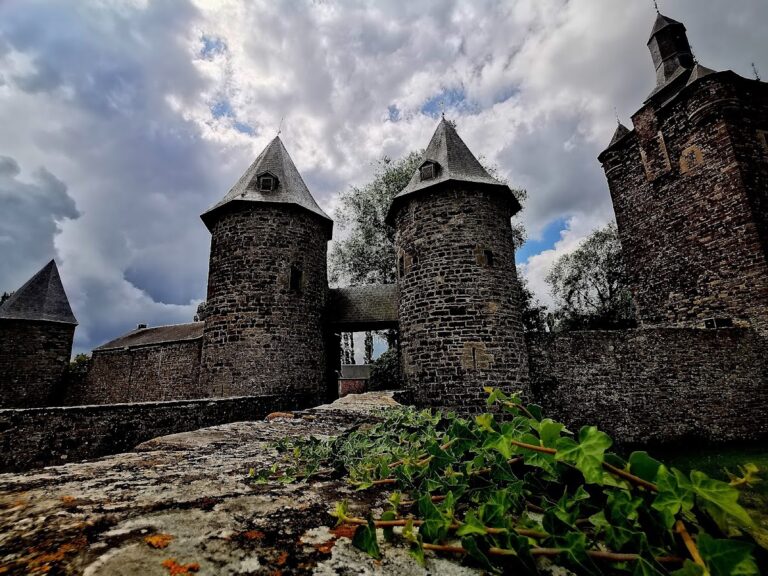
The keep, or principal fortified tower, was built during the second half of the thirteenth century, probably around 1285. It occupied the strategically placed castle site and functioned as a lookout post in the defensive system of the County of Namur. The keep forms the medieval core of the later castle-farm complex.
Seventeenth-century manor house
A manor house from the seventeenth century forms the former seigneurial residence. As the castle’s military importance declined, this residential element belonged to the transformation of the fortified site into a more comfortable lordly home. It was later converted for hotel and restaurant use and is also used as a golf clubhouse.
Eighteenth-century and agricultural features
Tower and stables
An eighteenth-century tower and stables are among the principal components of the complex. They belong to the later phase in which Falnuée functioned as a residence joined to agricultural buildings. The stables and other former farm structures were adapted within the grounds of the Falnuée golf course.
Castle-farm grounds
The agricultural buildings and surrounding land retain the combined character of a rural residence and working farm. Their adaptation for the golf course formed part of the restoration of a large portion of the complex after 1987, while preserving the relationship between the former residence and the farm buildings.
Nearby sites