Santa Maria delle Vigne: Genoa’s Historic Marian Basilica


Site at a Glance
- Rating
- 4.7
- Popularity
- Medium
- Country
- Italy
- Primary era
- Early Modern
- Eras represented
- Medieval, Early Modern, Modern
- Civilizations
- Genoese, Holy Roman Empire, Kingdom of Sardinia
- Site type
- Religious
- Remains
- Basilica
On this page15 sections
History
Santa Maria delle Vigne is a Roman Catholic church and minor basilica in Genoa, Italy, in the city’s Maddalena district. Built and reshaped by successive Christian communities, it is regarded as Genoa’s oldest Marian sanctuary and one of the city’s oldest Catholic churches. The present building combines medieval foundations with Baroque reconstruction and a nineteenth-century Neoclassical facade.
Early Marian foundation
A chapel dedicated to the Virgin Mary probably stood on the site in the sixth century. A local tradition connects its foundation with a Marian apparition witnessed by Argenta of the Grillo family, while a liturgical calendar indicates that devotion to Mary was established there by 560. The chapel is said to have been enlarged between 650 and 680 with stone taken from Luni.
At that time the site lay beyond Genoa’s Carolingian walls, near the extra-urban cathedral of San Siro and the Rio di Soziglia. Its name, originally Sancta Maria in Vineis, referred to the vineyards surrounding the chapel. Shortly before the year 1000, a larger church was built in the centre of this cultivated area.
Foundation and collegiate community
Around 980, Oberto, the son of Idone, promoted the construction of the new church with Guido di Carmandino. Oberto was a viscount of the Genoese Comitato within the Obertenghi March, a medieval territorial jurisdiction in northern Italy. Income from the vineyards partly supported the building project, which was also intended to suppress older superstitious practices associated with the area.
The earliest official record of the new church dates from 1083, and an inscription preserves the memory of the foundation initiative. A collegiate chapter, an organized community of canons serving a church, already existed by 1061. In 1222, Pope Honorius III fixed the chapter at twelve canons and regulated their communal life. Chapter statutes were issued in 1375 and approved that year by Archbishop Andrea Della Torre. The chapter received the title Insigne from the Congregation of Rites in 1710, and its provost, the senior officer of the chapter, retains the title Prelate of Honour of His Holiness.
Bishop Raperto consecrated the church in 916–918, and it was consecrated again in 1117. In 1147 it became a parish church and joined the group of churches entitled to participate in the election of Genoa’s archbishops. These developments established Santa Maria delle Vigne as both a religious centre and an institution within the city’s ecclesiastical government.
Integration into medieval Genoa
A settlement grew around the church during the twelfth century. As Genoa expanded, the area around Santa Maria delle Vigne and San Siro was absorbed into the city. The new Barbarossa walls enclosed the church, which became the parish church of a rapidly developing commercial district close to the port.
The church was altered repeatedly from the thirteenth century onward. In the late sixteenth century, Agapito Grillo financed an enlargement of the apse towards the cemetery behind the church and the expansion of the side apses. Gaspare della Corte directed this work, including the creation of chapels beside the high altar. The presbytery was enlarged in 1598.
Seventeenth-century rebuilding
During a pastoral visit in the mid-seventeenth century, Cardinal Stefano Durazzo found the complex in poor condition and ordered further renovation. Daniele Casella rebuilt the naves, replaced the columns, opened three semicircular windows, and constructed the dome. The work gave the interior a more unified form and substantially changed the spatial character of the earlier Romanesque basilica.
Confraternities and noble families then refurbished the chapels and side altars with paintings and sculpture. Decoration continued through the eighteenth and nineteenth centuries. Vault frescoes were completed around 1820, and Ippolito Cremona designed a new marble facade, erected between 1841 and 1848. No later substantial architectural alteration is recorded after the facade.
Marian devotion and notable associations
The principal annual feast is the Presentation of the Virgin on 21 November. A decree of 1632 formally established the parish celebration. From the early seventeenth century, Genoa’s doge and senior officials customarily joined the pilgrimage to the shrine. After a new image of Our Lady of the Vines was crowned in 1616, Doge Bernardo Clavarezza proclaimed the Virgin Queen of Genoa. The chapter later received permission to use a double archiepiscopal cross in processions, and the feast became a semi-holiday throughout the archdiocese.
The church has also been connected with important religious and civic figures. Giuliano Della Rovere, a former canon of the collegiate church, became Pope Julius II in 1503. Elisa Giuseppina Mezzana, Eugenia Maria Ravasco, Itala Mela, Cardinal Gaetano Alimonda, and Rosa Gattorno were associated with Santa Maria delle Vigne through religious or pastoral activity. Alessandro Stradella, a prominent seventeenth-century Italian composer, was fatally stabbed by hired assassins during a stay in Genoa on 25 February 1682 and was buried in the church. Giovan Battista Lomellini was suspected of ordering the killing because of Stradella’s alleged relationship with Lomellini’s sister, but was acquitted for lack of evidence.
Pope Pius VII visited the church on 16 April 1815 while sheltering in Genoa during Napoleon’s Hundred Days, the brief return to power that followed Napoleon’s escape from Elba. He celebrated Mass and was received by the provost, Antonio Podestà. Pius granted the canons the privilege of wearing a red mozzetta and later extended spiritual and canonical privileges, including a plenary indulgence at the Madonna altar.
Giacomo della Chiesa was baptized at Santa Maria delle Vigne in 1854. He remained closely connected with the parish during the first twenty-one years of his life and later became Pope Benedict XV, serving from 1914 to 1922.
War damage and modern status
During the Second World War, a bomb dropped on the night of 22–23 October 1942 destroyed the dome, damaged the stucco decoration and paintings by Giuseppe Passano, and almost completely destroyed the roof over the right aisle. The church was subsequently restored.
The millennium of Santa Maria delle Vigne was solemnly commemorated in 1980. On 8 January 1983, Pope John Paul II granted the church the title and privileges of a minor basilica, a papal status carrying special privileges, and confirmed its position as Genoa’s First Marian Sanctuary. The church is also identified as a national monument. It continues to serve as a parish church and undertakes social and educational activities, including children’s education and initiatives connected with the regeneration of Genoa’s historic centre.
Remains
Romanesque structure and later interior
The present basilica preserves traces of its Romanesque predecessor in parts of the perimeter walls, roof structure, vaulting, and beneath the pavement. The original church was a three-aisled basilica with an exposed roof supported by trusses, a slightly projecting transept, an octagonal tiburium, a structure rising over the crossing, and three semicircular apses. Eight columns on each side separated the central nave from the aisles. Above them ran a triforium, an upper gallery formed by rows of paired openings with three arches.
Stone blocks survive in the perimeter walls, together with a possible green Levanto-marble column in the left aisle. The column carries an image of the Madonna della Vita, dated variously to the early fourteenth or fifteenth century. The image’s strong devotion among the faithful is said to have helped preserve the column.
The seventeenth-century rebuilding raised the roofs over the side aisles and inserted a barrel vault beneath the original trussed roof of the central nave. Four pairs of taller marble columns replaced the former eight-column system. This reduced the spaces between the columns from nine to five and largely suppressed the spatial effect of the Romanesque interior. Three semicircular windows and an octagonal-based dome replaced the earlier crossing arrangement, changing the distribution of light and creating an interior in which the central and side spaces are only weakly separated.
Facade and external features
The current facade is a late Neoclassical composition in marble, designed by Ippolito Cremona and built between 1841 and 1848. Cremona incorporated earlier Renaissance columns into a design with a double pediment, but died before the work was completed.
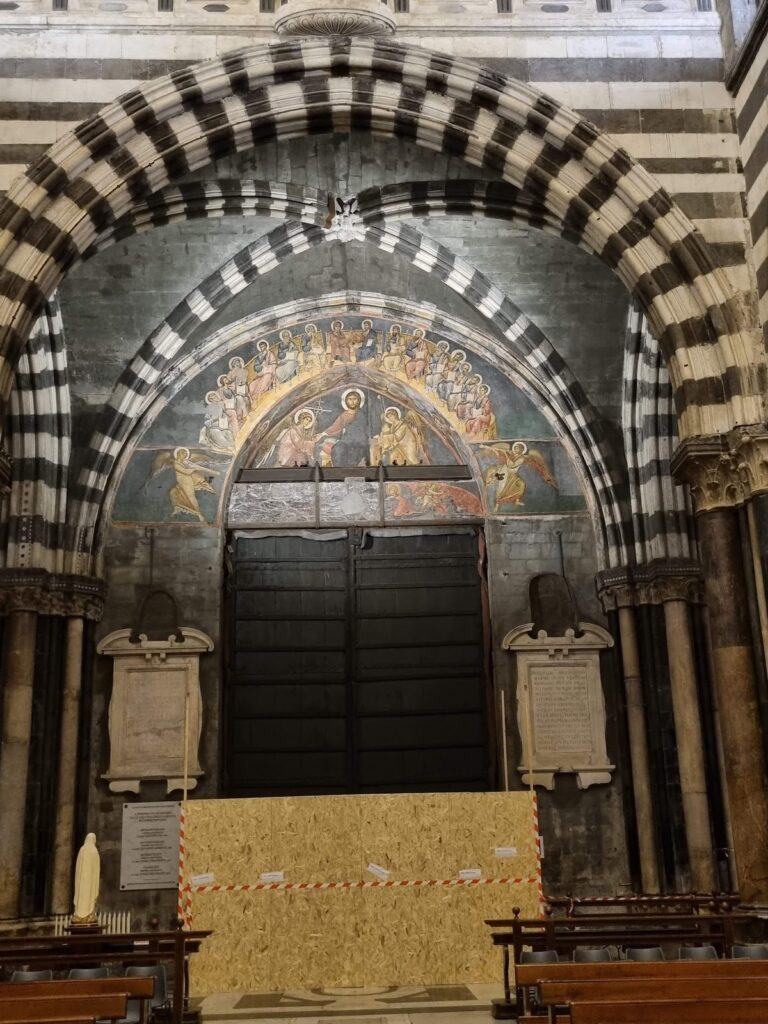
A fifteenth-century portal survives on the right side of the church. Statues above it are attributed to Donato Rodari and Giovanni Gaggini. Its lunette contains Domenico Piola’s late seventeenth-century fresco of the Madonna and Child with Saint John the Baptist offering a bunch of grapes.
On the left, beneath the arch spanning the base of the bell tower, is a 1304 arcosolium, a tomb beneath an arched recess, for Anselmo d’Incisa. He was a surgeon and physician to Pope Boniface VIII and King Philip IV of France. The tomb reused a second-century sarcophagus decorated with scenes identified either as the story of Alcestis or the death of Phaedra. The original sarcophagus is now in the Diocesan Museum, while a copy occupies the street-facing tomb.
Bell tower and cloister
The Romanesque-Gothic bell tower rises between the church’s perimeter walls and the cloister, spanning the lane that passes through its base. It is the only structure preserved intact from its construction period. Its square base rests on massive walls of dressed stone, while the upper levels are opened by paired two-light and five-light windows. An octagonal spire with four corner pinnacles completes the tower, which rises about 40 metres to the highest cornice and approximately 60 metres to the top of the spire.
The tower was built around the middle of the twelfth century, when the church became a parish and the surrounding vineyard district was being incorporated into Genoa. Its base remains open for passage along the lane, and a raised passage connects the cloister directly with the church through the tower.
The cloister dates from the first half of the eleventh century and occupies two levels around a quadrangular courtyard measuring 17 by 13 metres. Canonical residences open onto the courtyard. Although modified over time, it retains an archaic Ligurian Romanesque character, with sturdy black-stone columns, cubic capitals, and round arches incorporated into the street-facing walls. These arches may represent former arcosolium tombs. A well in the courtyard supplied drinking water to local residents.
Presbytery and high altar
The presbytery contains Lazzaro Tavarone’s frescoes, including the Glory of Mary on the vault, painted in 1612. Other works include Giuseppe Cades’s Birth of the Virgin, painted in Rome in 1784; Giovanni David’s Presentation of the Virgin of 1785; and Carlo Giuseppe Ratti’s Annunciation of 1787. Near the sacristy are an Annunciation by Francesco Spezzino and a Crucifixion by Stefano Magnasco.
The white-marble high altar was made between 1692 and 1713 by Pierre Puget and Giacomo Antonio Ponsonelli for Marcantonio Grillo, patron of the presbytery. Ponsonelli completed Puget’s work while only partly following his design. The altar is finished on every side, allowing the canons seated in the presbytery stalls to view its rear. Its lower section surrounds a decorated urn with the symbols of the four Evangelists. Above the altar table, clouds, cherubim, and a life-sized angel support a small shrine with eight marble columns. A Madonna supported by angels, also by Ponsonelli, stands above it.
Nave and aisle chapels
The central nave contains Francesco da Pavia’s Saint Catherine of Alexandria, the surviving central panel of a dispersed polyptych dated between 1476 and 1494. Above the main entrance is Simone Balli’s early seventeenth-century Last Supper, transferred from the former Oratory of San Giacomo delle Fucine. Near the entrance are Michele Sansebastiano’s 1896 group of Christ and Saint Peter and Anton Domenico Parodi’s 1697 baptismal font, decorated with statues of the Baptism of Jesus.
Each aisle contains five richly decorated altars, while the ends terminate in the Chapel of the Virgin and the Chapel of the Crucifix. Their patrons included Genoese patrician families, the Greek community, and medieval trade and craft corporations such as the goldsmiths and the Society of Couriers. The first right-aisle altar, belonging to the de Fornari family, is dedicated to Saint Leonard and contains Domenico Parodi’s early eighteenth-century Madonna with Saints Leonard and Stephen. The Society of Couriers’ altar contains Giovanni Andrea Carlone’s Annunciation, dated to about 1690. Between these altars stands the green-marble column bearing the Madonna della Vita.
The third right-aisle altar, associated with the Greek community, contains Daniello Solaro’s marble relief of Saints John the Baptist and Roch interceding for souls in Purgatory, made around 1670. It is displayed with Giovanni Mazone’s Madonna and Child with Angels, attributed to about 1465. The fourth altar contains Gregorio De Ferrari’s Saint Michael, painted around 1680. The fifth, associated with the Guild of Servants, is dedicated to the Pietà and contains a large marble tabernacle and Domenico Piola’s Triumph of the Cross, painted around 1690.
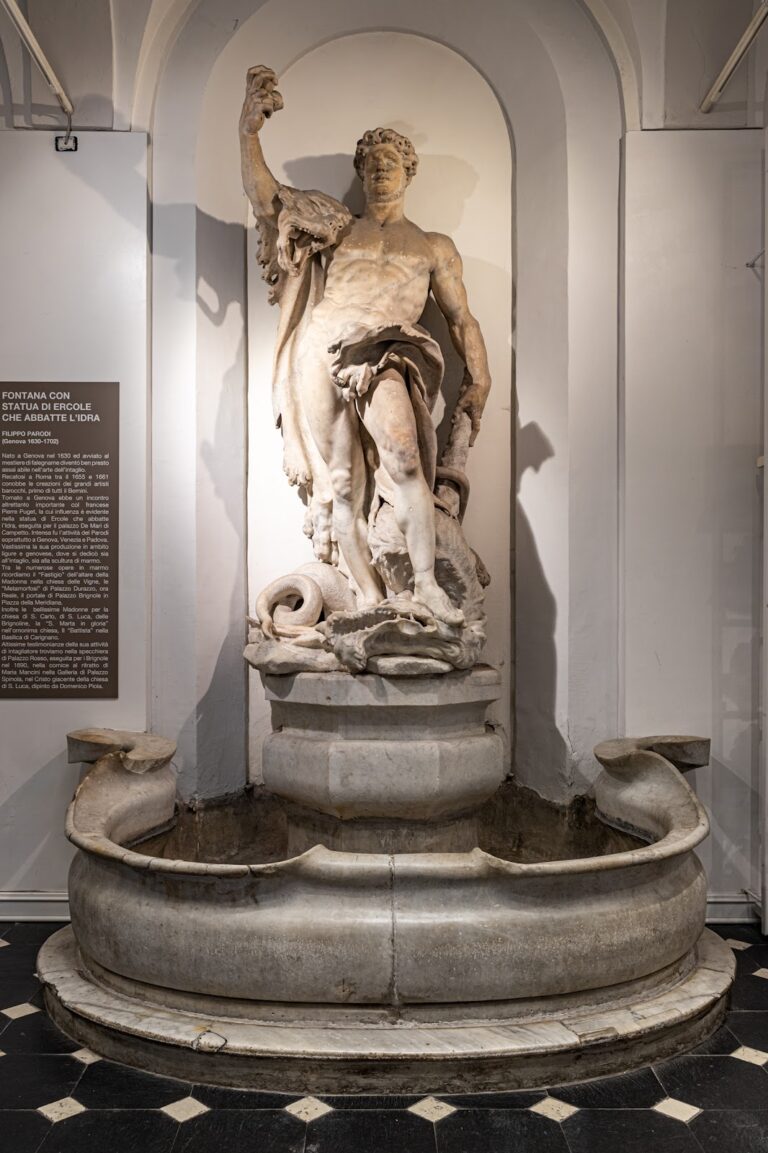
The Chapel of the Madonna delle Vigne closes the right aisle. Its small late fourteenth-century image of the Madonna and Child is attributed to the Sienese painter Taddeo di Bartolo. Beneath it stands a 1616 statue of the same subject by Giovanni Battista and Tommaso Orsolino, with statues of the theological virtues by Filippo Parodi, dated 1661. Domenico Piola frescoed the vault with the Immaculate Conception, prophets, and sibyls. Other works include Santino Tagliafichi’s Visit of the Magi of 1819 and Apparition of Christ to His Mother of 1820, Felice Vinelli’s Rest during the Flight into Egypt of about 1820, and Giuseppe Passano’s Visitation of about 1820.
The left aisle includes the Casoni family altar, with Giovanni Battista Casoni’s 1681 Virgin with Saints Lawrence, Liborius, and Philip Neri. The goldsmiths’ altar contains Bernardo Castello’s 1580 Ten Thousand Crucifixions and Saints, in which Saint Eligius, patron of goldsmiths, is prominent. Other altars hold a wooden Saint Anthony in Glory from the Maragliano workshop, transferred from the former church of San Francesco di Castelletto; Domenico Piola’s Vision of Saint John the Evangelist of 1685; and Carlo Giuseppe Ratti’s Trinity and Saints of 1770. A tombstone of the Goldsmiths’ Guild dated 1459 depicts Saint Eligius.
The Chapel of the Crucifix closes the left aisle. Its wooden group of the Crucifix between the Virgin Mary and Saint John the Evangelist comes from the Maragliano workshop, associated with Genoese Baroque wooden sculpture. Tavarone painted the vault’s scenes of the Mysteries of the Passion before they were repainted in the eighteenth century. Two oil paintings, Birth of Christ and Ascent to Calvary, are traditionally attributed to Bartolomeo Guidobono.
Chapel of the Crowned Virgin
The Chapel of the Crowned Virgin was built and decorated in white marble between 1603 and 1716 by Tommaso Orsolino and Filippo Parodi under the patronage of the Massari family. Its creation followed the discovery in 1603 of a small Madonna and Child painting attributed to Taddeo di Bartolo and dated 1396–1397.
A 1616 Madonna and Child statue by Tommaso Orsolino stands on the altar. It was his first dated and signed work. Filippo Parodi later added three statues of virtues to the pediment and a marble vine-and-grape decoration around the chapel and its arched entrance. Two angels support the decoration at its ends.
Painted decoration and organ
The vaults contain frescoes by Giuseppe Palmieri, Paolo Gerolamo Brusco, Giuseppe Paganelli, Santino Tagliafichi, Giuseppe Passano, and other artists. Tavarone’s presbytery fresco dates from 1612, while most of the remaining vault decoration belongs to the eighteenth and nineteenth centuries.
An organ was rebuilt or adapted in 1504 by the organist Tiburzio de Fiechis, who modernized its wind chest, keyboard, principal pipe, and reed organs. The present grand organ was built by the Pontifical Organ Factory of Giovanni Tamburini of Crema and inaugurated by Marco Enrico Bossi on 2 January 1916. It has four sections: the Grand Organ in the right transept, the Swell Organ in the left transept, the Choir Organ behind the console in the apse, and the Solo-Echo Organ in the dome. Three manuals of 58 keys, a German-style pedalboard of 30 notes, and approximately 4,000 pipes form the instrument, which incorporates tonal material from an earlier 1830 organ by the Serassi brothers of Bergamo. The organ was restored between 2019 and 2024.