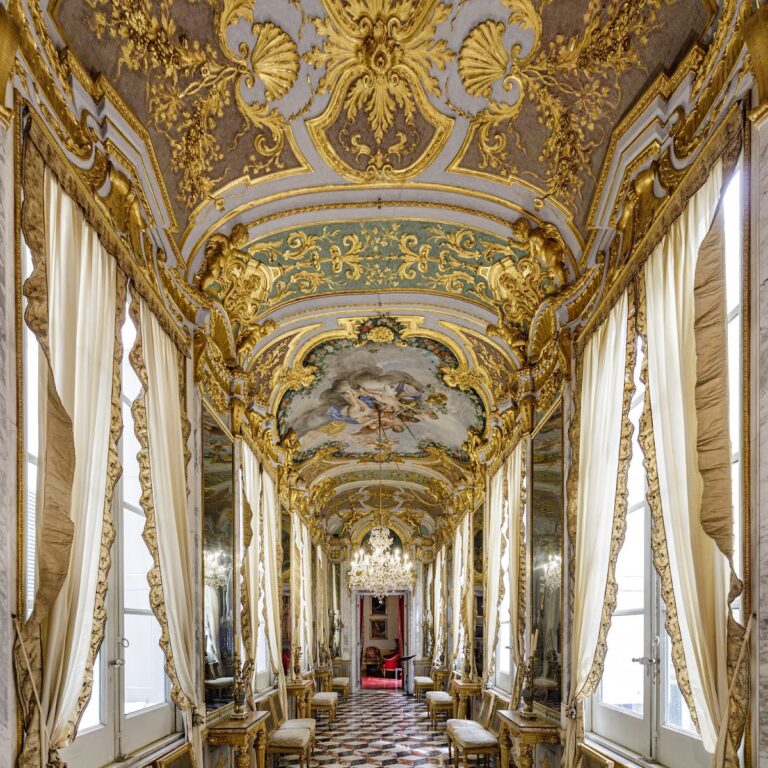
Palazzo Bianco: A Historic Palace and Picture Gallery in Genoa



Site at a Glance
- Rating
- 4.5
- Popularity
- Low
- Country
- Italy
- Primary era
- Early Modern
- External website
- Open
- Eras represented
- Medieval, Early Modern
- Civilizations
- Genoese
- Site type
- Domestic
- Remains
- Palace
On this page11 sections
History
Palazzo Bianco is a historic palace and picture gallery in Genoa, Italy. Its origins reach back to a villa built between 1530 and 1540 for Luca Grimaldi di Gerolamo, a member of one of the city’s leading families. The palace later became part of the Palazzi dei Rolli, Genoese aristocratic residences entered in official registers for the compulsory accommodation of distinguished state guests. Palazzo Bianco appeared in the registers from 1576 to 1664, first in the second class and, from 1599, in the first class.
From the Grimaldi villa to Palazzo Bianco
The original residence stood behind the later alignment of the Strade Nuove and faced the Salita di San Francesco di Castelletto. In 1658, ownership passed to the Franchi de Candia family. In 1711, heirs of Federico de Franchi transferred the property to Maria Durazzo Brignole-Sale, who intended it for her nephew Giovanni Giacomo Brignole.
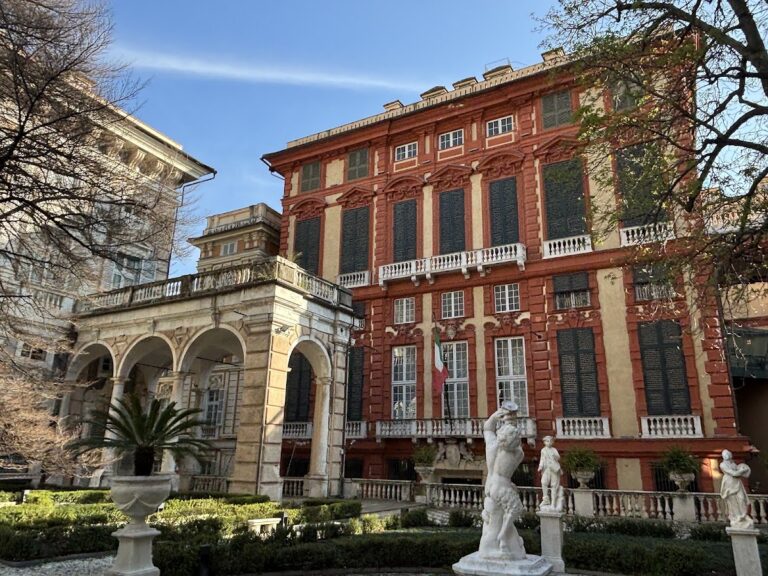
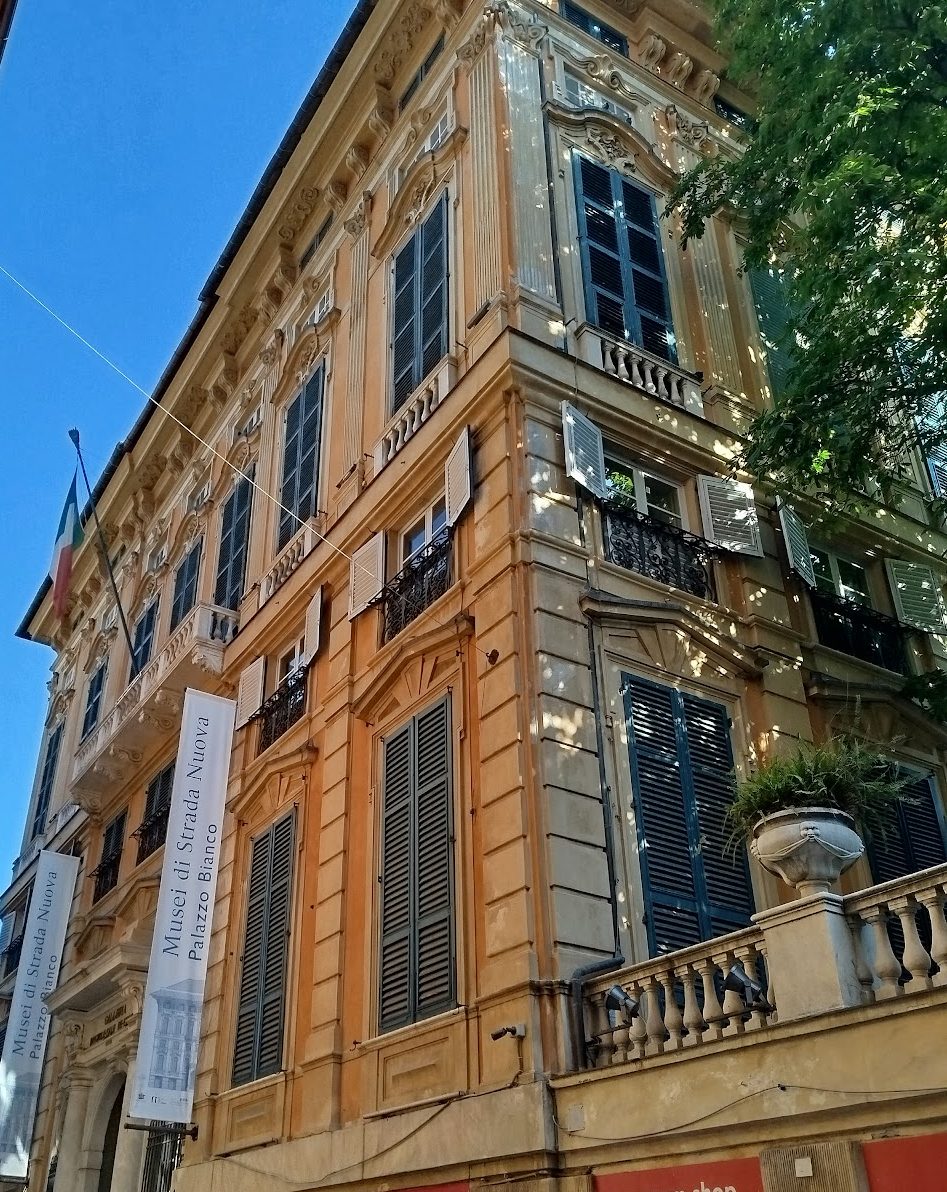
Maria Durazzo Brignole-Sale commissioned a major reconstruction from the architect Giacomo Viano between 1714 and 1716. Inspired by the neighboring Palazzo Tursi, the work brought the palace into alignment with Strada Nuova, now Via Garibaldi, and gave it a light-colored exterior. This remodeling established the name Palazzo Bianco and redirected the principal entrance toward the new street.
The Brignole-Sale gallery
The palace remained within the Brignole-Sale family until Maria Brignole-Sale De Ferrari, Duchess of Galliera and the family’s last descendant, gave it and part of her art collection to the Municipality of Genoa. The civic gallery opened in 1892 during the four-hundredth-anniversary commemorations of Christopher Columbus’s transatlantic voyage.
After its opening, the collection grew through private bequests, donations, and municipal purchases. The early museum combined paintings and sculpture with archaeological finds, historical objects, and other municipal collections. Gaetano Poggi began a first reorganization between 1906 and 1908. After Orlando Grosso became director in 1928, historical collections were moved elsewhere and the artistic holdings were arranged according to modern museum principles.
War, reconstruction, and museum transformation
An Allied bombing raid in 1942 caused extensive damage to the palace. Postwar reconstruction was followed by a complete reorganization directed by Caterina Marcenaro. Mario Labò and especially Franco Albini designed the new installation, which applied the functional planning, geometric clarity, and restrained design associated with Italian Rationalism. The museum reopened in 1950, and Albini’s work became an important example of this approach to museum display.
In 1970, Marcenaro radically reorganized the institution in connection with the creation of the Museo di Sant’Agostino, intended for sculpture and frescoes removed from buildings elsewhere in Genoa. Palazzo Bianco consequently became exclusively a picture gallery. Together with Palazzo Rosso and Palazzo Doria-Tursi, it now forms the Museums of Strada Nuova. The three palaces belong to the UNESCO World Heritage property “Genoa: Le Strade Nuove and the system of the Palazzi dei Rolli,” inscribed in 2006 under criteria (ii) and (iv). The designation recognizes the planned Renaissance and Baroque development of the streets and their aristocratic palaces, as well as the organized system of state hospitality.
The gallery’s principal chronological emphasis is on European painting from the sixteenth through eighteenth centuries. Its holdings include Genoese, Flemish, Dutch, French, Spanish, Venetian, Roman, Bolognese, and other Italian schools. Antonio Canova’s The Penitent Magdalene has been associated with the museum since 2009 and is displayed in the adjoining Palazzo Tursi, which is directly connected to Palazzo Bianco.
Remains
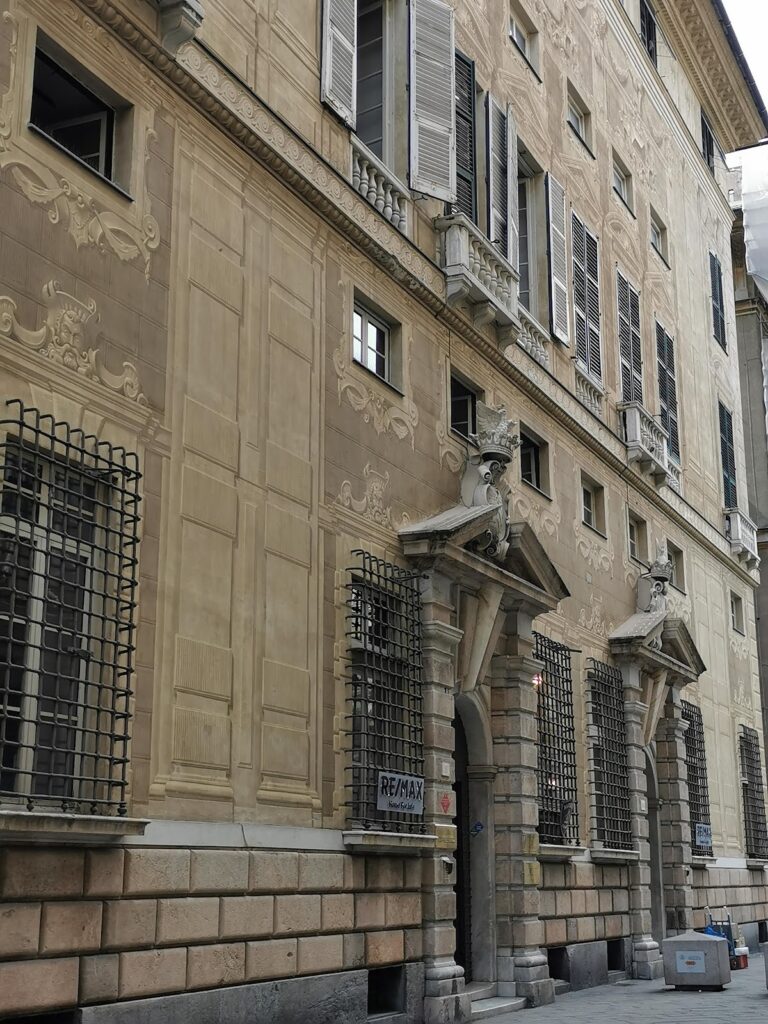
Palazzo Bianco occupies the uphill, north side of Via Garibaldi, opposite Palazzo Rosso and beside Palazzo Niccolò Grimaldi. Its eighteenth-century facades are relatively restrained in decoration and reflect Giacomo Viano’s remodeling. The sloping ground is managed by a central staircase between the entrance level and the courtyard. At the principal residential level, the piano nobile, a gallery encircles the courtyard. Its side sections are closed, while entrances to the residential rooms open from this circulation space.
Palace and gardens
Courtyard and terraces
The sixteenth-century residence was entered from the Salita di San Francesco di Castelletto and possessed a larger garden along its eastern and southern sides. The eighteenth-century rebuilding created the present relationship between the palace, the street, and the surviving eastern garden terrace, which lies at the level of the street-side first floor and courtyard. The lower garden and the garden of the adjoining Palazzo Tursi were joined into one large terrace in the late nineteenth century.
Lower garden
The lower garden is arranged with four parterres, formal geometric beds edged with box hedges. Its paving includes a Genoese risseu, a Ligurian technique that forms mosaic patterns from contrasting black and white pebbles. An octagonal fountain basin is topped by a faun blowing a shell, a figure from classical mythology with human and animal features associated with woodland and nature. The present statue replaced an earlier one eroded by water.
The garden also contains benches, greenery, and eighteenth-century statues of musicians. In the Palazzo Tursi portion stands a polylobed basin with a statue of the Venus pudica, the classical type showing Venus in a gesture of modestly covering her body. The statue was formerly located in Palazzo Bianco’s old courtyard. The garden complex underwent restoration in 2024, including both basins, the statues, the risseu pavement, the benches, and the surrounding vegetation.
Upper garden
The upper garden lies along the passage toward Palazzo Tursi and includes a terrace overlooking the lower green space. Palazzo Rosso can be seen across Via Garibaldi. The garden also preserves monumental remains connected with the former church and monastery of San Francesco di Castelletto, a major Gothic religious foundation of medieval Genoa. The church was finally demolished around 1820.
San Francesco di Castelletto remains
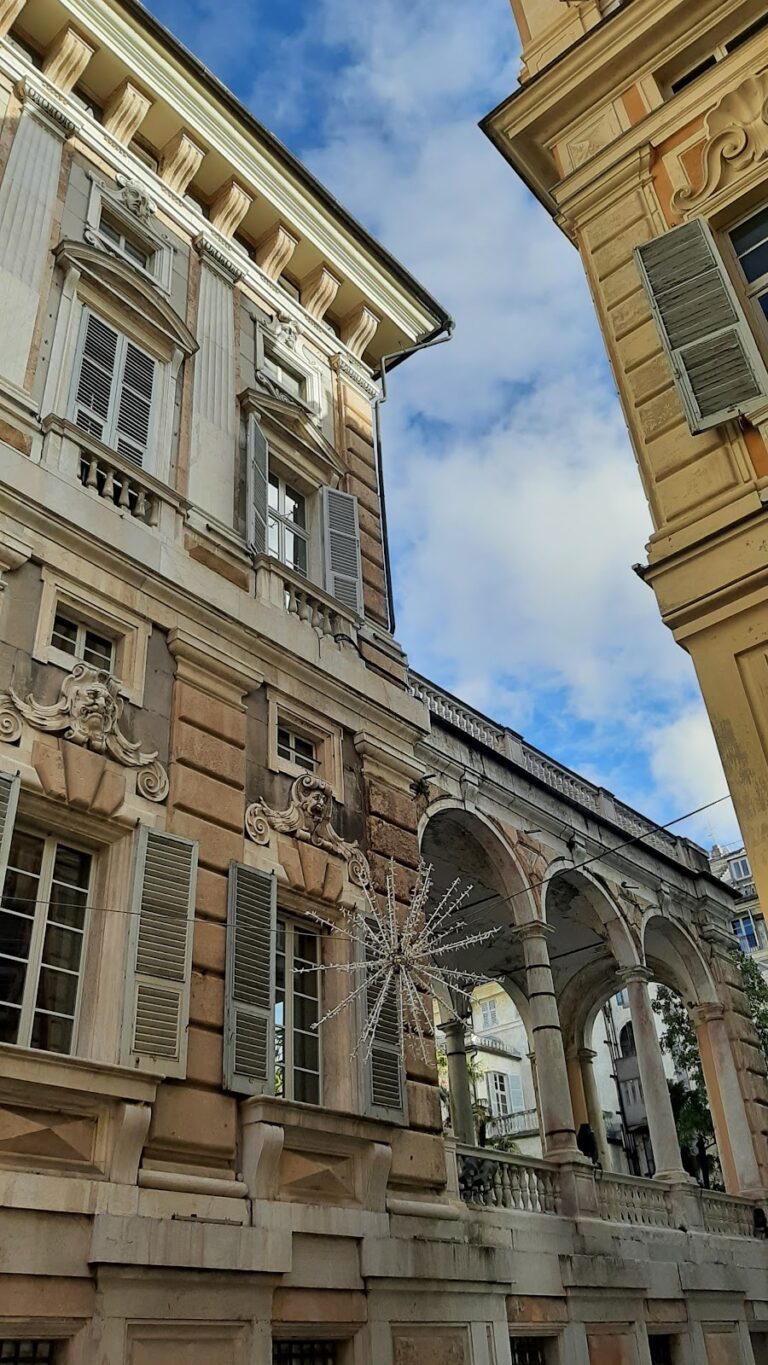
Arches and columns from one nave of San Francesco di Castelletto survive in the upper garden area. Their columns are made from alternating drums of white and black stone and are incorporated into the facade of the nineteenth-century municipal building behind the museum. Other remains of the adjoining monastery survive in situ within the museum complex, linking the palace grounds with the earlier religious buildings that occupied the nearby area.
Paintings in the gallery
The collection includes paintings associated with Luca Cambiaso, among them Madonna of the Candle and Self-Portrait of the Painter Painting His Father’s Portrait. Caravaggio’s Ecce Homo, an oil painting on canvas dated 1605, is displayed alongside Matthias Stomer’s Salome with the Head of Saint John the Baptist, dated before 1652. Other works include Filippino Lippi’s Francesco Lomellini Altarpiece of 1502–1503, Morazzone’s Beheading of Saint John the Baptist from 1612–1613, Jan Matsys’s Charity, Hans Memling’s Blessing Christ, Gerard David’s Cervara Polyptych from 1506–1510, and Peter Paul Rubens’s Venus and Mars, or Allegory of Intemperance from 1632–1635.
Further works are associated with Antoon van Dyck, including Vertumnus and Pomona, as well as Simon Vouet’s David with the Head of Goliath, Bartolomé Esteban Murillo’s Flight into Egypt, Francisco de Zurbarán’s Saint Ursula and Saint Euphemia, Paolo Veronese’s Crucifixion and Susanna and the Elders, Palma the Younger’s Christ and the Samaritan Woman and The Adulteress, and Giorgio Vasari’s Portrait of a Florentine Gentleman.
Genoese Baroque painting is represented by works associated with the Grechetto, Bernardo Strozzi, Valerio Castello, Domenico Piola, Anton Maria Piola, Paolo Gerolamo Piola, Gregorio De Ferrari, Alessandro Magnasco, Giovanni Benedetto Castiglione, and Giovanni Andrea Ansaldo. The wider holdings include works associated with Pier Francesco Mazzucchelli, Anton Maria Vassallo, Sinibaldo Scorza, and Gioacchino Assereto, including Flight into Egypt, Landscape with Erminia among the Shepherds, and The Death of Cato. European works by Peter Cook van Aelst, Gerard David, Jan Provost, Cornelis de Wael, Giacomo Legi, Pietro Francavilla, and the Venetian painter Parisio Micheli complete the range of artists represented in the gallery.
Nearby sites