Palanok Castle: A Historic Fortress and Museum in Ukraine


Site at a Glance
- Rating
- 4.7
- Popularity
- High
- Country
- Ukraine
- Primary era
- Early Modern
- External website
- Open
- Eras represented
- Bronze Age, Iron Age, Medieval, Early Modern
- Civilizations
- Habsburg, Hungarian
- Site type
- Military
- Remains
- Castle
On this page17 sections
History
Palanok Castle, also known as Mukachevo Castle, is a historic fortress and museum in Mukachevo, Ukraine. Its exact foundation date is unknown, but documents mention it by the eleventh century. The site is a nationally significant architectural monument of Ukraine, listed as No. 168. Its history reaches back further, since the hill was inhabited during the Neolithic period and later held earthwork defenses during the Bronze and Iron Ages.
Early fortifications and the medieval stronghold
At the time of the Hungarian conquest, a palisaded fort occupied the summit. A palisade was a defensive barrier made from upright timber posts. King Stephen I of Hungary considered the position important and strengthened its walls, while King Ladislaus I continued the work and commissioned a stone enclosure. The name Palanok is associated with the later timber palisade below the castle. A tradition recorded by Anonymus, a medieval chronicler traditionally identified as a notary of King Bela III, connects the name Mukachevo with the Hungarian conquerors resting there after crossing the Verecke Pass. Another explanation derives it from a Slavic word meaning “suffering,” referring to the labor involved in building the fortress.
The castle faced repeated attacks. Pechenegs besieged it for five days in 1086 without capturing it. In 1190, the Tatars devastated villages in Bereg and Ung counties and also failed to take the fortress. Batu Khan’s army destroyed Mukachevo in 1241 but could not overcome the castle’s defenses. After the Mongol withdrawal, King Bela IV ordered new fortresses to be built and existing ones strengthened in 1242.
During the thirteenth century, Mukachevo became one of the largest and best-defended strongholds in Hungary. King Charles Robert valued its position in relation to the growing powers of Poland and Rus. He brought Italian craftsmen to rebuild and reinforce the castle, and King Louis I continued the construction. In 1352, the garrison defeated another Tatar force, captured Khan Atlamos, and beheaded him.
The Koriatovich residence and changing ownership
In 1396, King Sigismund granted the castle and its domain to Theodore Koriatovich, Prince of Podolia. Koriatovich moved his court to the region, made the castle his residence, and greatly enlarged it. A moat and an oak palisade were added below the stronghold. His administration contributed to the economic and cultural development of the surrounding region.
After Koriatovich and his wife died, the castle changed hands several times. George Brankovic held it from 1423, followed by Laszlo Paloczi from 1439 and John Hunyadi from 1445. After Hunyadi’s death in 1456, his widow Elizabeth Szilagyi became its holder. The castle later belonged to King Matthias Corvinus and his son John Corvinus.
The people of Mukachevo took an active part in George Dozsa’s peasant revolt of 1514, an uprising against the social and political order of the Hungarian kingdom. The rebels captured Mukachevo, Huszt, and Kiralyhaza castles. The castle and its domain became property of the Hungarian Crown in the same year and passed from king to king. The revolt caused serious damage, and King Louis II began repairs that remained unfinished. John Zapolya seized the castle in 1528 and exchanged it with Palatine Stephen Bathory the following year.
Stephen Bathory built the upper castle’s ring-shaped bastion and a watchtower 14 metres high. King Ferdinand I besieged and captured the fortress in 1537. After 1541, it belonged nominally to John Sigismund Zapolya, while his mother, Queen Isabella, governed for him. Ferdinand granted it to Stephen Dobo in 1560, although Dobo could not take possession while the castle remained in enemy hands. Imperial troops captured it in 1567. Emperor Maximilian II pawned it to Gaspar Magocsy in 1573, and it later passed into the Rakoczi family through Sigismund Rakoczi’s marriage into the Magocsy family. Nicholas Esterhazy owned it in 1611.
The Rakoczi period and the War of Independence
During the 1620s, Gabriel Bethlen acquired the castle and its domain for 300,000 forints. Captain Janos Balling repaired the fortress and built a new structure in the middle courtyard. After Bethlen died in 1629, the castle passed to his widow, Catherine of Brandenburg, who soon surrendered it to George I Rakoczi.
The Rakoczi dynasty held the castle from the 1630s until 1711 and used it as a princely residence. George I received French, Polish, and Swedish envoys there and conducted diplomatic negotiations. After his death, his wife Zsuzsanna Lorantffy continued to enlarge and strengthen the fortress with the help of French architectural specialists. Their son, George II Rakoczi, later became its lord. In 1649 and 1656, he received delegations from Bohdan Khmelnytsky, the Zaporizhian Cossack hetman, to discuss joint action against Poland.
George II’s campaign against Poland in 1657, launched despite the Ottoman sultan’s opposition, ended in defeat. Polish forces under Prince Lubomirski retaliated by burning the counties of Bereg, Ung, and Zemplen and destroying Mukachevo and Beregszasz. They did not capture the castle.
After George II’s death, his widow Zsophia Bathory and their son Francis I Rakoczi moved into the fortress. Francis married Ilona Zrinyi, whose father was the Croatian ban, and their son was Francis II Rakoczi. Ilona Zrinyi and Imre Thokoly married at the castle in 1682. Thokoly repaired and reinforced it and maintained a wealthy court there.
When Thokoly was taken into Ottoman captivity, Ilona Zrinyi defended the castle with her two children. Imperial forces reached Mukachevo in November 1685 after taking Uzhhorod Castle. On 10 March 1686, Imperial Field Marshal Aeneas Caprara demanded the garrison’s surrender, but Zrinyi refused. She led Hungarian, Rusyn, Slovak, and German soldiers through a seven-month defense, often appearing on the bastions with her ten-year-old son Francis. Her daughter Julianna cared for the wounded.
Caprara abandoned the siege in April 1686, and his troops plundered Mukachevo while withdrawing toward Kosice. Twenty-four defenders were killed, while Austrian losses were many times greater. Caprara returned in 1687 with more than 3,000 troops. Zrinyi rejected another demand for surrender on 2 November, and the siege continued for about a year. She eventually negotiated terms and signed an agreement on 15 January 1688. Imperial troops under Antonio Caraffa entered the castle two days later. Zrinyi was taken to Vienna and confined in a convent, while her children were placed in Austrian lyceums. Emperor Leopold I then ordered further fortification, and the castle was regarded as an impregnable stronghold and the strongest fortress in the eastern part of the Austrian Empire.
From 1703 to 1711, the fortress served as an important base for Francis II Rakoczi’s War of Independence, a Hungarian anti-Habsburg movement. The Habsburg monarchy was the ruling dynasty and imperial political system against which the Rakoczi and Thokoly movements fought. Rakoczi’s forces captured Mukachevo on 24 June 1703 but did not initially take the castle. Their siege began in November and ended with a Kuruc victory on 16 February 1704. The Kuruc were Hungarian anti-Habsburg insurgents, especially those active during Rakoczi’s war. Rakoczi moved into the fortress and directed the conflict from there.
Rakoczi commissioned the military engineer Demoiseaux to prepare plans for enlargement and modernization. Work began in 1705 and continued until 1710, much of it carried out by Hungarian and Rusyn serfs from Bereg County. Colonel De La Mothe first supervised the construction, followed by the military engineer De la Faux from 1708. In 1706, Rakoczi converted a mill beside the castle on the left bank of the Latorca into a mint, which operated until 1713. He also received foreign delegations there, including envoys of Tsar Peter I of Russia.
The Kuruc war ended in defeat, and the defenders surrendered on 22 June 1711. Austrian reprisals destroyed dozens of Rusyn and Hungarian villages around the castle. The fortress then lost much of its strategic importance and was used mainly as a military storehouse.
Prison, revolution, and imperial rule
After the war, the castle passed to King Charles III. The Habsburg government converted it into a prison, establishing a political prison in 1782. Joseph II ordered its conversion into a prison in 1787. More than 20,000 prisoners were held there over more than a century, including Alexandru Ipsilanti, Ferenc Kazinczy, the 42 participants in the Martinovics conspiracy, Mikhail Bakunin, and Guard Captain Ferenc Reindl. Prisoners endured exceptionally harsh conditions and were sometimes kept in chains.
The Hungarian Holy Crown was kept secretly under guard in the castle from 11 December 1805 to 10 March 1806 while it was being moved away from Napoleon’s advance. The crown was associated with the Hungarian monarchy and the legitimacy of the Hungarian state, which explains the care taken during this military danger.
A fire began on 27 July 1834 when a candle ignited a curtain. It lasted nearly a week and destroyed the castle’s wooden structures. The buildings were rebuilt and their roofs were covered with tiles instead of shingles. Poet Sandor Petofi visited the prison castle on 11 July 1847 and wrote “In the Castle of Mukachevo.” The place where he composed the poem remains disputed, with some literary historians placing it in Beregszasz rather than Mukachevo.
After the Hungarian Revolution began in March 1848, residents of Mukachevo opened the prison casemates and released the prisoners. During the 1848 to 1849 revolution and war of independence, the castle again became a stronghold of the independence movement. Its defenders, led by Captain Pal Mezossy, defeated Imperial troops at the Latorca bridge near Podhering on 22 April 1849. They surrendered on 26 August after Russian forces intervened on the Austrian side. The garrison then consisted of 32 officers and 1,329 ordinary soldiers.
The castle was converted back into a prison by imperial order on 1 July 1855. Alterations made in 1857 to 1859 involved prisoners in the construction work. The prison was officially closed in October 1896 during the millennium celebrations, although it continued operating until 1903. The Austro-Hungarian Ministry of Justice purchased the castle in 1897, and inadequate maintenance contributed to its deterioration.
Twentieth-century uses and preservation
A bronze Turul monument was inaugurated on the northeastern Hajdu Bastion in 1896. The Turul is a legendary bird of Hungarian tradition and a major national symbol. The monument was removed in 1924, and in 1945 the bronze was melted down by the Red Army and recast into Soviet red stars. An obelisk commemorating the defenders’ 1849 victory at the Latorca bridge was erected in 1901 and later demolished.
After the First World War and the transfer of Zakarpattia to Czechoslovakia under the Treaty of Trianon, the Czechoslovak army used the castle as barracks from 1919 to 1938. The Hungarian army occupied it after the region returned to Hungary and remained there until 1944. Soviet military units used the castle from 1945. A vocational school trained agricultural-machine operators there from 1962 to 1973, alongside other Soviet-period educational uses.
A Lviv restoration institute worked at the castle from 1971 to 1993. That work caused substantial damage, after which more extensive renovation restored rooms and allowed exhibitions to open. The Mukachevo Historical Museum, based on the Lehoczky Collection, was established in the castle and presents objects from all historical periods. In 2009, the Ukrainian parliament adopted measures concerning the preservation of the castle’s cultural heritage, including a review of its transfer into municipal ownership and plans for a state historical-architectural reserve.
A replica of the Turul was installed in March 2008 with support from the Pakh family. Created by Mihajlo Beleny, it was slightly larger than the original and stood on a 25-metre column. The statue was removed on 13 October 2022 at the request of the Mukachevo Historical Museum. A Ukrainian trident, the national coat of arms of Ukraine, was installed in its place on 25 October. The change prompted protests from city-council representatives and the Transcarpathian Hungarian Cultural Association, which challenged the legality of the removal. The castle is now a monument and museum, with restored rooms containing historical exhibitions. A memorial room dedicated to Theodore Koriatovich was established there in 2018.
Remains
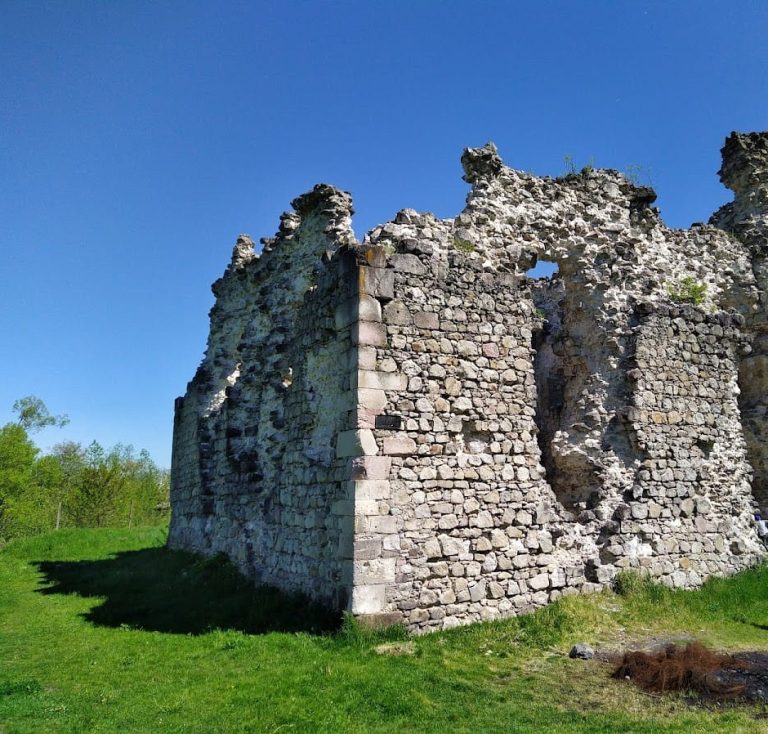
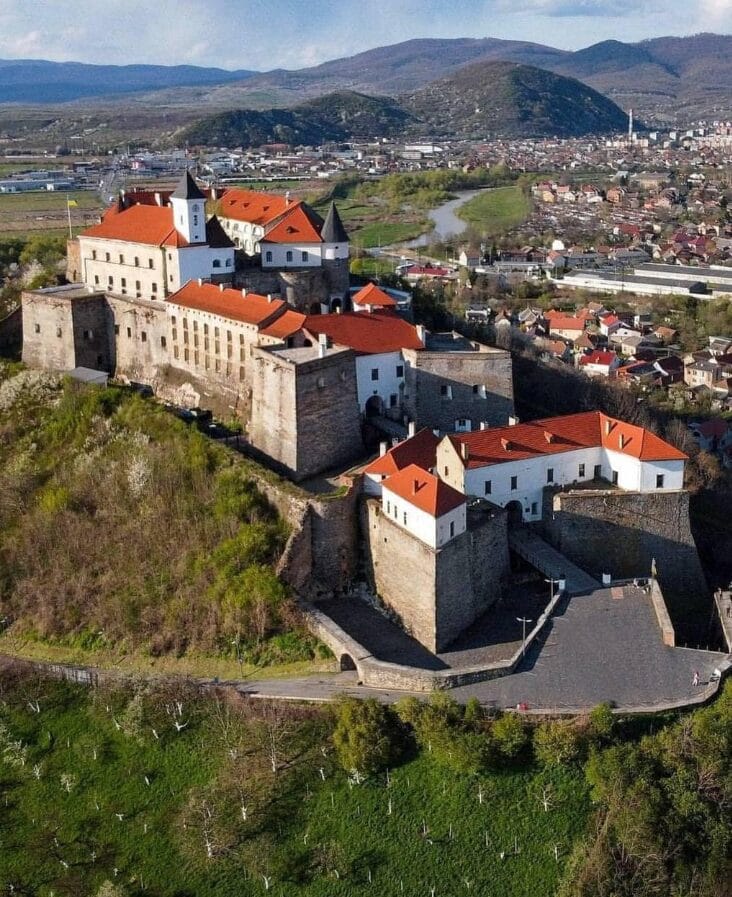
Palanok Castle occupies a volcanic hill rising 68 metres above the surrounding plain. The hill is about 408 metres long and 266 metres wide. The terraced fortress extends for approximately 250 metres, reaches a maximum width of 110 metres, and covers about 13,930 to 14,000 square metres. Its three main defensive systems were supplied separately and arranged at different elevations: the upper castle or citadel, the middle castle six metres lower, and the lower castle another ten metres below. A fourth terrace, ten metres below the lower castle, formerly held a gate bastion protecting the southern approach.
Lower and middle defenses
Lower Castle
The lower castle is entered between the German Bastion on the right and the Hajdu Bastion on the left. This level housed servants and craftsmen who supported the fortress. The defenses included a dry ditch 10 to 12 metres deep between the lower and middle castles. A historical description from 1690 also refers to triple defenses, deep rock-cut cellars used for shelter, a water-filled ditch reaching about 12 feet in depth, and marshland around the ditch.
Middle Castle
The middle castle is reached through a gate flanked by the Hussar Bastion on the left and the Wheelwright, or Wagner, Bastion on the right. Its courtyard is known as Rakoczi Square. Two- and three-storey buildings around the courtyard contained soldiers’ barracks, ammunition stores, a knights’ hall, and food stores. The former captain’s house stood opposite the gate and was demolished in the second half of the twentieth century.
Upper castle and citadel
Citadel
The citadel occupies the highest and oldest part of the complex. A residential tower once stood there and was enlarged during Theodore Koriatovich’s period. Three rebuilt round towers from an earlier four-bastion enclosure survive, each measuring about 3.9 metres in diameter. The citadel’s defenses also included the Lorantffy Bastion on the left and the Rakoczi Bastion on the right, with the Bastion of the Tree of Freedom between them.
Palace buildings and well
The citadel contained the lord’s residence and court. Two- and three-storey palace buildings surround three sides of the courtyard and are joined by an arcaded gallery. A rock-cut well in the courtyard is described as about 85 to 86 metres deep and 2.5 metres in diameter. At a depth of approximately 71 metres, a secret passage was cut from the well toward the bank of the Latorca. The well is covered and cut into solid rock.
Bastions and towers
A tower beside the Lorantffy Bastion is the tallest structure in the castle and provides access to the Geczy Bastion and the citadel. The Rakoczi Bastion provides access to the Vezir, or Long, Bastion. On the northern projections of the citadel, the German Bastion stands to the west and the Hajdu Bastion to the east. Across the fortress, the walls reach about 3.8 metres in thickness in places, and the defenses included eight external angular Italian bastions and three round bastions. An Italian bastion is a projecting fortification designed to let defenders fire along the faces of adjoining walls.
Construction and commemorative features
The castle’s present form largely derives from the enlargement and reconstruction carried out during Francis II Rakoczi’s War of Independence. Stone and brick are the principal construction materials. The 1834 fire destroyed the wooden structures, and the rebuilt buildings received tile roofs. The surviving terraces, bastions, courtyards, towers, palace buildings, and restored rooms express the fortress’s successive medieval, early-modern, and later military uses.
Turul monument
The 1896 Turul monument consisted of a large bronze bird with outspread wings and a sword in its beak. It stood on a 33-metre obelisk designed by Gyula Berczik, with the sculpture made by Gyula Bezeredy. The replacement installed in 2008 was a slightly larger copy by Mihajlo Beleny on a 25-metre column. The column was later replaced by a Ukrainian trident in 2022.
Latorca battle obelisk
The memorial obelisk erected in 1901 stood at the site of the 1849 battle near the Latorca bridge. It commemorated the victory of the castle’s defenders and was later removed.