Palais Henckel von Donnersmarck: A Ringstrasse Urban Palace in Vienna


Site at a Glance
- Rating
- 4.6
- Popularity
- Very Low
- Country
- Austria
- Primary era
- Modern
- Eras represented
- Modern
- Civilizations
- Austria-Hungary, Habsburg
- Site type
- Domestic
- Remains
- Elite Residence
On this page6 sections
History
Palais Henckel von Donnersmarck is a historicist urban palace in Vienna, Austria, built by the Silesian industrialist and aristocrat Hugo Henckel von Donnersmarck in 1871–1872. Located in the Innere Stadt, Vienna’s historic central district, at the corner of Parkring and Weihburggasse, it formed part of the grand nineteenth-century development along the Ringstrasse, the boulevard created on the line of the former city fortifications. The palace was commissioned as a gift for Hugo’s second wife, Laura, Countess Kaszongi, and initially served as the family’s city residence.
Aristocratic residence and changing ownership
For a period, the palace was occupied by Count Edmund Zichy, a Hungarian aristocrat and patron of art and science who participated in Vienna’s nineteenth-century high society. Following Countess Zichy’s death, the property was sold to Count Mir in 1906. Count Mir’s widow sold it again in 1917, this time to Alberto, Marquis de Hohenkubin, who used the residence only rarely.
The palace was looted and seriously damaged during the Second World War. It then stood empty for an extended period. After the marquis died in 1972, the property passed to his heirs, who sold it to the City of Vienna in 1977. This transaction ended its period as a private aristocratic residence.
Conversion and renewed use
Between 1983 and 1985, Pfeffer Consult converted the palace into a hotel. Together with the adjoining Palais Leitenberger at Parkring 16, it became part of the Radisson Blu Hotel complex, which closed at the end of 2013. The connected buildings subsequently underwent another major redevelopment. Palais Henckel von Donnersmarck was temporarily adapted for luxury residences, with twelve apartments in use from 2021, while plans for renewed hotel use were developed.
Palais Henckel von Donnersmarck and Palais Leitenberger now form the five-star Almanac Palais Vienna hotel. The Austrian WSF Group owns and invested in the two buildings, while Almanac Hotels operates the hotel. Architect and co-owner Tina Haselbacher directed the revitalization concept and interior design. The palace is protected as an Austrian listed historic monument.
Remains
Facade and entrance
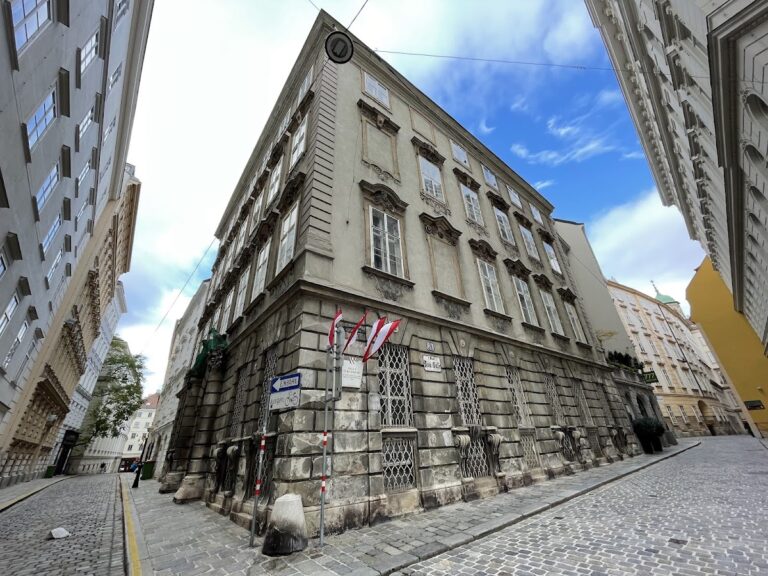
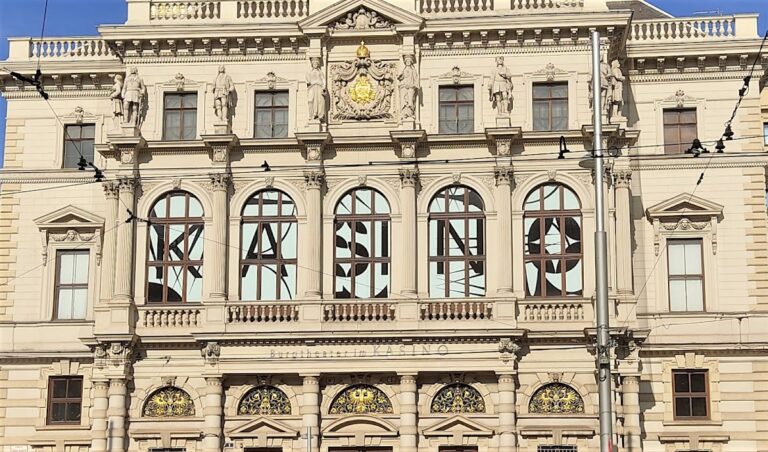
Designed by August Schwendenwein and Johann Romano, with construction supervised by Paul Wasserburger, the palace follows the historicist style, especially the Neo-Renaissance forms favored by Vienna’s Ringstrasse development in the second half of the nineteenth century. Its symmetrical facade is organized by a strong horizontal division between the storeys. Massive window surrounds and decorative pediments give the lower levels a formal character, while caryatids, sculpted female figures used as architectural supports or decoration, distinguish the windows of the third storey. The highest storey is more restrained, reinforcing the monumentality of the principal facade.
At the corner facing Weihburggasse, a richly sculpted entrance portal forms one of the building’s defining features. Its balcony rests on eight columns. The pediment carries the monogram “M” beneath a count’s coronet, a surviving reference to the period of Count Mir’s ownership.
Interior spaces and connected complex
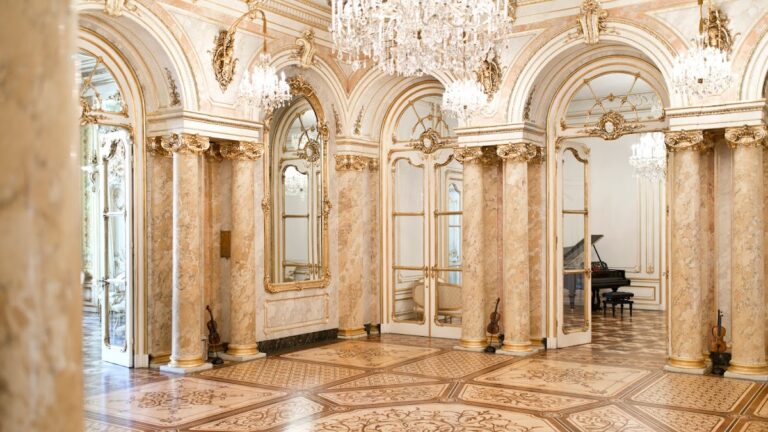
Parts of the original interior survive on the piano nobile, the principal ceremonial residential floor. Valuable ceiling stucco and wood paneling remain in the representative salons, and the monumental main staircase continues to be an important feature. Numerous twentieth-century alterations changed most of the rooms, while the staircase and several halls retain historic elements. During Edmund Zichy’s residence, his apartment contained large carpets designed by him and a collection of Indian and Chinese bronzes.
The present hotel extends through both Palais Henckel von Donnersmarck and Palais Leitenberger, which are internally connected. The complex contains 111 rooms and suites, a restaurant, a bar, a spa center, and banquet rooms. Historic marble portals, stucco, and carved details are combined with modern furnishings, Austrian finishing materials, and works by Austrian artists.
Nearby sites