Franziskanerkloster Wien: Franciscan Monastery and Church in Austria


Site at a Glance
- Rating
- 5
- Popularity
- Very Low
- Country
- Austria
- Primary era
- Early Modern
- External website
- Open
- Eras represented
- Early Modern
- Civilizations
- Habsburg, Holy Roman Empire
- Site type
- Religious
- Remains
- Monastery
On this page15 sections
History
Franziskanerkloster Wien is a Franciscan monastery and church complex in Austria, developed in its present form during the Renaissance period between 1603 and 1621. Its history reaches back to the first Franciscan settlement in Vienna, probably founded around 1224 on the initiative of Duke Leopold VI of Austria while Francis of Assisi was still alive. The brothers served the local community, preached, and assisted people in poverty.
Medieval Foundations in Vienna
A small Franciscan convent beside Vienna’s city wall was recorded in 1234. Bishop Berthold of Passau consecrated a Chapel of the Holy Cross for the brothers in 1251. This early establishment stood near the present Minoritenkirche, and only a small part of its original monastery survived the following centuries.
The early Franciscan presence later became associated with the Minoritenkirche, while the monastery now known as Franziskanerkloster Wien occupies the former House of St. Hieronymus complex. The two institutions therefore reflect separate stages in the history of the Franciscan community in Vienna.
The Observant Reform and St. Theobald
During the fifteenth century, the Vienna Franciscans became involved in the Observant reform, a movement that advocated a stricter interpretation of the Franciscan Rule. Johannes of Capistrano, a Franciscan reformer and preacher, brought this programme to Vienna on 6 June 1451 after Austrian envoys invited him and Pope Nicholas V authorized him to establish Observant monasteries in Austria.
On 22 July 1451, Frederick IV, Duke of Austria, allowed Johannes to establish a new monastery at St. Theobald on the Laimgrube. Johannes held the first provincial chapter there in 1452. A provincial chapter was the formal governing assembly of a religious province. Frederick IV supported the enlargement of the monastery, which was planned to accommodate as many as 200 brothers.
The brothers at St. Theobald continued the Franciscan commitment to the poor. Timotheus and Angelus are particularly associated with caring for victims during Vienna’s plague epidemic of 1453. Ottoman forces destroyed the monastery completely on 25 September 1529 during the siege of Vienna. About 100 brothers died, while around 20 escaped into the city.
Relocations and the House of St. Hieronymus
After the siege, Bishop Johann Fabri of Vienna assigned the Franciscans St. Rupert’s Church and an adjoining house. The buildings were dilapidated, and the house was too small for the growing community. The brothers moved there on 8 October 1533 but soon began seeking a more suitable residence.
In 1545, at the brothers’ request, Ferdinand I granted them the Beneficiates’ House in Singerstraße together with the small Church of St. Nicholas. The community continued to expand. In 1589, Archduke Ernst of Austria transferred the House of St. Hieronymus to the Franciscans.
The House of St. Hieronymus had originally been a fourteenth-century refuge for penitent women, established by wealthy and influential citizens of Vienna. Its community ended after the death of its last superior, Juliana Kelbergerin, on 20 January 1553. The city then used the building for orphaned girls until the Franciscans received it on 10 May 1589.
Construction of the Present Complex
When the Franciscans took possession of St. Hieronymus, they found that the buildings required extensive renewal. Provincial Bonaventura Daum and the order’s German commissary general, Valentin Friecius, decided to replace the existing complex. Several adjoining houses were acquired, and the former penitents’ house, its chapel, and the neighboring buildings were demolished.
The foundation stone of the new church was laid on 14 August 1603. The brothers ceremonially entered the unfinished building on 8 December 1607. Cardinal Franz Fürst Dietrichstein, acting as a papal legate, consecrated it on 11 December 1611. A papal legate was an official representative delegated by the pope. The church and its tower were completed in 1614.
On 11 August 1614, Bonaventura Daumius laid the foundation stone of the monastery. Abraham Mall and Peter Centner completed the building in 1621. It was designed for a community of up to 200 brothers, and a small hospital with its own chapel was added in 1630.
Later Institutional and Pastoral History
Since 1633, the monastery has housed the General Commissariat of the Holy Land, an institutional office supporting Franciscan missions in the Holy Land. In 1825, the Vienna Franciscan monastery was incorporated into the Hungarian-Slavonian Province of St. Capistran.
The complex also houses the Rosary Atonement Crusade, a prayer movement for world peace founded by the Franciscan priest Father Petrus Pavlicek. The Franciscans continue to serve the monastery church through worship, confession, and other pastoral work. Assistance to people in poverty remains part of the community’s activity, including daily food distribution at the monastery gate and a weekly soup kitchen operated by volunteers. The associated charity Franz Hilf directs donations to aid projects, especially in eastern Europe.
The earlier Franciscan site near the Minoritenkirche followed a different institutional path. During the Josephinian reforms, the church and religious institutions associated with the Minorites were reorganized, and the Minorites moved to the Alserkirche in 1782. Joseph II transferred the church to the Italian Congregation of Maria Schnee in 1784, and it was given to the Priestly Fraternity of Saint Pius X in 2021. The Franciscan monastery and church at Franziskanerplatz remain the separate complex created from St. Hieronymus.
Remains
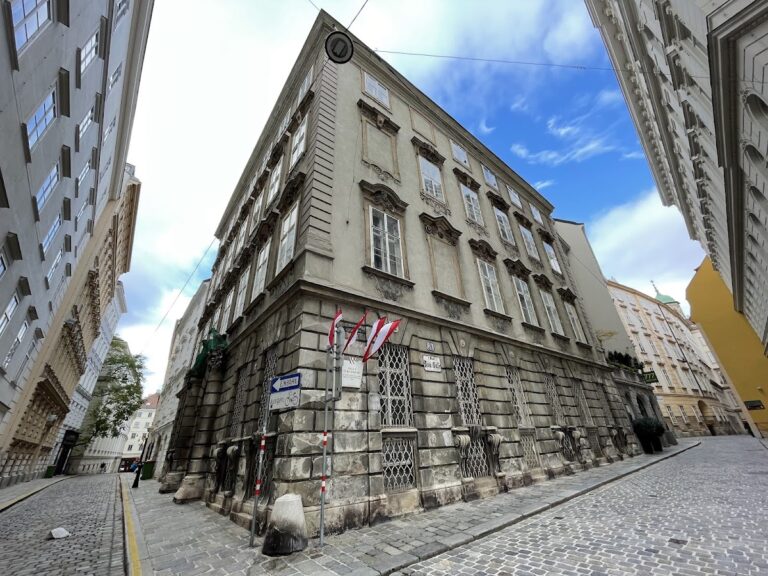
The surviving complex at Franziskanerplatz consists of a Renaissance church with a completed tower and a monastery built around the former House of St. Hieronymus site. The present buildings replaced the penitents’ house, its chapel, and adjoining houses, and the monastery was planned on a scale suitable for as many as 200 brothers. A small hospital and separate chapel were added to the monastic establishment in 1630.
The Renaissance Church and Monastery
Franciscan Church
The church was constructed between the laying of its foundation stone in 1603 and its completion, including the tower, in 1614. Its Renaissance design makes it a distinctive surviving example of sacred architecture in Vienna from that period. The building was consecrated in 1611, while work on the tower continued until 1614.
Monastery and Hospital
The monastery was founded beside the church in 1614 and completed in 1621 by Abraham Mall and Peter Centner. It replaced the former House of St. Hieronymus and neighboring buildings as part of the new Franciscan complex. The plan provided accommodation for up to 200 brothers, and the addition of a small hospital with its own chapel in 1630 expanded the site’s religious and charitable functions.
Earlier Franciscan Establishments
Original Convent near the Minoritenkirche
The first Franciscan complex stood near Vienna’s city wall around the site of the present Minoritenkirche. It included the convent associated with the 1234 record and the Chapel of the Holy Cross consecrated in 1251. Only a small tract beside the church remained after the medieval complex was altered over the centuries.
St. Theobald on the Laimgrube
The St. Theobald complex had been built in 1349 as a provision institution for members of the court household of Duke Albrecht II of Austria. Franciscan Third Order sisters occupied it from 1354 until they moved to a renovated municipal house near the Minoritenkirche. The Observant Franciscans later used the complex after Johannes of Capistrano established the new monastery there in 1451. Ottoman forces destroyed it in 1529.
St. Rupert’s and St. Nicholas
After the destruction of St. Theobald, the Franciscans received St. Rupert’s Church and an associated house. Both required repair, and the house could not accommodate the expanding community. In 1545, the brothers acquired the Beneficiates’ House in Singerstraße and the small Church of St. Nicholas. The latter property had previously belonged to Cistercian nuns and included a fourteenth-century school of Scripture run by the community.
House of St. Hieronymus
The House of St. Hieronymus was built in the fourteenth century as a refuge for penitent women. Its chapel was consecrated on 20 November 1387 by Simon of Castoria, an auxiliary bishop of Passau. The house and chapel received numerous privileges and indulgences before the complex was later taken over by the Franciscans and replaced by the present monastery and church.
Nearby sites