Palais Equitable: A Historicist Office and Commercial Building in Vienna


Site at a Glance
- Rating
- 4.7
- Popularity
- Low
- Country
- Austria
- Primary era
- Modern
- Eras represented
- Modern
- Civilizations
- Austria-Hungary, Habsburg
- Site type
- Civic
On this page8 sections
History
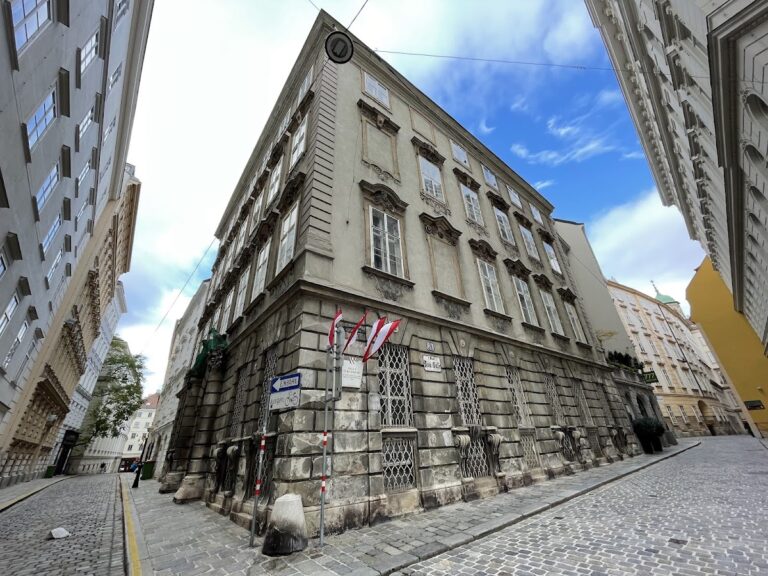
Palais Equitable is an office and commercial building in Vienna, Austria, constructed between 1887 and 1891 in the nineteenth-century historicist style for The Equitable Life Assurance Society of the United States. It stands on the former Stock-im-Eisen-Platz, now part of Stephansplatz, in the Innere Stadt.
Construction and Early Uses
The building replaced five small medieval structures that were demolished between 1856 and 1886, partly to widen Kärntner Straße. Andreas Streit designed the new palace, which is unusual among Vienna’s palaces and mansions because it was never an aristocratic residence.
Palais Equitable combined commercial, diplomatic, and office functions. Its tenants included Wilhelm Beck & Söhne, suppliers of uniforms to the Austro-Hungarian Empire, the dual monarchy that governed Austria and Hungary from 1867 to 1918, and the United States consulate.
Damage and Later Changes
Palais Equitable was damaged during the Second World War and restored in 1949. Rüdiger Lainer renovated its entrance area in 1997. The building is protected as an Austrian listed historic monument and continues to contain offices for companies and organizations, including the Austrian division of Sal. Oppenheim, together with a retail outlet for Augarten Porcelain.
Remains
Architectural Features
Façade and Entrance
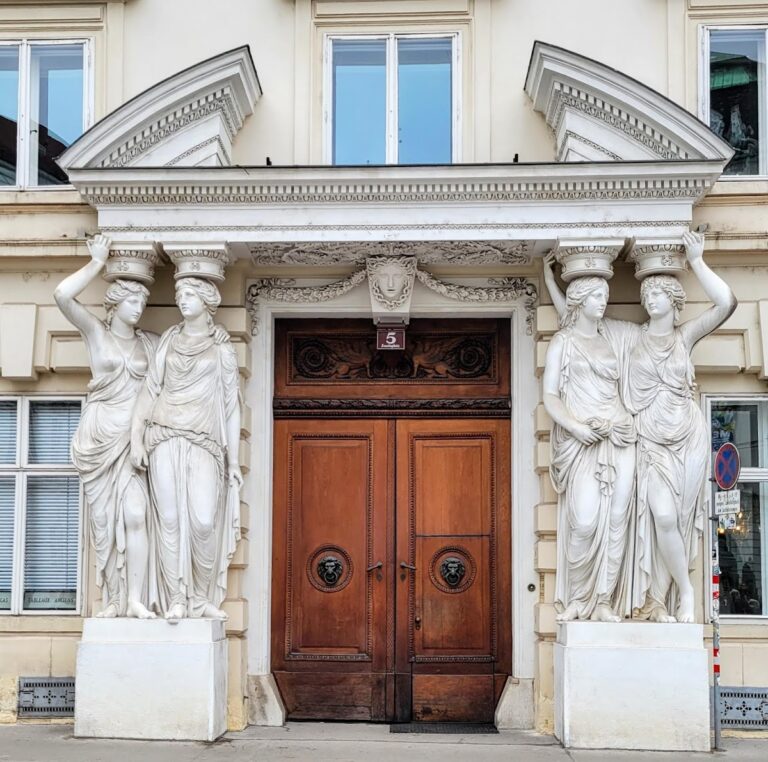
The richly decorated façade reinterprets forms from earlier architectural periods, characteristic of historicism, and includes American eagles. The main doors carry bronze reliefs by Rudolf Weyr depicting the history of the Stock im Eisen. Further ornamentation was created by Viktor Oskar Tilgner and Johann Schindler.
Stock im Eisen
At the Kärntner Straße corner, the building incorporates the Stock im Eisen, a medieval nail-tree associated with Vienna’s medieval traditions. The preserved wooden object, into which numerous nails were driven, is enclosed in glass and displayed in a niche.
Interior Spaces
Hallein marble and Saxon granite appear in the grand staircase and vestibule. The interior courtyard is covered by glass and entirely clad in tiles and maiolica. The staircase was apparently designed so that it could be adapted to provide access to a future subway station. Julius Victor Berger created the lobby ceiling painting and the stucco ornamentation on the second floor.
Nearby sites