Palacio Ducal: A Neoclassical Aristocratic Palace in Fernán Núñez, Spain


Site at a Glance
- Rating
- 4.5
- Popularity
- Low
- Country
- Spain
- Primary era
- Early Modern
- Eras represented
- Medieval, Early Modern
- Civilizations
- Crown of Castile, Spanish
- Site type
- Domestic
- Remains
- Elite Residence
On this page7 sections
History
Palacio Ducal is an eighteenth-century Neoclassical palace in Fernán Núñez, Spain, built between 1783 and 1787 as the residence of the Counts of Fernán Núñez. Its development followed earlier Islamic and Christian fortifications on the same site, while its design was influenced by the Palace of the Necessities in Lisbon.
Islamic and Christian origins
Before the present palace, the site held an Islamic watchtower protected by fortified walls. A fountain dating from the twelfth century has also been found there. After the Christian conquest, Ferdinand III of Castile, known as the Saint, granted the fortification to the nobleman Fernán Núñez de Témez on 29 June 1236. A castle was later built, becoming the seat of the lordship and subsequently the County of Fernán Núñez.
From castle to palace
The old castle suffered damage in the Lisbon earthquake of 1755. Carlos José Gutiérrez de los Ríos, the sixth Count of Fernán Núñez and Spain’s ambassador in Lisbon during the reign of Charles III, then ordered the site’s transformation. He drew inspiration from the Palace of the Necessities, where the Spanish embassy was located. The replacement residence was constructed from 1783 to 1787 in the Neoclassical style, an architectural movement that deliberately referred to ancient Greek and Roman forms and proportions.
The building remained an aristocratic residence until 1982, when the family transferred it to the municipal authorities. It is now owned by the Fernán Núñez town council. The palace became an Asset of Cultural Interest in 1983, a Spanish legal designation for heritage sites and cultural properties recognized for notable historical, artistic, or archaeological value. The family’s Fernán Núñez Palace in Madrid passed out of its ownership earlier, in 1940, when it was sold to the National Company of Western Railways.
Decline and restoration
In 2003, the Andalusian regional culture authority described the palace’s condition as very poor, but no intervention followed at that time. Between 2011 and 2020, work focused mainly on strengthening the foundations. This allowed interior shoring to be removed and spaces including the Chapel of Santa Escolástica, the principal staircase, and the kitchens to be recovered.
The town council began definitive restoration work in November 2023. Archaeological remains uncovered during the project caused delays, and comprehensive interior restoration was completed in December 2025.
Remains
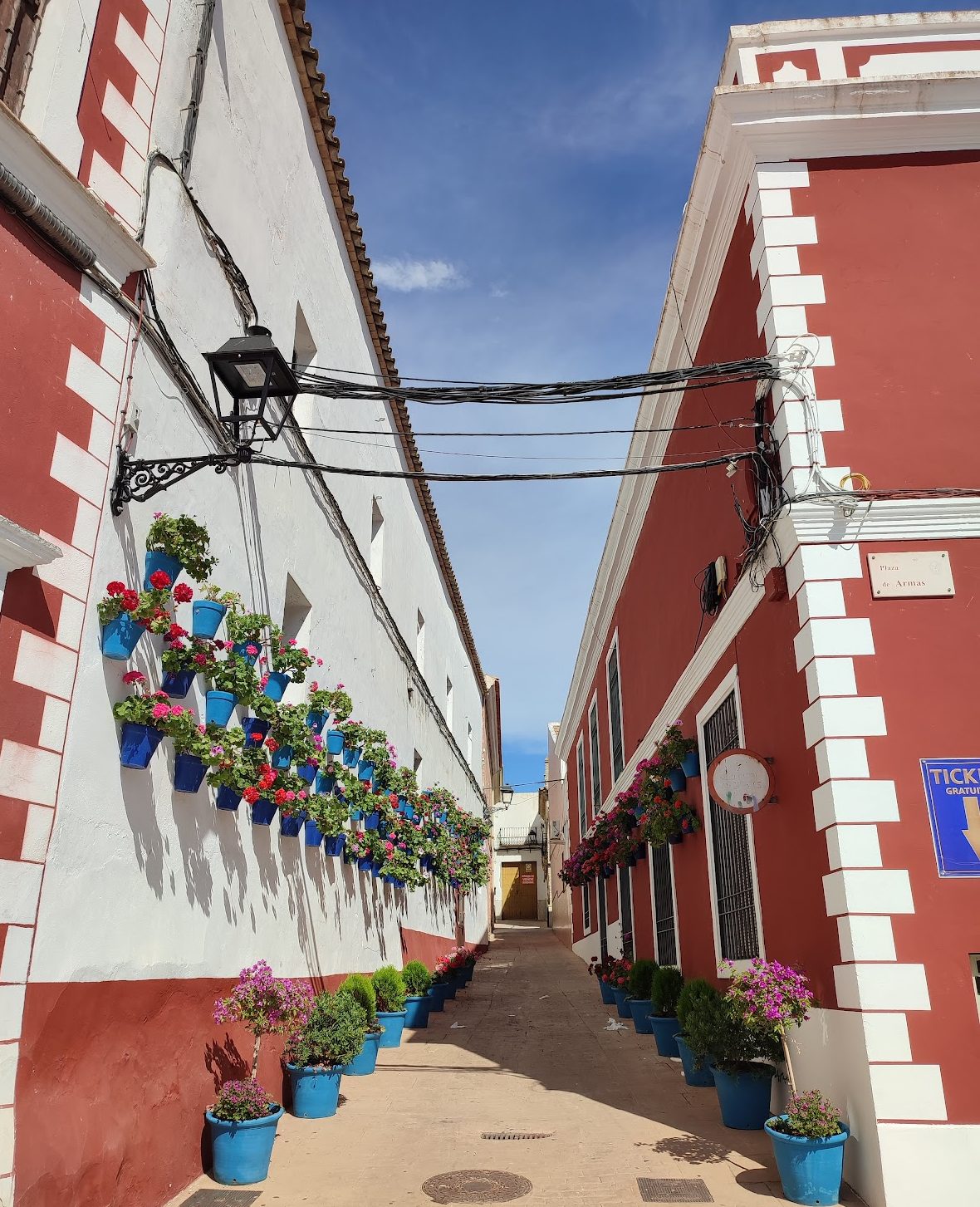
Palacio Ducal is a Neoclassical building whose facade was inspired by the Palace of the Necessities in Lisbon. It forms part of a uniform architectural ensemble around the Plaza de Armas, together with the town hall and former service buildings that included the duke’s inn, stables, and schools. Behind the palace, restored gardens occupy approximately 1,200 square metres. Their trapezoidal plan is organized across three terraces that accommodate the slope of the ground.
Chapel of Santa Escolástica
The Chapel of Santa Escolástica is named for Escolástica Gutiérrez de los Ríos, the only sister of the sixth Count of Fernán Núñez, who died in Madrid in 1782. Its construction was authorized by Baltasar de Yusta Navarro, Bishop of Córdoba, and the completed chapel was blessed by Cayetano Carrascal, a canon of Córdoba’s Mosque-Cathedral.
The chapel has a square plan and a dome that formerly carried a large lamp. Vegetal-form mural paintings decorate its walls, dating from the early twentieth century, and an inscription remains visible inside. Niches once held images of Saint Scholastica, Saint Charles Borromeo, a sixteenth-century Italian cardinal and Catholic reformer, and the Resurrection of Christ. Those images are now in the principal parish church. Elevated galleries connect the upper chapel with the count’s quarters, allowing him to attend Mass.
Fortress tower and artillery
One of the two towers crowning the palace was built over remains of the former fortress conquered by Fernán Núñez de Témez. A cannon and eight bombards, large heavy artillery pieces used before and during the early modern period, survive embedded in the tower. Diego Gutiérrez de los Ríos y Guzmán, the second Count of Fernán Núñez, seized these weapons from the English admiral Robert Blake during a maritime conflict in the waters of Cádiz in 1657.