Roman Bridge of Córdoba: A Historic Crossing of the Guadalquivir



Site at a Glance
- Rating
- 4.7
- Popularity
- Very High
- Country
- Spain
- Primary era
- Medieval
- External website
- Open
- Eras represented
- Classical, Medieval, Early Modern, Modern
- Civilizations
- Roman, Spanish, Umayyad
- Site type
- Infrastructure
- Remains
- Bridge
On this page11 sections
History
The Roman Bridge of Córdoba is a historic stone crossing of the Guadalquivir in Córdoba, Spain, associated with the Roman expansion of the city during the reign of Augustus. It probably formed part of the Via Augusta, the major Roman road linking Rome with Cádiz through the Iberian Peninsula, and became the principal route into Córdoba from the south.
Roman foundation
The bridge is generally dated to the period when Córdoba became Colonia Patricia, the Roman colonial title associated with the city during the Augustan period. Its construction is broadly placed in the first century BC or the first century AD, possibly replacing an earlier temporary crossing. As Córdoba expanded toward the Guadalquivir, the bridge connected the city with southern Iberian ports and commercial centres. For travelers approaching from the south, it provided a land route across the river without the need to use boats.
The bridge’s existence at the city’s southern entrance was not yet certain in 45 BC. Aulus Hirtius, a Roman soldier and historian, recorded that Julius Caesar crossed the river near Córdoba after the Battle of Munda using a temporary passage made from stones. This indicates that the bridge at the later southern entrance had not yet been built, although other Roman crossings may have existed nearby.
Early Islamic and medieval rebuilding
The crossing was substantially reconstructed during the early Muslim period. Around 720, Al-Samh ibn Malik al-Khawlani, the valí, or provincial governor, of al-Andalus, ordered work on the remains of the earlier bridge. The rebuilding used stone blocks taken from the city walls. Further major repairs followed during the tenth-century caliphate, particularly around 918.
The bridge standing today is therefore the product of repeated rebuilding rather than an untouched Roman structure. Its pointed arches and other elements indicate extensive medieval reconstruction. The original Roman bridge may have been destroyed or made unusable by flooding before later bridges were erected on or near its remains. Modern analysis identifies four courses of masonry beneath the Calahorra Tower as visibly Roman, while only arches 14 and 15, counted from the Puerta del Puente, are identified as original.
Later alterations and modern conservation
Further rebuilding took place during the caliphal period and after the Reconquista, the Christian reconquest of Muslim-ruled territories in the Iberian Peninsula. In 1927, the bridge was adapted for motor traffic. These later interventions were described as largely aesthetic rather than structural, but they considerably changed the appearance inherited from earlier periods.
In more recent history, the bridge carried the national N-4 road between central and southern Spain. A customs office at the Puerta del Puente collected consumption duties from travelers entering Córdoba from the south. After the San Rafael Bridge was built in 1953 and the Miraflores Bridge in 2003, the Roman Bridge was closed to motor traffic on 1 May 2004 and converted into a pedestrian crossing. It had been Córdoba’s only bridge across the Guadalquivir for roughly twenty centuries.
Conservation and restoration began after the closure, with work starting in 2006 under the direction of the municipal architect Juan Cuenca Montilla. The intervention combined internal and external structural conservation with extensive remodeling and was completed on 9 January 2008. Its treatment of the bridge’s appearance, especially the introduction of pink granite paving, prompted controversy.
Since 1931, the bridge, the Puerta del Puente, and the Calahorra Tower have held Spanish cultural-heritage protection as a monument. They also form part of the Historic Centre of Córdoba, which was inscribed on the UNESCO World Heritage List in 1984 and extended in 1994.
Remains
Bridge structure and setting
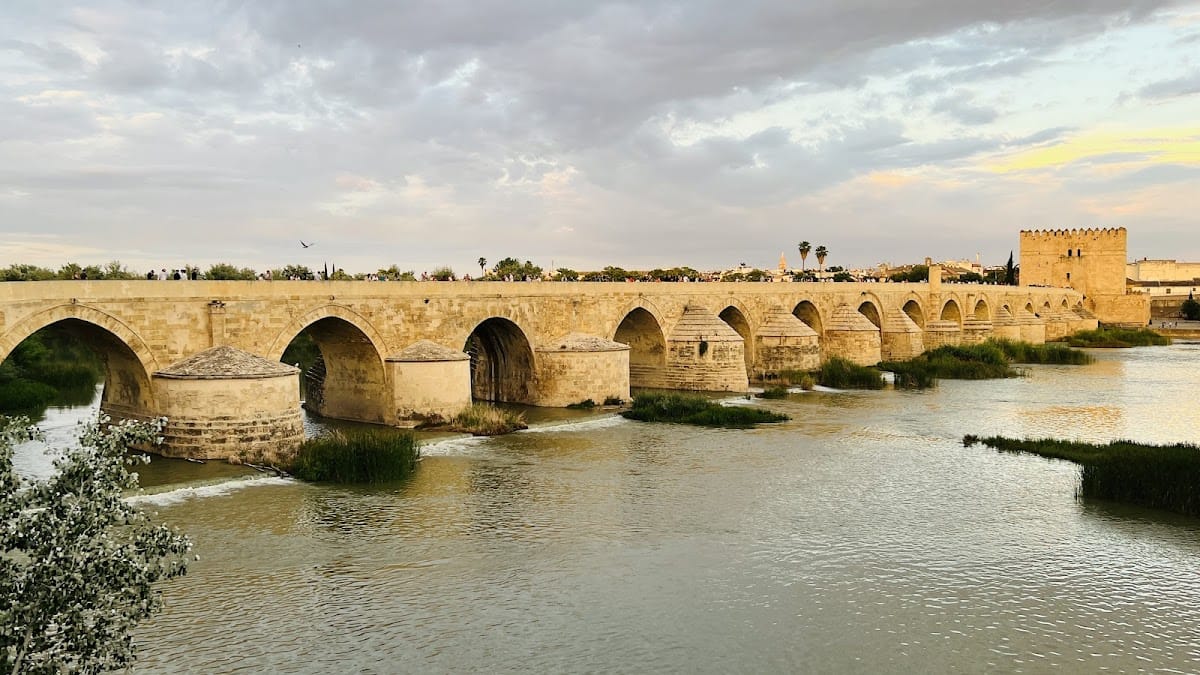
The Roman Bridge is a solid stone arch bridge extending for about 331 metres across the Guadalquivir. Its present structure contains 16 arches, compared with 17 in its earlier form, and is approximately 9 metres wide. It links the Campo de la Verdad district on the southern side of the river with the Cathedral district to the north. The Calahorra Tower stands beside its southern end, while the Puerta del Puente marks the northern end.
The bridge’s masonry incorporates the physical evidence of its long rebuilding history. Its pointed arches reflect medieval work, and only arches 14 and 15, counted from the northern gate, are identified as original. Four courses of masonry beneath the Calahorra Tower are visibly Roman. During the 2006 to 2008 restoration, the cutwaters, the projecting parts of the piers that divide and deflect flowing water, were cleaned to expose original stone blocks and recover the rough, unpolished appearance of the masonry.
The restoration also replaced the former cobbled surface with smooth granite slabs that are partly polished. Nineteenth-century street lamps were replaced by modern functional lighting, and the northern end was raised or otherwise re-leveled to align with the Puerta del Puente and the Paseo de la Ribera.
Gates, tower, and sculpture
Calahorra Tower
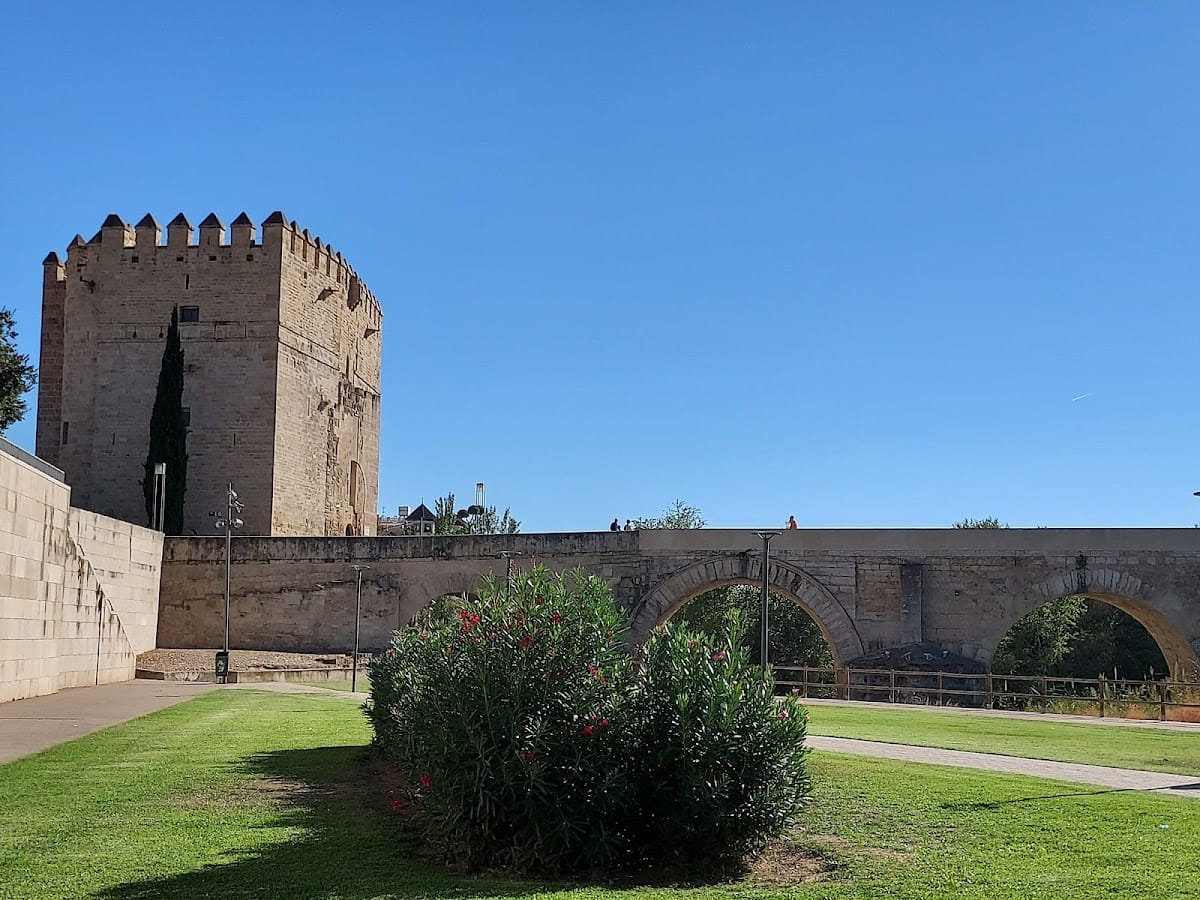
The Calahorra Tower is a defensive structure beside the southern end of the bridge. Together with a northern gate, it protected the crossing and controlled an entrance into Córdoba through the former city walls. Its position also preserves the connection between the bridge and the city’s historic fortifications.
Puerta del Puente
The present Puerta del Puente was designed by Hernán Ruiz II and built in 1572 during the Renaissance. It is sometimes known as the Arch of Triumph, although it was not constructed as a triumphal arch. The gate forms the northern architectural counterpart to the Calahorra Tower and provides the bridge’s connection with the Cathedral district.
Saint Raphael monument and niches
A monument to Saint Raphael stands at the centre of the bridge. It is the oldest of Córdoba’s monuments dedicated to the saint, dating from 1651 and made by the sculptor Bernabé Gómez del Río. The bridge’s niches, recessed spaces intended to hold statues or other objects, once contained several sculptures. The niche dedicated to Saint Acisclus and Saint Victoria was rehabilitated, while sculptures were moved from other niches, including the notably old sculpture of Saint Victoria.
River reserve and watermills
The bridge and its surroundings lie within the protected natural area of Sotos de la Albolafia. This small reserve covers slightly more than two hectares and supports about 120 bird species, including some endangered species. Its river landscape forms part of the setting in which the bridge, its piers, and nearby historic structures survive.
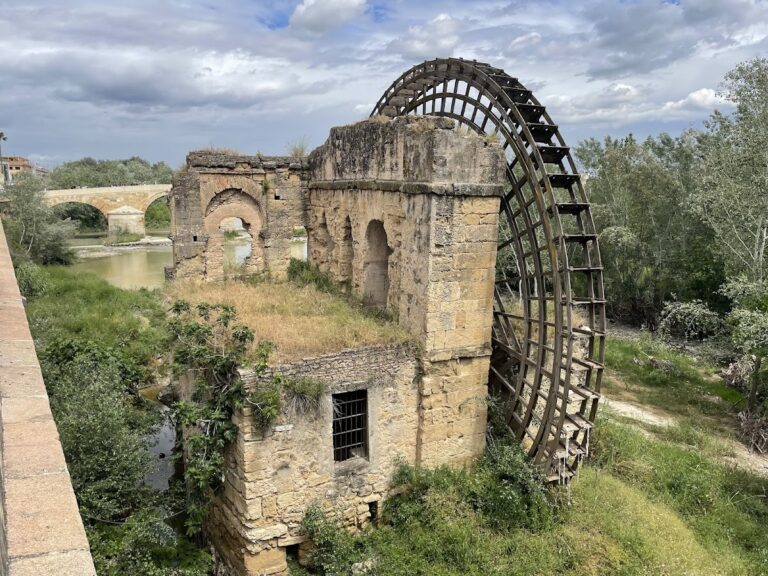
Several historic watermills remain near the bridge, including the Molino de San Antonio and the Molino de la Albolafia. The latter is represented on Córdoba’s coat of arms. These mills, together with the bridge and the river reserve, form part of the surviving physical context around the crossing.