Palace of Moncloa: Official Residence and Government Complex in Madrid


Site at a Glance
- Rating
- 4.2
- Popularity
- Low
- Country
- Spain
- Primary era
- Early Modern
- External website
- Open
- Eras represented
- Early Modern, Modern
- Civilizations
- Crown of Castile, Spanish
- Site type
- Civic
- Remains
- Palace
On this page19 sections
History
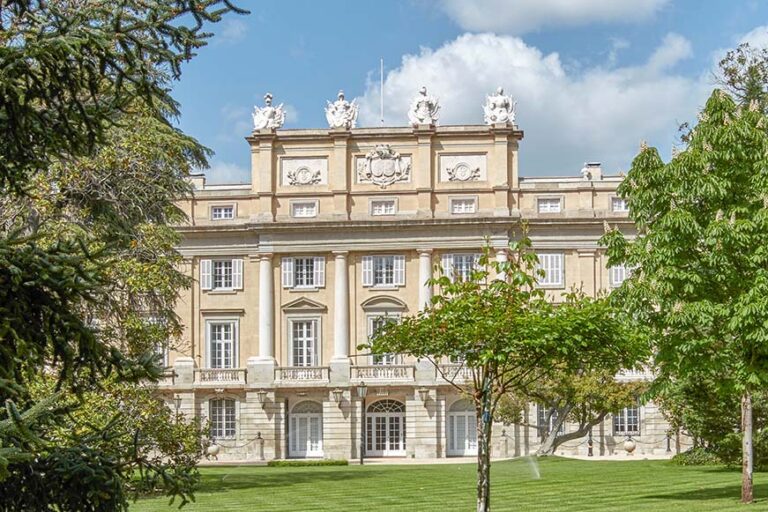
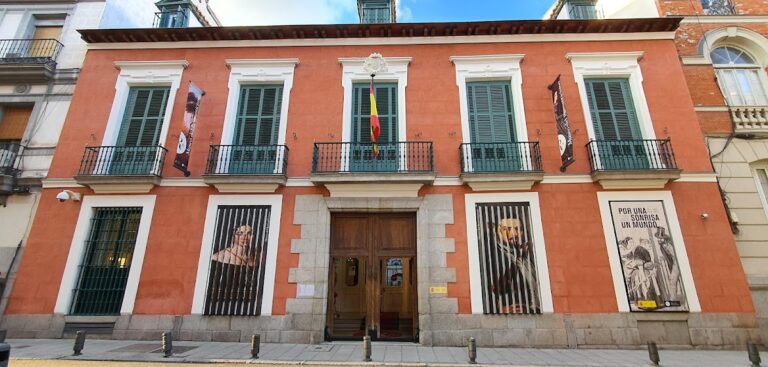
Palace of Moncloa is a neo-Herrerian palace complex in Madrid, Spain, reconstructed between 1949 and 1954 after the earlier palace was destroyed during the Spanish Civil War. Today it serves as the official residence and principal working center of Spain’s prime minister, while the wider Moncloa Complex houses offices supporting the Presidency of the Government, Spain’s central executive institution.
From Orchard to Aristocratic Estate
The site began as an agricultural estate and became a palace-house through a succession of aristocratic owners. In the early seventeenth century, it belonged to Ana de Mendoza, Countess of Cifuentes. After passing through several hands, it was acquired by Juan Croy, Count of Sora, and became known as Sora Orchard.
Gaspar de Haro y Guzmán, Marquis of Carpio and Eliche, acquired Sora Orchard and the neighboring La Moncloa Orchard in 1660. The latter name came from its former owners, the Counts of Monclova, and gradually developed into “Moncloa.” Gaspar de Haro ordered a palace on the highest part of the combined estates. It was first called Eliche Palace and was also known as the Painted House, a reference to frescoes on its exterior walls. Once the two properties had been joined, the residence became known as the Palace of Moncloa.
The estates and Gaspar de Haro’s nearby properties passed to his only daughter, Catalina de Haro, who was married to Francisco Álvarez de Toledo y Silva, 10th Duke of Alba de Tormes. Among later owners was Antonio Joaquín Guerra, Marquis of Guerra, after whom the estate was temporarily called Guerra Orchard.
Royal Ownership and the Museum
María del Pilar Ana de Silva-Bazán y Sarmiento, Dowager Duchess of Arcos, acquired the estate in 1781. When she died in 1784, it passed to her daughter, María del Pilar Teresa Cayetana de Silva Álvarez de Toledo, 13th Duchess of Alba de Tormes. The duchess is remembered as a muse of Francisco de Goya.
After the duchess died without descendants in 1802, King Charles IV acquired the palace and orchard and incorporated them into the Royal Site of La Florida. The estate thereafter became known as the Royal Site of Moncloa. In 1816, Ferdinand VII commissioned Carlos Isidro González Velázquez to restore the palace.
Queen Isabella II transferred the entire Moncloa property to the state thirty years later, and it became dependent on the Ministry of Development. Joaquín Ezquerra del Bayo carried out another restoration in 1929, after which the palace reopened as a museum. Its earlier life as an aristocratic and royal residence was therefore followed by a period in which the restored building served a public cultural purpose.
Destruction and Reconstruction
The old palace was almost completely destroyed during the Spanish Civil War, the conflict fought from 1936 to 1939 between the Republican government and forces led by Francisco Franco. The Siege of Madrid formed part of that conflict and contributed to the destruction of the earlier building.
About a decade later, Diego Méndez reconstructed the present palace between 1949 and 1954. He used the Casa del Labrador at Aranjuez, a historic royal residence, as its architectural model. The reconstructed building was inaugurated by Francisco Franco in 1953, while construction and the official opening are also dated to 1955. The result was largely a mid-twentieth-century reconstruction of the earlier palace rather than an entirely new foundation.
The reconstructed residence was initially intended to receive foreign heads of state visiting Spain and other high-ranking guests. On 3 June 1954, Rafael Leónidas Trujillo became the first foreign head of state to stay there. Carlos Andrés Pérez, who arrived on 28 November 1976, was the last foreign head of state received under this earlier function. The main bedroom, which is now reserved for the prime minister, had previously accommodated visiting leaders including Saddam Hussein in 1974, Rafael Leónidas Trujillo, Richard Nixon, and Dwight Eisenhower.
Under a law dated 15 July 1954, the palace and gardens were incorporated into Spain’s National Heritage, the public institution that administers important royal and historic properties for the state. Together, they cover 58,293.81 square meters and adjoin Madrid’s University City on all four sides. The palace and gardens are also protected as a cultural property of importance under Spanish law.
Moncloa and the Democratic Transition
In 1977, Prime Minister Adolfo Suárez moved the headquarters of the Presidency of the Government from the centrally located Palace of Villamejor to Moncloa. The relatively isolated position away from central Madrid was chosen largely for security reasons, amid concern about a possible attack on the newly appointed prime minister. The move also established an official residence for the prime minister and the prime minister’s family, which had not previously existed at the headquarters.
The original palace’s Hall of Columns witnessed the signing of the Moncloa Pacts in 1977. These agreements were concluded among trade unions, political parties, and employers’ organizations during Spain’s democratic transition from Franco’s dictatorship to constitutional democracy after Franco’s death. The name “Moncloa” consequently came to refer metonymically to the Presidency of the Government and, more broadly, to Spain’s central government, particularly in contrast with the governments of the autonomous communities.
The 1978 Constitution established a political system in which the Presidency of the Government had growing powers and responsibilities. Additional facilities were therefore built around the palace to protect the architectural integrity of the original building while accommodating government work. This development created the Moncloa Complex.
Expansion of the Government Complex
Successive prime ministers altered the complex after 1977. Adolfo Suárez added a tennis court, renovated the swimming pool, and covered the former main courtyard, which became the Hall of Columns. During Leopoldo Calvo-Sotelo’s premiership in the early 1980s, additional bedrooms and a music room were installed on the third floor.
During Felipe González’s premiership from 1982 to 1996, the grounds received a small bonsai orchard, an underground bunker was built in response to the memory of the attempted coup of 23 February 1981, and a separate Council Building was constructed to distinguish the palace’s residential and working functions. José María Aznar’s residence from 1996 to 2004 was associated with a games room and a paddle-tennis court. During José Luis Rodríguez Zapatero’s premiership, the private rooms were substantially renovated in a minimalist style, while Mariano Rajoy’s period was associated with few known changes apart from the replacement of vases.
The Council Building was completed in 1989 during Felipe González’s premiership. The Vice Presidency Building followed in 2006 during José Luis Rodríguez Zapatero’s premiership. The complex now includes the palace, Moncloa Gardens, buildings for the Council of Ministers, the Deputy Prime Minister’s Office, the Ministry of the Presidency, the State Secretariat for Communication, and the Cabinet Office of the Presidency. Security, protocol, service, health, and operational facilities are also present, together with a helipad, a shelter, and a hospital. The complex as a whole consists of sixteen buildings, a bunker, and a hospital.
Remains
The Reconstructed Palace
The present palace stands in northwestern Madrid beside the University City, in the Moncloa-Aravaca district. Its pavilion-based plan organizes the complex as separate building units and wings rather than one continuous block. The architecture is neo-Herrerian, a twentieth-century revival based on the austere forms associated with Juan de Herrera and late sixteenth-century Spanish royal architecture. The reconstruction follows the Casa del Labrador at Aranjuez and incorporates the earlier palace within its historical design.
Hall of Columns
Twelve columns from the cloister of the former Archbishop’s Palace at Arcos de la Llana in Burgos were reused during the reconstruction. A cloister is a covered walkway surrounding an open courtyard, usually associated with an ecclesiastical building. The columns had previously belonged to the summer residence of the bishops of the Diocese of Burgos and now form the Hall of Columns.
The hall occupies the position of the former interior courtyard. It was originally open to the sky, but a roof was added in 1970 for the visit of United States President Richard Nixon. The enclosed space now forms one of the wings containing the prime minister’s reception and working areas. It is also the room associated with the signing of the Moncloa Pacts in 1977.
Interior Rooms
The ground floor is used for ceremonies and official activities, while the private part of the palace occupies the upper floor of the main building. On entering the building, a reception office used by the prime minister is on the right. At the rear right is the prime minister’s working office, preceded by a library with a large window overlooking the rear garden.
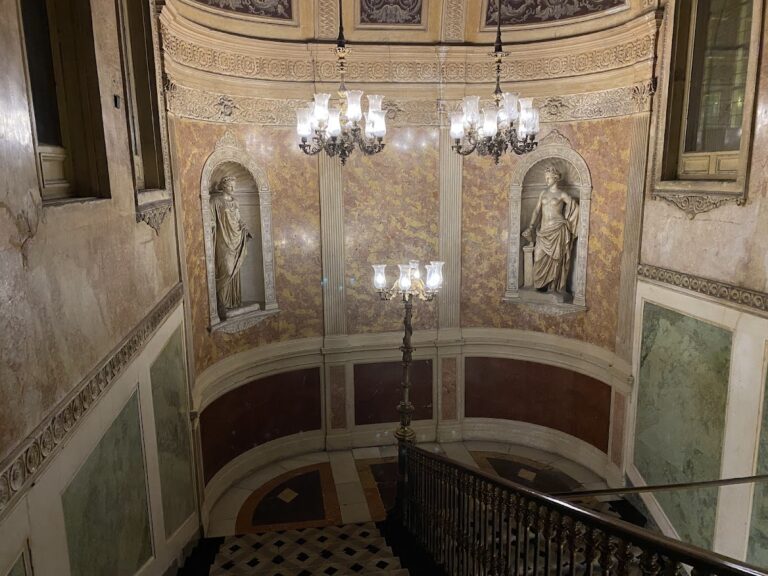
The interiors retain elements of the original Neoclassical decoration, although they were substantially remade after the war. Rooms contain paintings by Anton Raphael Mengs, Michel-Ange Houasse, Fernando Brambila, and Joan Miró. They also include furniture in several artistic styles, tapestries produced by the historic Royal Tapestry Factory, and a lamp-clock made by François-Louis Godon, an eighteenth-century clockmaker who served the Spanish kings.
Gardens and Palace Precinct
Moncloa Gardens
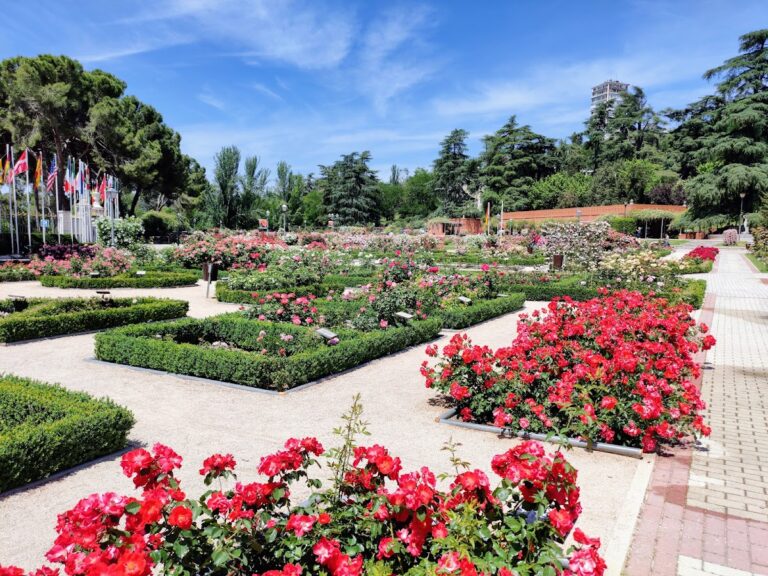
The Moncloa Gardens contain fountains, decorative sculptures, and plantings whose arrangement derives from the period of King Charles III. Their botanical design and planting are attributed to Francisco Antonio Zea, a former director of the Royal Botanical Garden. The gardens were later rehabilitated by landscape architect Javier Winthuysen, who emphasized the fountains and decorative sculptures, and underwent another major reform in the early twentieth century under gardener Cecilio Rodríguez.
Residential and Reception Areas
The palace and gardens are enclosed and separated from the rest of the complex to preserve the privacy of the prime minister and the prime minister’s family. The palace precinct includes the Council Pavilion together with offices and reception rooms used by the prime minister and close advisers. The Council Pavilion accommodates meetings of the government.
Administrative Buildings
Council Building
The separate Council Building contains the Council Room, where the Council of Ministers, Spain’s cabinet, holds its weekly meetings. It also includes the Tapestry Room, used for receptions, official events, and occasional press conferences, and the Tàpies Room, where the prime minister receives guests.
More than 140 works from the Reina Sofía Museum decorate the Council Building. Artists represented include Joan Miró, Eduardo Chillida, Julio González, Pablo Palazuelo, and Antoni Tàpies. The building also contains furniture belonging to National Heritage.
INIA Building
The INIA Building was constructed in 1953 by José Azpiroz. It formerly housed the National Institute of Agrarian Research and now houses the Ministry of the Presidency. Its resemblance to a monastery has given it the additional name “Monastery of the Presidency.” Meetings of the General Commission of Secretaries of State and Undersecretaries take place there. This body prepares matters for consideration by the Council of Ministers.
Seeds Building
The Seeds Building was constructed in 1950 as part of the Ministry of Agriculture for storing seeds. It later became the personal Cabinet of the Prime Minister’s Office.
Press Building
The Press Building was also constructed in 1950, originally as a Ministry of Agriculture laboratory for analyzing seeds. It later housed the Information Office and now contains the State Secretariat for Communication. Its Press Room provides working spaces for journalists, while its Press Centre is used by the government spokesperson and other ministers for briefings after meetings of the Council of Ministers.
Security and Service Facilities
The broader complex contains facilities for security, protocol, health services, and operational resources, as well as the Greco Building, a helipad, an underground bunker or shelter, and a hospital. These buildings and installations surround the historic palace and support its combined residential, ceremonial, and governmental functions.