Liria Palace: The Madrid Residence and Collections of the House of Alba


Site at a Glance
- Rating
- 4.3
- Popularity
- Medium
- Country
- Spain
- Primary era
- Early Modern
- External website
- Open
- Eras represented
- Early Modern, Modern
- Civilizations
- Crown of Castile, Spanish
- Site type
- Domestic
- Remains
- Palace
On this page10 sections
History
Liria Palace is an eighteenth-century neoclassical mansion in Madrid, Spain, built for the Dukes of Berwick and Liria and later becoming the principal residence, archive, and art collection of the House of Alba. Its design followed the French petit hôtel, a detached urban mansion set back from the street, and construction was completed in 1785.
The Berwick and Liria Foundation
The palace was commissioned by Jacobo Francisco Fitz-James Stuart y Colón de Portugal, 3rd Duke of Liria, whose family held the titles of Berwick, Liria, and Jérica. The first Duke of Berwick, James Fitz-James, was the illegitimate son of James II of England. After supporting Philip of Bourbon during the War of the Spanish Succession, the conflict that established Bourbon rule in Spain, he received the duchies of Liria and Jérica and the Order of the Golden Fleece from Philip V after the Battle of Almansa in 1707.
The Dukes of Liria selected a site near the Royal Alcázar and the newly built Conde-Duque barracks, where troops of the Guardia de Corps protected the royal family. Its position within an enclosed parcel and away from the street may have reflected the security concerns associated with this military setting. The palace took its name from Liria in Valencia, where the duke’s son, Carlos Bernardo Fitz-James Stuart y Silva, 4th Duke of Liria and Jérica, was born after his parents had lived there between 1751 and 1753.
Construction began around 1767. The French architect Louis Guilbert designed the building, but he was dismissed in 1771 after defects including cracks appeared and suspicions of embezzlement arose. Ventura Rodríguez, a leading Spanish architect of the period, then took over the work. Earlier histories attributed the principal design to Rodríguez, while later assessments regard Guilbert as the main designer and Rodríguez as the architect who corrected the technical problems. The completed residence was praised by Joseph Townsend in 1786 and by William Beckford in 1787. Its salons hosted music, drawing sessions, and dinners that continued until dawn.
Union with the House of Alba
A major change came in 1802, when María del Pilar Teresa Cayetana de Silva y Álvarez de Toledo, 13th Duchess of Alba and the sitter associated with Goya’s portraits, died without children. Her relative Carlos Miguel Fitz-James Stuart y Silva inherited the Alba and Berwick titles, becoming the 14th Duke of Alba and 7th Duke of Berwick. Liria thereafter served as the family’s principal residence in Madrid.
The inheritance was complicated by litigation because Cayetana had distributed much of her property among friends. Carlos Miguel received only 32 paintings from the Alba collection, while other works passed to Manuel Godoy and later to museums outside Spain. The family also did not inherit the Alba residences of Buenavista and Moncloa.
Carlos Miguel enlarged the collection during a nine-year journey through Europe. He acquired about 200 paintings, including works by old masters, along with sculptures, Roman antiquities, and Greek ceramics. The cost created serious debts, and he was forced to sell more than 80 works, including tapestries representing Raphael’s Acts of the Apostles. Further sales took place in Paris in 1840 and 1877, although other paintings remained with the family or were later reacquired.
The palace’s historical archive had already suffered a major loss when a fire on 19 March 1833 destroyed part of it. Around 1900, the building underwent limited alterations associated with Edwin Lutyens, the English architect and urban designer. Eugenia de Montijo, former Empress of France and a relative of the Alba family, died at Liria in 1920. Her inheritance added paintings, decorative objects, jewellery, Sèvres porcelain, an Empire-style writing table, and a diamond-and-pearl tiara to the collections.
Destruction and Reconstruction
At the beginning of the Spanish Civil War, the palace was seized by Communist Party militias for protection. It was temporarily used for cultural visits and lectures, but incendiary bombs and fire devastated the building on 17 November 1936. Aircraft belonging to the Francoist side caused the damage, although Francoist propaganda later blamed the Republicans. Only the façades remained standing.
Household employees and Republican volunteers removed furniture, tapestries, carpets, arms, porcelain, silver, and other objects from the burning palace. Paintings and important documents had already been moved to safer buildings, including the Bank of Spain and the British Embassy. Fire and rain nevertheless destroyed or damaged much of the collection of about 6,000 prints and drawings.
During the war, the rescued works were moved through Valencia and eventually to Geneva as part of the wider evacuation of Spain’s artistic heritage. They returned to Madrid nearly three years later. The collection remained under state heritage protection after its return, while the Alba family gradually reassembled it between 1939 and 1944.
Reconstruction took place from 1948 to 1956 under Manuel Cabanyes Mata, using earlier plans by Lutyens. The project was promoted by Cayetana Fitz-James Stuart, 18th Duchess of Alba, and her first husband. Cayetana retained the property in accordance with a promise made to her father. The rebuilt palace was inaugurated on 13 June 1956, with new rooms organized around the collections, including the Stuart, Italian, Grand Duke, Spanish, and Goya salons.
Residence, Museum, and Archive
After reconstruction, Liria Palace resumed its place in Madrid’s social life and remained the property and official residence of the head of the House of Alba. The Casa de Alba Foundation was established in 1973 to manage the family’s historic properties and collections. Liria was declared a Site of Cultural Interest in 1974 and began regular public visits in 2019 while continuing to function as a residence, museum, and archive.
The private collection brings together material inherited from the Berwick, Alba, Lerín, Lemos, Carpio, Olivares, Ayala, and Híjar families. Works from the palace have also been lent to exhibitions in Madrid, Barcelona, Seville, Dallas, and Nashville. These loans included about 40 works shown in Seville in 2009 and 2010, around 150 in Madrid in 2012, and about 130 in Dallas in 2015 before the exhibition moved to Nashville in 2016.
Remains
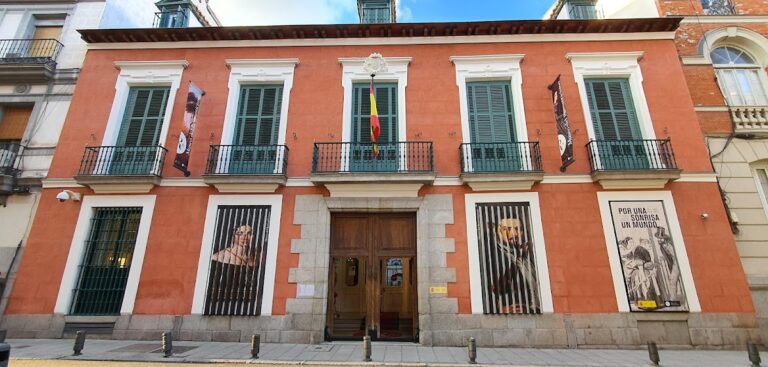
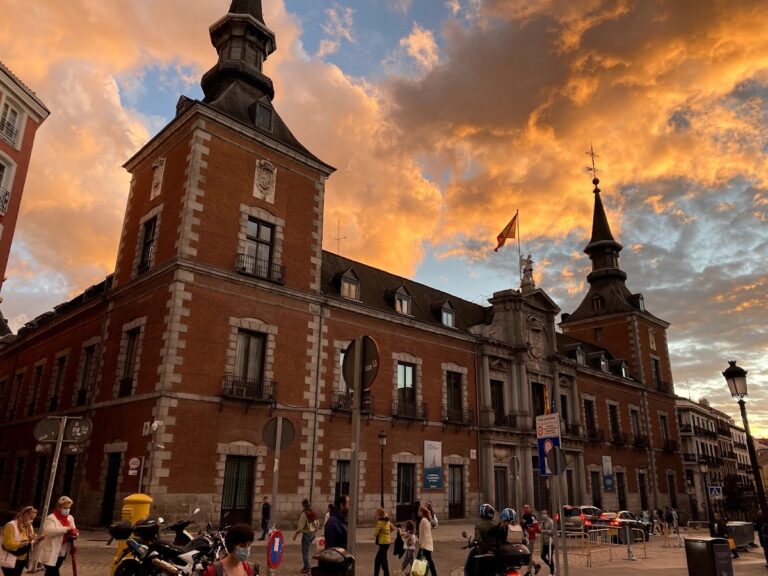
Liria Palace occupies a broad enclosed parcel at 20–22 Calle de la Princesa, in the former Barrio de los Afligidos. The independent neoclassical building covers approximately 3,500 square metres and contains 200 rooms, including 26 salons. Its elongated rectangular plan differs from the squarer arrangements and large inner courtyards common in many Spanish palaces. Two long façades face Calle de la Princesa and the private garden, forming a symmetrical architectural framework for the grounds.
Building and Interior Arrangement
The principal façade is organized horizontally into three zones. Rusticated stonework forms the lower level, two storeys of windows and balconies occupy the middle, and a broad upper frieze or architrave of windows may conceal the roof. Vertically, the elevation is divided into five parts. Four columns mark the central tetrastyle section, which is crowned by a heraldic belfry-like feature. Wider window-and-balcony sections with giant-order pilasters flank it, while paired pilasters terminate the outer sections. The garden façade follows the same composition but replaces the upper feature with four sculptural trophies. The side elevations are more restrained, with their lower storey partly buried by the slope of the ground and stairways linking them to the gardens.
The representative rooms are concentrated on the noble first floor and arranged enfilade, in a sequence of aligned rooms, with balconies facing the gardens. These salons were intended mainly for displaying the family collections. The ground floor contains the entrance hall, principal staircase, chapel, and a large library. The library occupies much of the right side of the main façade and is described as holding about 9,000 books, while the palace’s wider bibliographic holdings number about 30,000.
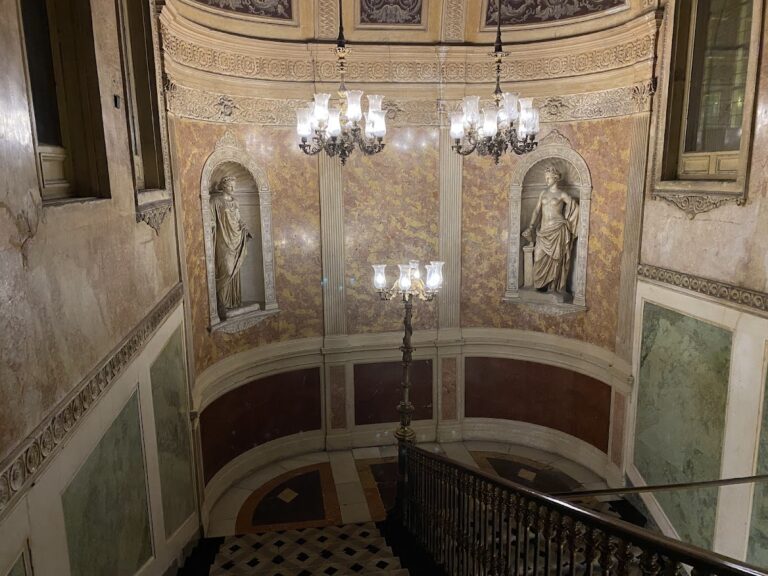
The principal staircase was rebuilt after the Civil War as a wider single-flight stair with columns and balusters. Later neo-Baroque alterations affected the entrance hall and staircase. The chapel, partly collapsed in the 1936 fire, was reconstructed with an incomplete version of its earlier decoration. Its surviving furnishings include paintings by Josep Maria Sert and a seventeenth-century altarpiece from the House of Sotomayor.
The reconstructed interiors contain moulded and coffered ceilings, parquet floors, fabric-covered walls, marble fireplaces, large chandeliers, and Rococo-style furniture. Marble and mosaic work on the entrance floor bears the year 1953, referring to the death of the 17th Duke of Alba rather than to the completion of the reconstruction. The rebuilt library has wooden shelving and furniture painted green to imitate the lost malachite finishes. Its fittings combine open shelves above with lower cupboards supporting document cases.
Gardens and Grounds
The gardens occupy one of the largest private historic garden areas in central Madrid. The front garden was probably once a cleared ceremonial forecourt, or cour d’honneur, and was later planted with trees in the Romantic English manner. Behind the palace, the garden retains a geometric design inspired by Versailles, with clipped hedges and parterres. Eighteenth- and nineteenth-century changes were followed by a 1915 redesign of the rear garden by Nicolas Forestier, who introduced circular and elliptical beds and reorganized its sides.
A central fountain existed during the early development of the grounds, although it does not appear on some plans from 1761. The gardens also contain an eighteenth-century sculptural group around a pond, largely intact sphinxes, and sculptures of fantastic animals. A small cemetery contains the family’s dogs, buried beneath inscribed stones. Near the entrance stands a guard building attributed to Lutyens. A kidney-shaped pool added during the 1950s was among the early installations of its kind in Madrid.
Paintings, Prints, and Decorative Arts
The palace contains approximately 350 paintings, including portraits of successive dukes spanning five centuries. Important works include Goya’s The Duchess Cayetana in White, a traditional portrait of the 3rd Duke of Alba now attributed to Antonio Moro, and Ignacio Zuloaga’s equestrian portrait of Cayetana Fitz-James Stuart at the age of three.
The Italian paintings include works attributed to or associated with Pietro Perugino, Andrea Previtali, Mariotto Albertinelli, Pordenone, Lavinia Fontana, Giuseppe Cesari, Guido Reni, Guercino, Carlo Maratta, and Francesco Guardi. A small painting of the Christ Child embracing a lamb is regarded as probably having come from Leonardo da Vinci’s workshop. A large Last Supper, once attributed to Palma il Vecchio or treated as uncertain, was identified by an Italian expert as an original work by Titian and lent to an exhibition in Belluno in 2007. A portrait of a young man by Palma il Vecchio is also regarded as one of the collection’s finest paintings.
The Flemish and Dutch holdings include landscapes by Jacob van Ruisdael, Simon de Vlieger, and Willem van de Velde the Younger, as well as works by Rubens, Gaspar de Crayer, Paul van Somer I, David Teniers the Younger, Cornelis de Vos, and Jan Brueghel. A Landscape with Ruins traditionally attributed to Rembrandt remains unconfirmed. Spanish works are associated with El Greco, Murillo, Zurbarán, Ignacio Iriarte, Francisco Rizi, and José de Ribera. Recent analysis regards the Portrait of the Infanta Margarita, traditionally attributed to Velázquez, as a replica by an assistant, while a Saint Onuphrius once associated with Ribera is considered an imitation by Luca Giordano.
The French and British collection includes Ingres’s The Imposition of the Golden Fleece on the Duke of Berwick of 1818, described as the only painting by Ingres in Spain. Other works are by Mengs, Winterhalter, Reynolds, Romney, Raeburn, Gainsborough, and George Stubbs. Paintings added between the 1950s and 1970s include works by Corot, Eugène Boudin, Henri Fantin-Latour, Renoir, Picasso, Joan Miró, and Salvador Dalí. About thirty prints by artists including Mantegna, Dürer, Van Dyck, and Rembrandt survive from the much larger group damaged or destroyed in the 1936 fire.
More than forty tapestries remain in the palace. They include a fifteenth-century Fight between Greeks and Amazons and the Death of Queen Penthesilea, from a cycle on the Trojan War, and three works from Willem de Pannemaker’s workshop depicting the Battle of Jemmingen of 1568. Three tapestries based on designs by François Boucher hang in the room of the Loves of the Gods. Four large Gobelins tapestries showing exotic animals were presented to the 12th Duke of Alba by Louis XV when the duke was Spanish ambassador in Paris. Two further tapestries depict Napoleon III and Eugenia de Montijo in full length.
Library, Archive, and Sculpture
The library and archive preserve 21 manuscript documents associated with Christopher Columbus, including six letters and a drawing of the coast of Hispaniola. Other holdings include a record of sailors who accompanied Columbus, including the Pinzón brothers; the last will of Ferdinand the Catholic dated 22 January 1516; the marriage capitulations of Joanna of Castile and Philip the Handsome; letters by Titian, Elizabeth I of England, and the Count of Aranda; the autograph will of Philip II; a manuscript by Rousseau; a 1537 grant of arms from Charles I of Spain to Francisco Pizarro; a first edition of Don Quixote; papal documents; and the fifteenth-century Alba Bible.
The sculpture collection includes Hellenistic and Roman works such as a statue of Venus Genetrix, together with sculptures and busts by José Álvarez Cubero, Antonio Solá, Lorenzo Bartolini, and Mariano Benlliure. It also contains two porcelain busts of the Count of Aranda and a clay model by Aniceto Marinas for his monument to Velázquez. A cuirass associated with the Count-Duke of Olivares is preserved in the palace and may be the armour reproduced by Velázquez in his celebrated equestrian portrait.
The rooms are arranged partly by collection and historical association. Italian, Flemish, and Spanish paintings occupy separate rooms, while the ballroom evokes the Second French Empire through tapestries and Sèvres porcelain. The room dedicated to the 3rd Duke of Alba was arranged to recover its pre-fire appearance. Among the unusual objects is a sixteenth-century wooden sculpture showing the duke spearing a hydra whose heads represent Elizabeth I of England, the Elector of Saxony, and Pope Paul IV.