Lubomirski Palace in Lublin: A Historic Government and University Building

Site at a Glance
- Rating
- 4.5
- Popularity
- Very Low
- Country
- Poland
- Primary era
- Modern
- Eras represented
- Early Modern, Modern
- Civilizations
- Polish–Lithuanian Commonwealth, Russian
- Site type
- Domestic
- Remains
- Palace
On this page7 sections
History
Lubomirski Palace in Lublin, Poland, is a historic residence and public building whose origins reach back to the sixteenth century. Built as a Renaissance manor, it later became a Baroque palace and acquired its present Neoclassical appearance with Empire elements after a reconstruction in the nineteenth century. Its history is closely connected with aristocratic families, governmental institutions, military authorities, and the restoration of Polish independence in 1918.
From Renaissance Manor to Baroque Palace
The property began as a Renaissance manor belonging to the Firlej family. It later passed to the Ostrogski family and entered the possession of the Lubomirski family through the marriage of Teofila Ludwika Ostrogska to Crown Grand Marshal Józef Karol Lubomirski.
Toward the end of the seventeenth century, the manor was rebuilt as a Baroque palace. Baroque architecture, a style associated with dramatic forms, strong visual effects, and elaborate decoration, shaped the redesign by Tylman van Gameren, a Dutch-born architect active in the Polish-Lithuanian Commonwealth. In 1727, through Anna Maria Lubomirska, the palace became the property of Paweł Karol Sanguszko.
Fire, Neglect, and Government Use
Neglect gradually weakened the palace. In 1768, during the Bar Confederation, an armed movement of Polish nobles formed against Russian influence and the policies of King Stanisław II Augustus, a fire affecting Krakowskie Przedmieście damaged the building. It was not repaired at once, and in the 1780s the property passed to the Szeptycki family.
In 1801, the severely damaged palace was purchased at auction by the mayor Beniamin Finke, who transferred it to the government. The building was then renovated for use as a military hospital, also known as a lazaret, a hospital intended for sick or wounded soldiers.
In 1822, Józef Zajączek, the viceroy of the Kingdom of Poland, designated the palace as the seat of the Commission of the Lublin Voivodeship. Józef Zajączek was a Polish military commander and politician who held the office of viceroy. The building was altered to a design by Jan Stompf, including the addition of another storey.
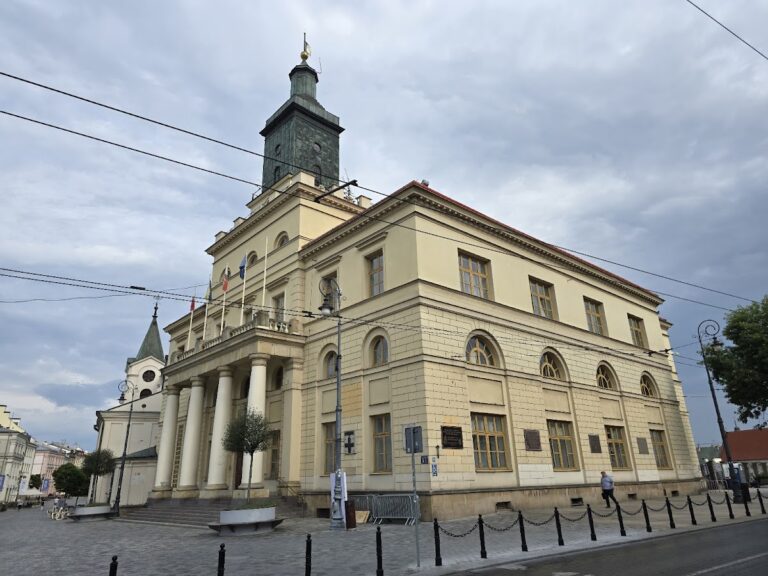
A further fire in 1829 led to another rebuilding, designed by Henryk Marconi. This work gave the palace its present external appearance. Neoclassicism revived the architectural language of ancient Greece and Rome, while the Empire style represented its more monumental early-nineteenth-century expression.
Political and Institutional History
During the partitions, the late-eighteenth-century divisions of the Polish-Lithuanian Commonwealth among Russia, Prussia, and Austria, the palace housed the seat of the Russian governor-general and, from 1915, the Austrian governor-general.
On the night of 6–7 November 1918, the government of the Republic of Poland known as the People’s Government was established in the palace under Ignacy Daszyński. Daszyński was a Polish socialist politician and statesman who headed this short-lived government in Lublin. A plaque beside the main entrance commemorates the event.
From 1918, the palace housed the command of the Lublin Garrison District and the command of Corps District No. II. General Mieczysław Smorawiński also lived there. During the interwar period, institutions of the Voivodeship Office occupied the building.
After the Second World War, the palace was transferred to Maria Curie-Skłodowska University, a public university in Lublin founded in 1944. Its Faculty of Political Science used the building until 2020. In 2017, the Ministry of Culture and National Heritage purchased the palace to establish the Museum of the Eastern Lands of the Former Polish-Lithuanian Commonwealth. The current owner is the National Museum in Lublin.
Remains
Lubomirski Palace stands at Litewski Square 3 in Lublin, between Czartoryski Palace and the Governor’s Palace. Its surviving form reflects several major building phases. The structure began as a Renaissance manor, was transformed into a Baroque palace toward the end of the seventeenth century, and was then reshaped into a two-storey Neoclassical building with Empire elements after the nineteenth-century reconstruction.
Palace Form and Transformations
The Baroque palace designed by Tylman van Gameren was a single-storey building with a high roof. Jan Stompf’s 1822 alteration added a further storey, creating the building’s present two-storey arrangement. The 1829 rebuilding by Henryk Marconi established the external appearance that defines the palace today.
Entrance Plaque
The main entrance carries a commemorative plaque marking the establishment of the People’s Government of the Republic of Poland in the palace on the night of 6–7 November 1918. The plaque connects the surviving entrance with one of the building’s most important political events.