Kozłówka Palace: A Baroque Aristocratic Residence and Museum in Poland


Site at a Glance
- Rating
- 4.8
- Popularity
- Medium
- Country
- Poland
- Primary era
- Early Modern
- External website
- Open
- Eras represented
- Early Modern, Modern
- Civilizations
- Polish–Lithuanian Commonwealth, Russian
- Site type
- Domestic
- Remains
- Palace
On this page9 sections
History
Kozłówka Palace is an eighteenth-century palace and park complex in Poland, built for the Polish–Lithuanian Commonwealth official Michał Bieliński between 1736 and 1742. Located in Kozłówka, about 9 kilometres west of Lubartów, it was designed in the Baroque style, an ornate European tradition of the seventeenth and early eighteenth centuries. Its layout followed the entre cour et jardin plan, placing the principal building between an entrance court and a formal garden.
The Bieliński and Zamoyski Estate
Michał Bieliński, voivode of Chełmno, commissioned the palace from the Italian architect Józef II Fontana. The design combined European artistic ideas with older Polish building traditions. The result was a residence organized around a formal court and garden, establishing the arrangement that shaped the estate’s later development.
The Zamoyski family acquired Kozłówka in 1799 and retained ownership until 1944. Under Konstanty Zamoyski, the palace became the family’s principal residence and was remodelled as a monumental, representative aristocratic home. A major rebuilding and modernization campaign began in the late nineteenth century and continued until 1914. The Neo-Baroque phase, a later revival of Baroque forms, is dated to 1879–1907 and brought new facilities and modernized services to the estate.
In 1903, Tsar Nicholas II, the last emperor of Russia, established the Kozłówka entail. This legally protected the estate from division or sale and required it to pass intact to the eldest heir. The palace also had a connection with Polish sport. In 1928, Adam Michał Zamoyski organized a training camp in the gardens for the Polish national gymnastics team preparing for the Summer Olympics in Amsterdam. He was chairman of the Polish Gymnastics Society Sokół.
War, State Ownership, and Museum Use
In July 1944, part of the palace’s furnishings and collections was moved to Warsaw to protect it from looting. The transferred objects included miniatures, medallions, porcelain, ivory objects, family memorabilia, and works of art. They were later destroyed during the Warsaw Uprising. Around 20 July, the Red Army occupied Kozłówka, and the palace temporarily served as quarters for a commander. A Soviet officer reportedly protected the furnishings and collections that remained in the building from destruction and looting.
After Count Aleksander Zamoyski and Countess Jadwiga Zamoyska left in November 1944, the palace became state property. It later served, among other purposes, as a storage repository for the Ministry of Culture and Art. The palace became a museum in 1979 and has housed the Zamoyski Family Museum in Kozłówka since 1992. In 2007, the palace and park complex received designation as a Polish Historic Monument, a national heritage status reserved for places considered especially important to Poland’s cultural heritage.
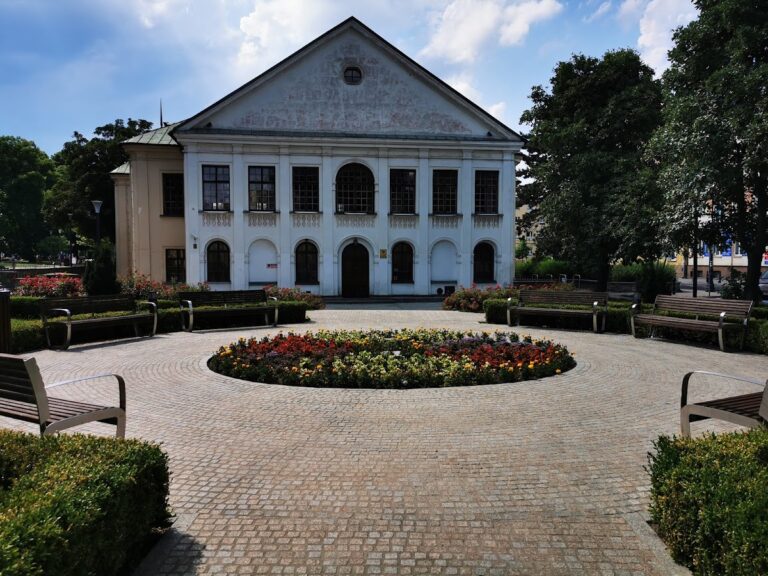
The former carriage house now accommodates the Gallery of Socialist Realist Art. Socialist Realism was the officially promoted artistic doctrine of communist states and was especially prominent in Poland during the early postwar decades. The gallery’s collection, formed mainly in the first half of the 1950s, contains more than 1,600 sculptures, drawings, paintings, prints, and posters, including works by leading Polish artists of the period. Outdoors, the presentation includes dismantled monuments of Bolesław Bierut, Vladimir Lenin, and Julian Marchlewski. Recorded communist-party speeches, newsreel excerpts, and songs including “The Internationale” also form part of the presentation.
Remains
Palace and Garden Complex
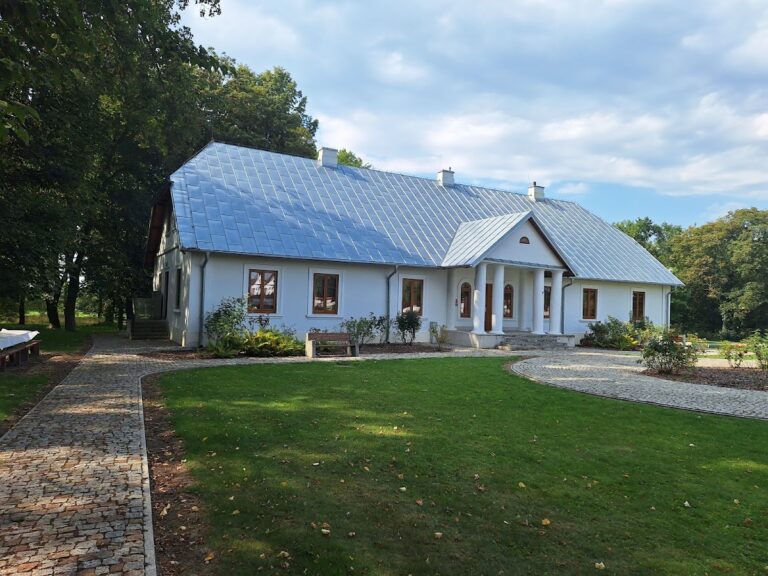
Kozłówka Palace remains a large Baroque complex with later Rococo, Neo-Baroque, and Neoclassical elements. The original plan placed the main building between the entrance court and the garden. The grounds include a French Baroque garden, the historic chapel, stables, a carriage house, and a monument to Napoleonic soldiers. Decorative and heraldic details include the Jelita coat of arms on the fronton and a projecting section bearing the Jelita and Pilawa coats of arms.
Main Palace
The late nineteenth- and early twentieth-century rebuilding added a columned portico supported by arcades to the front of the main body. Tall side towers contained large water tanks, while bathrooms were installed on the ground and first floors. A distinctive sewer system from the turn of the nineteenth and twentieth centuries supported the installation of these early modern bathrooms. The work also added or altered the theatre, a second outbuilding, and the entrance gate. A garden terrace with stairs leading toward the park was constructed during this period and demolished after the Second World War.
Chapel
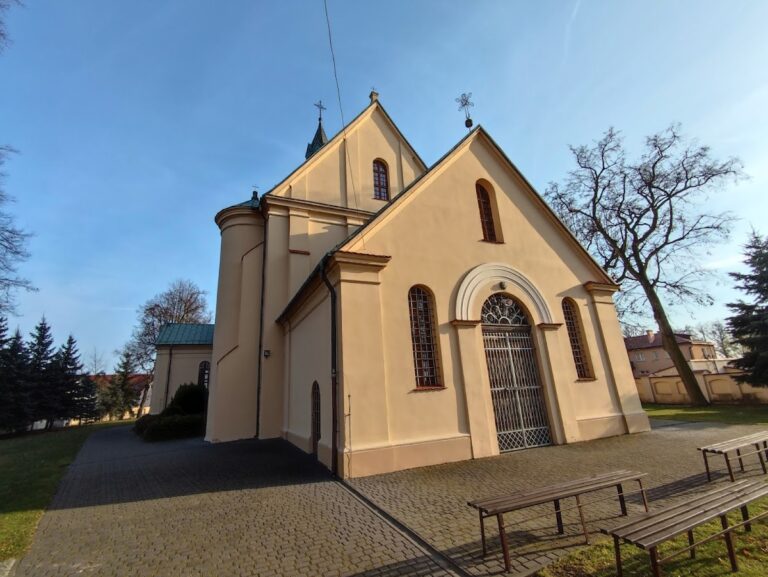
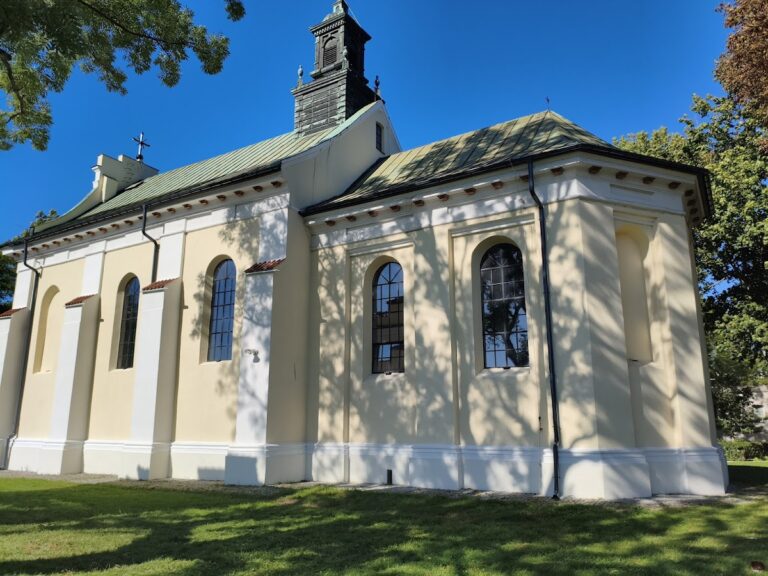
The chapel was remodelled during the rebuilding campaign on the model of the chapel at Versailles. It contains a copy of the tombstone of Zofia Zamoyska, who belonged by birth to the Czartoryski noble family. The chapel forms part of the surviving group of historic buildings within the palace grounds.
Interiors
The palace interiors retain an authentic late-nineteenth- and early-twentieth-century appearance. Neo-Baroque and Neo-Regency ceiling panels, based on Baroque and Regency design, accompany stoves made with Meissen tiles, marble fireplaces, and oak parquet floors. Jan Heurich the Younger designed the ceiling panels. The interiors are exceptionally well maintained and retain an unusually high degree of authenticity, a quality described as rare in Europe.
Paintings, furniture, sculptures, mirrors, carpets, porcelain, gilded-bronze objects, and silverware preserve the character of the former residence. The paintings consist predominantly of family portraits and copies of European masterpieces, with many portraits showing members of, or people associated with, the Zamoyski family. The collections also include works attributed to or associated with M. Willmann, J. Lampi, J. Buchbinder, Wilhelm Kotarbiński, and S. L. W. Norblin.
Carriage House Gallery
The former carriage-house building contains the Gallery of Socialist Realist Art, whose collection includes more than 1,600 sculptures, paintings, drawings, prints, and posters dating mainly from the first half of the 1950s. The outdoor display extends the gallery’s subject through dismantled monuments of Bolesław Bierut, Vladimir Lenin, and Julian Marchlewski, while recorded speeches, newsreel excerpts, and songs provide additional elements of its presentation.