Orava Castle: Medieval Frontier Fortress and Regional Administrative Center in Slovakia


Site at a Glance
- Rating
- 4.8
- Popularity
- Very High
- Country
- Slovakia
- Primary era
- Medieval
- External website
- Open
- Eras represented
- Medieval, Early Modern, Modern
- Civilizations
- Habsburg, Hungarian
- Site type
- Military
- Remains
- Castle
On this page19 sections
History
Orava Castle is a medieval and Renaissance fortress in Slovakia, built by the rulers and nobles of the Kingdom of Hungary to defend the northern frontier and the trade route to Poland. Rising above the Orava River, it also became the administrative center of the Orava region. Its foundation is undocumented, although construction probably followed the Mongol invasion of 1241, during the period when King Béla IV promoted the building and rebuilding of castles. Archaeological evidence points to prehistoric occupation of the rocky outcrop and to the arrival of Slavic settlers in the ninth century.
Royal Castle and Frontier Administration
The Balassa family were the first known owners. The earliest written reference dates from 1267, when Béla IV acquired the castle from Mikó Balassa, apparently in exchange for Varín, Žilina, and Sučany. For a time, Orava functioned as a royal castle under a castellan or county governor, an official responsible for managing the stronghold and its surrounding district.
In 1298 the castle was granted to Matthew Csák of Trenčín. After his death, Dancs-Master administered Orava and the Orava district for two decades as Count of Orava. King Charles Robert appointed Count Leopold of Kremnica to the same office in 1331 and made him castellan in 1335. Leopold held both responsibilities until 1349. By 1370, Orava had become a central seat of regional administration.
King Sigismund pledged the castle to Stibor of Stiboricz in 1420. Following the death of Albert of Austria in 1439, Jan Jiskra of Brandýs took control of much of the surrounding region but did not capture Orava. From 1441, Peter Komorowski, Count of Liptov and Orava, held the castle and used it as a base during a political and military struggle that threatened much of Upper Hungary for about twenty-five years.
Komorowski eventually surrendered Orava, together with its Orava and Liptov estates, to King Matthias Corvinus for 8,000 gold pieces. Matthias, a fifteenth-century Hungarian king who strengthened royal authority and maintained the professional Black Army, recruited some of the experienced garrison into his own service. Komorowski received the Żywiec estates from the Polish king Casimir IV Jagiellon as compensation.
Late Medieval Rulers and the Várday Tradition
Matthias Corvinus appointed Thomas of Kamenica as Count of Orava and Horvát Kiszewicz of Lomnica as castellan. In 1482 he granted Orava and Liptov to his illegitimate son John Corvinus, who became their count. Emeric Zápolya became castellan in 1484. The Zápolya family was a powerful Hungarian noble house whose leading members later contested the crown after the Battle of Mohács.
In the same year, Matthias imprisoned Peter Várday, Archbishop of Kalocsa and royal chancellor, at Orava for a reason that remains uncertain. A tradition preserves a sentence attributed to the king: “You were an orphan, Peter; you will be an orphan and will die in Orava.” The historical account holds that Várday was released only after Matthias’s death.
A later legend offers a more elaborate version. It says that Várday was confined for nine years in a chamber without windows, under the custody of the castle governor Mihály Meskó. Meskó’s daughter Katinka secretly learned reading, writing, and prayer from the prisoner. She then arranged for a breach to be made in the wall and led him in disguise to a monastery in Galicia. According to the tradition, Matthias spared Meskó after the escape, granted him Orava Castle, and arranged Katinka’s marriage to his soldier István Thurzo. The legend says that Várday died in exile.
Habsburg Rivalry and the Thurzo Estate
After the Battle of Mohács in 1526, which created a succession crisis and divided the Kingdom of Hungary between supporters of John Zápolya and Ferdinand of Habsburg, Orava became involved in the wider conflict. Peter and Nicholas Kostka defended the castle for the Zápolya side against attacks by the imperial general Katzianer. Ferdinand granted Orava to Alexius Thurzo in 1527, although the grant had no immediate effect because Ferdinand did not control the castle.
Ferdinand granted Orava to Jan of Dębowiec in 1534. Jan brought relatives and associates from Silesia, including Wacław Siedlnicki, and strengthened the castle in response to the Ottoman threat. Extensive alterations took place between 1539 and 1543. After Jan’s death in 1545, Siedlnicki inherited his position. In 1549 Ferdinand incorporated Orava into his own domains and leased it to Siedlnicki for 18,337 gold florins. In 1556 Siedlnicki had to surrender the castle to Francis Thurzo, Alexius’s brother.
The Orava estate then included six market towns, seventy-five villages, and about 74,000 acres of forest. The Thurzo family retained it until estates were nationalized after the Second World War. Francis Thurzo made the castle more comfortable as a residence while reinforcing its defenses. His son George continued the building program and remained loyal to Emperor Rudolf II during anti-Habsburg uprisings. In 1606 Rudolf rewarded him with the castle, the estate, and the office of county governor, making Orava the Thurzo family seat.
Co-Ownership and Anti-Habsburg Conflict
George Thurzo’s widow, Elizabeth Cobor, administered the property from 1616, followed by their son Imre after he reached adulthood. Imre supported an anti-Habsburg conspiracy and died in 1621, ending the male line of the Thurzo family at Orava.
After Elizabeth’s death in 1626, the estate passed to the couple’s seven daughters and their husbands. On 5 July that year, they established the Orava co-ownership estate, or komposesorat, a form of inherited joint ownership in which several heirs administered the property together. It covered almost the whole of Orava and part of the Western Tatras. Gaspar Illésházy managed the estate from 1626 to 1648, and Stefan Thököly took over in 1653.
Thököly was accused of involvement in the Wesselényi conspiracy against Emperor Leopold I. Although he denied the charge and swore loyalty, his property was confiscated, and he became a symbol of anti-Habsburg resistance. Imperial forces began to besiege Orava on 28 November 1670. The garrison opened the gates only after Thököly’s death. In 1672, peasants led by Gaspar Pika briefly seized the castle before imperial troops retook it.
Imre Thököly captured Orava in 1678. During the Rákóczi uprising, a revolt against Habsburg rule, forces commanded by Charles Alexander took the castle in 1703 and held it against the imperial army until the garrison surrendered in 1709. Following the peace settlement of 1711, control of Orava and the co-ownership estate returned to the Thurzo heirs.
Fire, Museum, and Modern Restoration
War damage, population flight, and declining population weakened the estate’s income. State officials administered it from 1764 for nearly two decades. Nicholas Esterházy became administrator in 1782 and Francis Zichy in 1792. Their alterations helped remove the castle’s defensive character and adapt it to later residential and administrative use.
A major fire began on 18 April 1800 and destroyed the wooden parts of the complex over several days. Francis Zichy protected part of the castle from further deterioration, but much of the ruined complex remained damaged for about sixty years. The castle also served as a severe prison for Tatra brigands during this period.
In 1868 Edmund Zichy ended the prison’s use and founded the Museum of the Orava Co-ownership Estate, one of the first museums in Slovakia. Its collections included weapons and armor from the former arsenal, furnishings, and wooden models of regional houses, sawmills, watermills, fulling mills, and water barriers. The collections opened to the public in 1868, and their first catalogues appeared in the 1890s.
Paul Esterházy administered the castle from 1894 to 1896. His successor, József Pálffy, held the position from 1896 to 1919 and carried out extensive repairs and restoration that substantially changed the interiors and renewed much of the complex. The First World War interrupted museum work and restoration. After the Treaty of Trianon, Orava became part of Czechoslovakia, and restoration resumed during the interwar period after the Czechoslovak state acquired more than half of the co-ownership shares.
After the Second World War, former German and Hungarian estates in Slovakia were nationalized, and Orava Castle became state property. Restoration began in 1953. Some interventions damaged historic fabric, including the insertion of a concrete ceiling in the thirteenth-century upper castle rather than the reconstruction of its original wooden ceiling. Repair and reconstruction continue. The castle now serves as a national monument and museum, with exhibitions on its history, especially the Thurzo period and the Orava co-ownership estate, alongside natural-history and ethnographic material. Its collections also include a substantial ornithological collection assembled by Antoni Kocyan, a Polish forester who worked in the forests of the Orava estate from 1870.
Remains
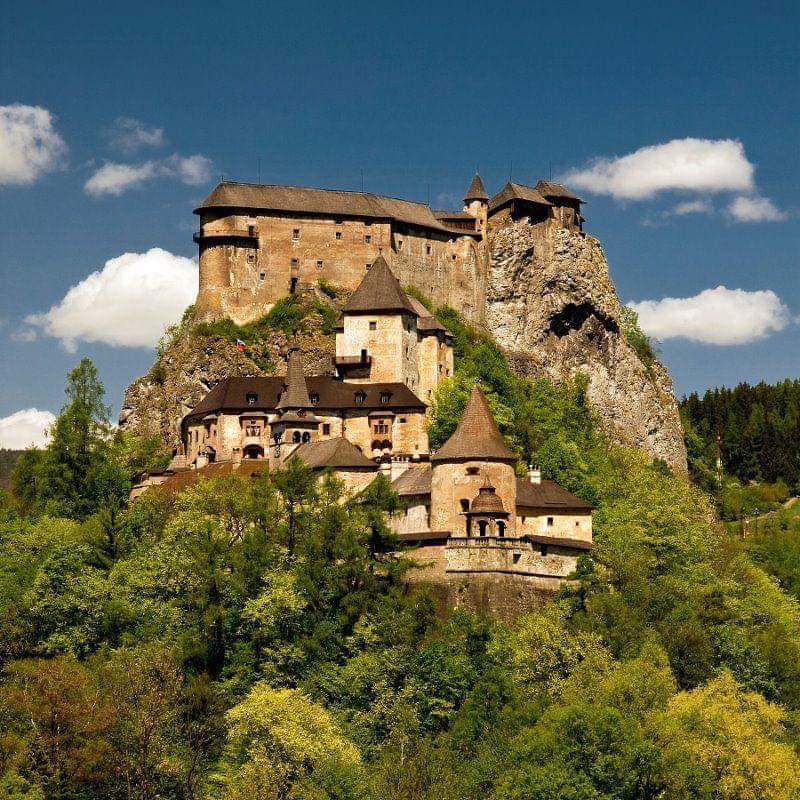
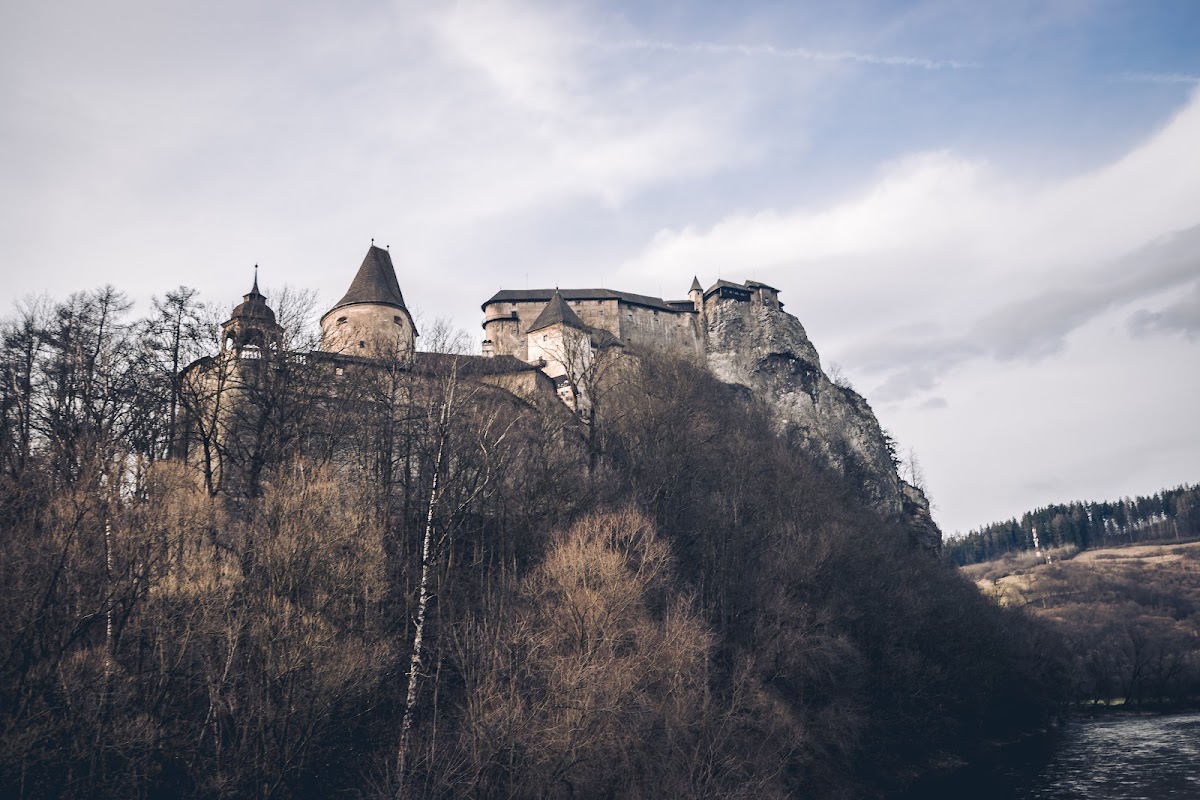
Orava Castle occupies a steep rocky outcrop beside the Orava River, about 112 meters above the river and approximately 520 meters above sea level. The surviving complex is arranged vertically on the rock in three successive groups, known as the upper, middle, and lower castles. Medieval and Renaissance buildings are joined by later work, and the ensemble preserves Romanesque, Gothic, Renaissance, Baroque, and neo-Gothic phases.
Upper Castle
Rock-Built Stronghold
The upper castle is the oldest major section and dates to the first half of the thirteenth century. It is a tall, narrow structure oriented from east to west, with additions attached to the main body. The buildings were constructed directly against the rock, making approach from outside difficult. The rock curves southward beneath the structure, producing the sharply elevated form of the upper complex.
Later Alterations
The 1800 fire destroyed the upper castle’s wooden elements. Later conservation campaigns renewed parts of the building ensemble, although a concrete ceiling was inserted into the thirteenth-century upper castle during postwar restoration instead of rebuilding the earlier wooden ceiling. Extensive conservation work allowed the upper castle to open in 1969.
Middle Castle
Palaces and Tower
The middle castle contains a quadrangular tower and two palaces. One palace is associated with Jan of Dębowiec and the other with John Corvinus. During John Corvinus’s period, work began on a large new palace and a forecourt with a defensive tower.
Courtyard Water Supply
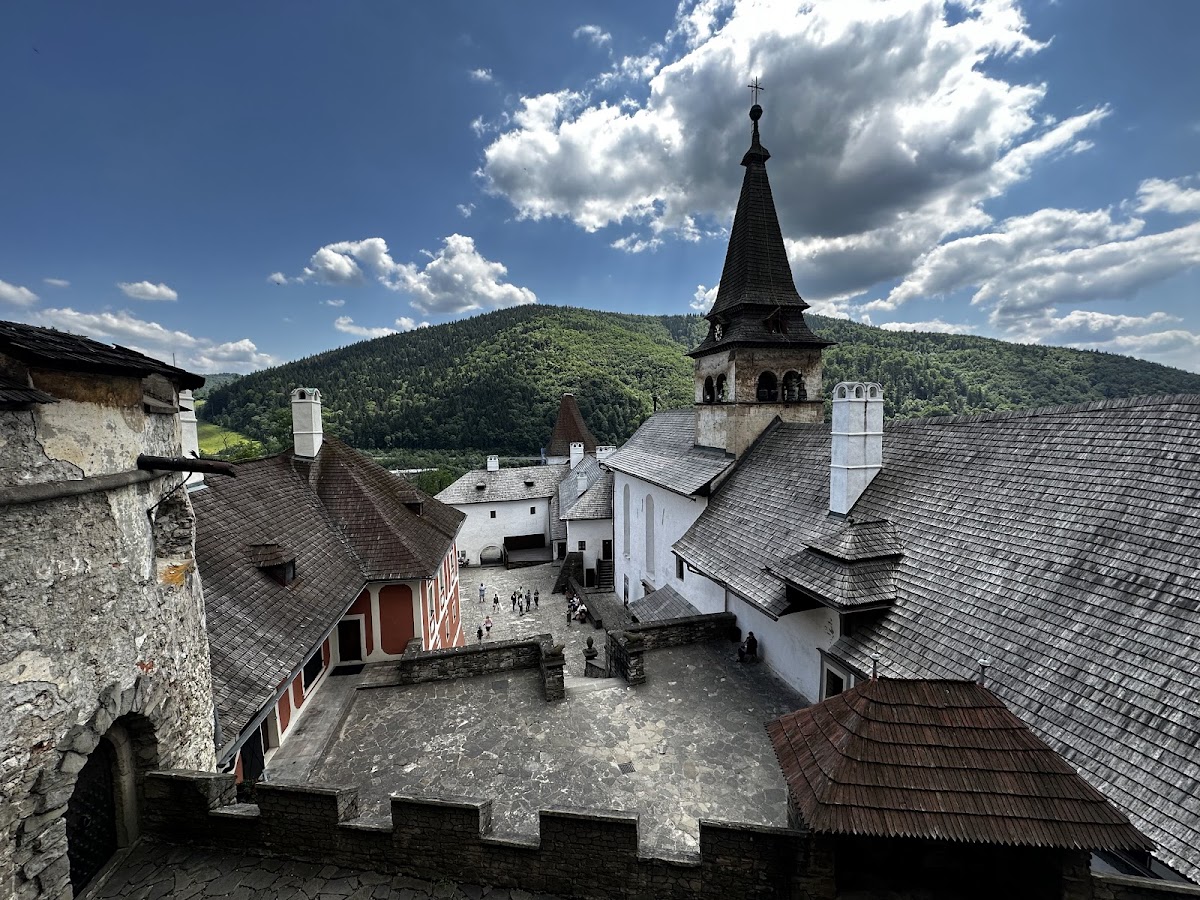
Francis Thurzo had a well dug in the middle-castle courtyard to supply water to all parts of the castle. He also renovated the two palaces and replaced wooden elements in the Archive Tower and the upper level with stone. In the Jan of Dębowiec Palace, he ordered wall paintings and other interior changes.
Lower Castle and Defensive Works
Gates and Fortifications
Under Jan of Dębowiec, the castle received major fortification improvements. A second gate with loopholes and a drawbridge was built, while the middle and lower levels gained additional residential and defensive structures. Francis Thurzo later replaced wooden defensive elements with masonry, added a wing in the lower castle, and built a third gate.
George Thurzo completed the first entrance gate with its drawbridge and strengthened the walls between the gates. He connected the second and third gates on the southern side with a projecting defensive platform and a broad terrace where guns could be placed during an attack. These works formed part of the successive changes that transformed the steep medieval stronghold into a fortified aristocratic residence.
Thurzo Palace and Chapel
The lower castle contains the Thurzo Palace, a tower, and a Baroque castle church. George Thurzo completed the palace and built a chapel with a priest’s residence opposite it. The palace and church belong to the residential and religious development of the lower complex, while the surrounding walls and gates retain elements of its earlier military function.
Interior Features and Collections
Religious and Commemorative Features
A Baroque altar dated 1751 survives as an important feature of the eighteenth-century interior. A memorial plaque commemorating Francis Zichy’s renovation of the castle is dated 1800.
Museum Collections
The museum displays weapons and armor from the former castle arsenal, historic furnishings, wooden architectural models, and archaeological and ethnographic material. The collections also include Antoni Kocyan’s ornithological material. Together, these objects form part of the museum’s presentation of the castle, the Orava estate, and the region’s natural and cultural history.