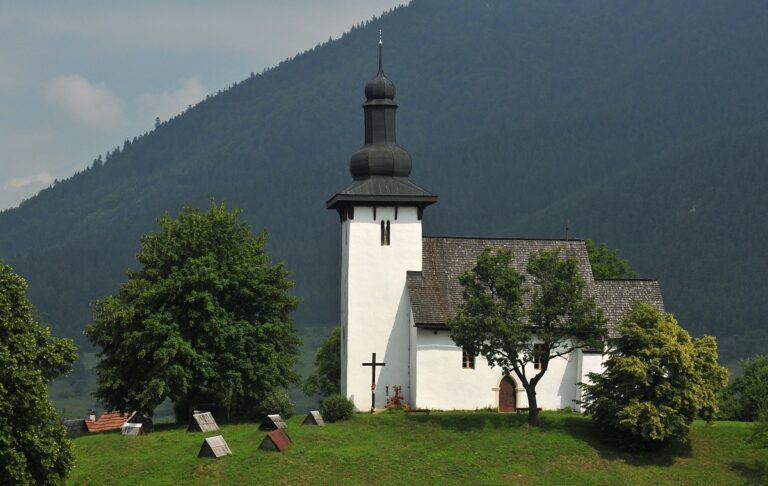
Church of All Saints of Tvrdošín: A Historic Wooden Church in Slovakia


Site at a Glance
- Rating
- 4.7
- Popularity
- Low
- Country
- Slovakia
- Primary era
- Medieval
- External website
- Open
- Eras represented
- Medieval, Early Modern
- Civilizations
- Hungarian
- Site type
- Religious
- Remains
- Church
On this page10 sections
History
The Church of All Saints of Tvrdošín is a Roman Catholic wooden church in Slovakia, originally built in the fifteenth century in the Gothic or Late Gothic tradition. Dedicated to All Saints, it belongs to the Diocese of Spiš, a territorial jurisdiction of the Roman Catholic Church. The parish is first mentioned in writing in 1395. The church is regarded as one of Slovakia’s oldest and most valuable examples of wooden religious architecture.
Medieval Origins
The present wooden building was probably constructed during the second half of the fifteenth century, although a late-fourteenth-century date has also been proposed. Its original form belonged to the Gothic or Late Gothic period. The church’s orientation, timber construction, and surviving medieval associations reflect its establishment as a parish place of worship.
Protestant Period and Renaissance Reconstruction
After the church was taken over by Protestants, it was reconstructed between 1650 and 1654 in the Renaissance style. The work included a new southern entrance with a Renaissance portal and a similar portal at the entrance to the sacristy. The interior decoration also belongs largely to this period, including painted work dated to 1653 and 1654 and a pulpit dated 1654.
Later Conservation and Recognition
Smaller modifications took place in 1899, 1927, 1952, 1966, and 1971. A thorough renovation followed between 1986 and 1992, with further reconstruction and restoration recorded in 1993. The work received recognition from Europa Nostra, a European heritage organization concerned with protecting and restoring cultural heritage, in the mid-1990s.
The church and its surrounding wall have been a national cultural monument since 1963. In 2008, the building was inscribed on the UNESCO World Heritage List as part of the Wooden Churches of the Slovak part of the Carpathian Mountain Area, together with seven other monuments. It is the only site in Slovakia described as having received both Europa Nostra recognition and UNESCO World Heritage status. The church now serves worshippers once a year, during the week around All Saints’ Day on 1 November, a Christian observance honoring all saints.
Remains
The church is an oriented wooden structure built from red spruce using log construction. Its smaller rectangular chancel includes a sacristy. A steep shingled roof has two ridges and carries an octagonal bell turret topped by a conical cap. Covered galleries, known as soboty, surround the building and provide sheltered circulation beside its walls; the galleries are supported by later masonry posts.
Interior Decoration
Nave Ceiling
The nave has a coffered ceiling divided into recessed panels. Its 49 rosettes are set within polychrome decoration, meaning painted architectural or artistic ornament, with motifs of wild and garden flowers. This work dates to 1653 and 1654.
Chancel Paintings
The chancel has a barrel vault, a continuous semicylindrical vaulted ceiling, painted with a starry sky and figures of the Four Evangelists, the traditional authors associated with the canonical Gospels. Figurative polychrome paintings cover the side walls.
Altar and Furnishings
The main altar is a Late Baroque work from the turn of the seventeenth and eighteenth centuries. It contains a painting of All Saints. The altar’s original fifteenth-century painting of the Lamentation of Christ was transferred to a museum in Budapest in 1919.
The pulpit, dated 1654, carries figures of the Four Evangelists. Nearly life-sized statues represent Saints Barbara, Justina, Margaret, John, Matthias, and Matthew. The interior also contains a painting of Saint George on horseback fighting the dragon, dated to around 1653, together with painted choir stalls.
Wall and Cemetery
A surrounding wall encloses the church and adjoining cemetery. Its Baroque gate has an octagonal shingled roof and a small turret capped by a conical roof. Within the cemetery stands a Renaissance stone tombstone dated 1555, commemorating Gaspar Koda, as well as two round stone structures from the seventeenth century.