Yamashiro Futagozuka Kofun: A Sixth-Century Elite Burial Mound in Japan

Site at a Glance
- Rating
- 4.2
- Popularity
- Very Low
- Country
- Japan
- Primary era
- Medieval
- External website
- Open
- Eras represented
- Medieval
- Civilizations
- Yamato
- Site type
- Burial
- Remains
- Burial Mound
On this page10 sections
History
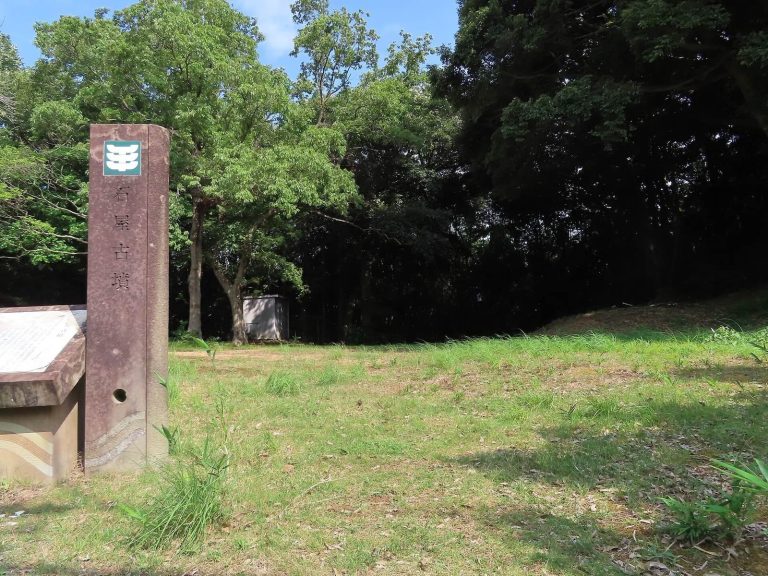
Yamashiro Futagozuka Kofun is a large burial mound from Japan’s Kofun period, an era of elite tomb construction generally dated from the third to the sixth centuries, in Matsue, Shimane. Built during the sixth century, probably in its middle or later decades, it belongs to the Yamashiro-Oba Tumulus Group and is regarded with the group’s other large tombs as the burial place of a paramount chief in eastern Izumo.
The Yamashiro-Oba Tumulus Group
The mound forms part of a group that also includes Obaniwatorizuka Kofun, Yamashiro Square Kofun, and Yamashirohara Kofun. Together, these large tombs reflect the authority held by the leading figure of eastern Izumo, a historical region corresponding broadly to eastern Shimane Prefecture, during the sixth century.
Historical recognition and damage
Yamashiro Futagozuka Kofun has an important place in the history of Japanese archaeology. Its description in the fourth volume of the History of Shimane Prefecture, published in 1925, marked the first use in Japan of the term zenpo-koho-fun. This term describes a burial mound made from a rectangular front section joined to a rectangular rear section, unlike the more familiar keyhole-shaped mound with a rounded rear.
In 1908, the eastern half of the rear section was cut away when a shooting range and associated facilities were installed after the Imperial Japanese Army’s 63rd Infantry Regiment moved to Matsue. The mound received National Historic Site designation under the name “Yamashiro Futagozuka” on December 9, 1924. The protected area was enlarged on February 9, 2017.
Survey, reconstruction, and interpretation
A survey of the mound took place in 1980 and 1981. Investigations connected with site improvement followed in 1990 and 1991, and again in 1994 and 1995, while excavation associated with environmental works was carried out in 2000. Between 1996 and 1997, the damaged eastern half of the rear section was reconstructed, and a facility was created to show the successive layers of earth used in the mound. Later improvements prepared the site for public viewing.
Ground-penetrating-radar surveys conducted in 1995 and 2025 indicate that the rear and front sections each probably contain one burial facility. Their precise structures remain uncertain, while the radar results have helped establish the likely arrangement beneath the mound.
Remains
Layout and construction
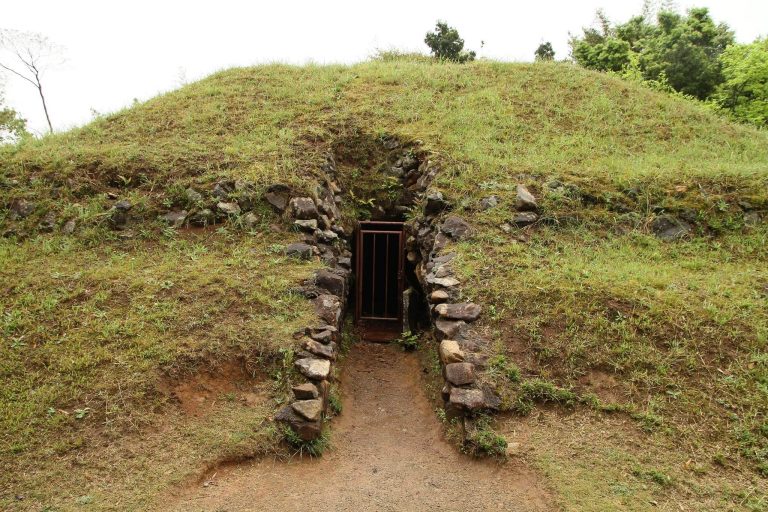
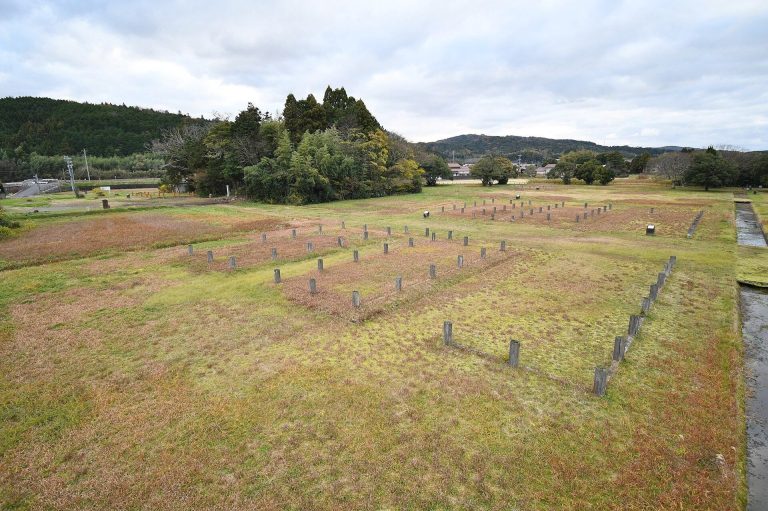
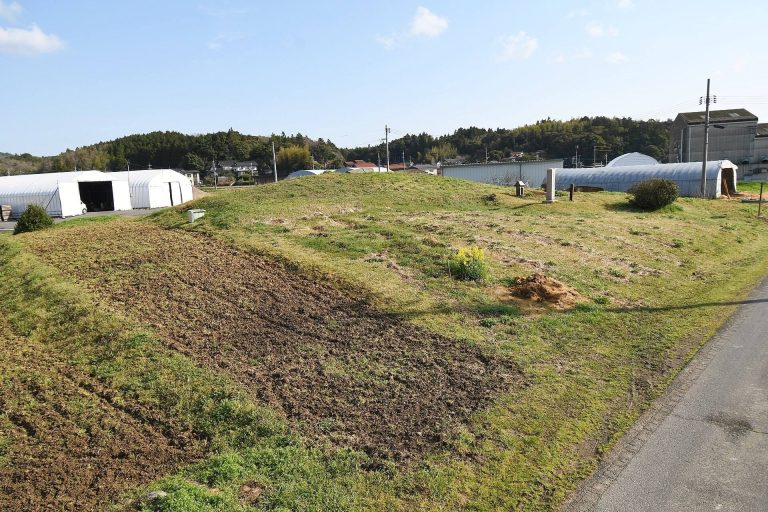
Yamashiro Futagozuka Kofun stands on the Nogi Terrace, a low natural terrace, at the northwestern foot of Mount Chausu on the southern outskirts of Matsue. Its zenpo-koho-fun plan joins two rectangular sections, with the front section directed toward the west-southwest. The mound was constructed in two stages and has a reconstructed length of about 94 meters.
The rear section measures approximately 57 meters from end to end, 53 meters across, and 8 meters high. The narrowed central area is about 33 meters wide, while the front section measures roughly 55 meters across. A rectangular moat and outer embankment surround the mound. The moat is approximately 5 to 7 meters wide, making the enclosed complex about 104 meters long and 70 meters wide. Including the outer embankment, the full complex extends to approximately 150 meters.
Rear section and moat
The eastern half of the rear section, damaged in 1908, has been reconstructed. Along the southern side of this section, the moat projects markedly outward. This unusual expansion suggests that an additional facility once occupied or was associated with that part of the complex.
Surface features and recovered objects
Fukiishi, stones placed over an earthen mound to protect and finish its surface, occur on the upper tier. Cylindrical and figurative haniwa were found on the mound. Haniwa are clay objects placed on or around burial mounds, and the examples here include the legs of a four-legged animal.
Sue ware vessels
Finds also include Sue ware, a high-fired pottery made with kiln technology during the Kofun period. Among the objects are an Izumo-style jar with smaller vessels attached to it and a lidded, high-footed cup identified as a transmitted or heirloom object. Objects associated with the mound are displayed at the Shimane Prefectural Yakumotatsu Fudoki-no-Oka Exhibition and Learning Hall and at the Shimane University Museum Ashikaru in Matsue.
Burial facilities
Radar survey suggests a horizontal stone chamber in the rear section. Such a chamber is entered through a passage. The 1995 survey estimated a structure about 10 meters long and 4.5 meters high, while the 2025 survey indicated a possible chamber approximately 11.5 meters long and 4.5 meters wide, apparently opening toward the narrowed central area.
A separate pit-type burial facility is estimated in the front section at about 6.0 meters long and 2.0 meters wide. A pit-type facility is constructed as a shaft or enclosed pit within the mound. These probable rear and front burial arrangements complement the mound’s two-part plan and provide the principal evidence for interpreting its internal structure.