Northburgh Castle: A Medieval Fortress Controlling Lough Foyle


Site at a Glance
- Rating
- 4
- Popularity
- Very Low
- Country
- Ireland
- Primary era
- Medieval
- External website
- Open
- Eras represented
- Medieval
- Civilizations
- English
- Site type
- Military
- Remains
- Castle
On this page7 sections
History
Northburgh Castle is a ruined late-thirteenth- or early-fourteenth-century castle in Ireland, located at Greencastle in northern Inishowen, County Donegal. Completed in 1305 by Richard Óg de Burgh, 2nd Earl of Ulster, it was built to control Lough Foyle, a large sea inlet on Ireland’s north coast, and to support his territorial expansion.
Conflict and de Burgh rule
Edward Bruce, a Scottish prince and military leader campaigning in Ireland, captured the castle in 1316. It remained under his control for two years, until his death in 1318, after which Richard Óg de Burgh recovered it.
The castle later became the scene of a violent family dispute. In 1331, Walter Liath de Burgh was imprisoned there by his cousin William Donn de Burgh, the Brown Earl and 3rd Earl of Ulster. Walter died of starvation in February 1332. William’s sister was found dead beneath the battlements, and a tradition associated with the castle holds that Walter’s imprisonment is commemorated by a skeleton on the coat of arms of Derry City.
O’Doherty stronghold and later decline
After William Donn de Burgh’s death, Northburgh Castle became a stronghold of the O’Dohertys, a Gaelic Irish lordly family associated with Inishowen. Its changing role extended beyond warfare. The castle’s gatehouse combined military purposes with residential accommodation, administration, the display of authority, and a base for territorial expansion.
Considerable damage from cannon fire left Northburgh Castle in ruins during or after the seventeenth century. The remains are now managed by the Government of Ireland through the Office of Public Works.
Remains
Enclosure and towers
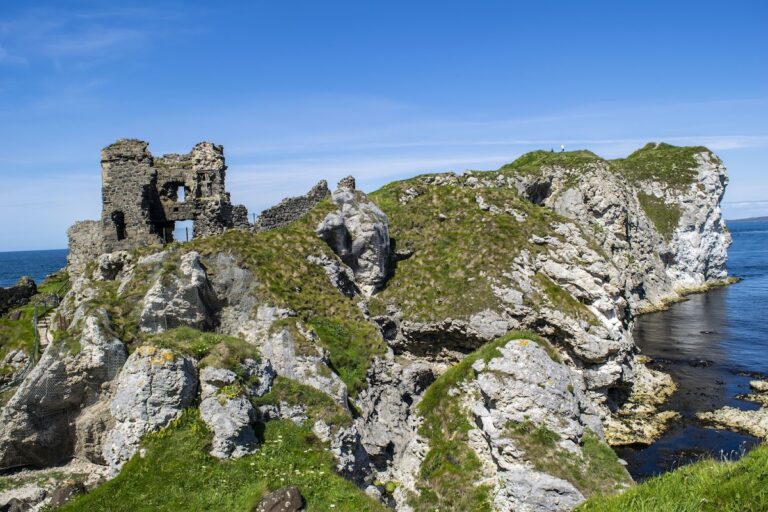
The castle occupies a rock outcrop or platform that was too small for the entire planned complex. As a result, the gatehouse stands below the main enclosure. The plan forms an oval defended area with a twin-towered, polygonal gatehouse at one end and a larger polygonal tower at the other. This second tower is more ruinous and was added later, probably in the fifteenth century.
Northburgh belongs to a castle type in which the keep, the principal defensive tower, forms part of the outer curtain wall rather than standing separately inside the enclosure. The curtain wall is the defensive wall linking the towers and entrances. This arrangement integrated the main strongpoint with the perimeter defenses.
Gatehouse and internal accommodation
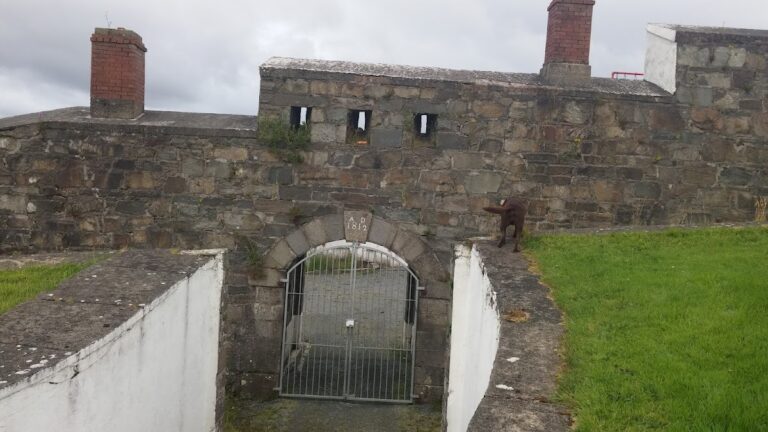
The gatehouse has its first floor at the level of the main courtyard. Its passage leads into a small lower courtyard, where steps rise to the principal courtyard. The building provided substantial accommodation and was described as exceptionally commodious. Further rooms occupied the north and west towers, while a great hall extended along the north wall.
Architectural connections
The gatehouse has been compared with Edward I’s castle at Harlech in Wales, although not in scale, while the rest of Northburgh has been compared with Caernarfon. Richard Óg de Burgh had been knighted by Edward I at Rhuddlan Castle, and these associations reflect the movement of architectural ideas between north-western Ireland and Wales during the late thirteenth and early fourteenth centuries. The surviving castle remains a ruin.
Nearby sites