Dunseverick Castle: A Historic Stronghold in the United Kingdom
Site at a Glance
- Country
- United Kingdom
- Primary era
- Early Modern
- Eras represented
- Iron Age, Early Modern
- Civilizations
- Irish
- Site type
- Military
- Remains
- Castle
On this page6 sections
History
Dunseverick Castle is a ruined stronghold near the village of Dunseverick and the Giant’s Causeway in the United Kingdom. Irish annals place a castle here in the fifth century and link the site with Saint Patrick, a Christian missionary associated with the spread of Christianity in Ireland. During his visit, Patrick baptized Olcán, a local man who later became a bishop, or senior Christian cleric.
Early Irish royal traditions
In the sixth century, Dunseverick was the seat of Fergus Mor MacEirc, king of Dál Riata, an early medieval Gaelic kingdom associated with northeastern Ireland and western Scotland. Tradition holds that around 500 the Lia Fail, a stone associated with the crowning of Irish rulers, was taken from Ireland to western Scotland. Muirceartaigh (Murtagh) MacEirc, the High King of Ireland, a title for a ruler regarded as pre-eminent among Ireland’s kings, lent it to Fergus for his coronation as his kingdom expanded westward.
Slige Midluachra, one of ancient Ireland’s five great royal roads, ended at Dunseverick. The route connected the site with Emain Macha, an ancient centre of the kingdom of Ulaid, with Tara, a royal and ceremonial centre, and with a crossing of the Liffey at what is now Dublin.
Medieval lordship
The O’Cahan clan held the castle from about 1000 until 1320, when it lost control. From around 1250 to 1350, the Earls of Ulster also used Dunseverick as a manorial centre, the administrative hub of an estate.
Early modern control and destruction
The O’Cahans regained and rebuilt the castle in the mid-sixteenth century. From about 1560, the McDonnells were associated with Dunseverick as a stronghold. General Robert Munro captured and destroyed the castle in 1642. Its destruction is also attributed to Cromwellian troops in the 1650s, forces associated with Oliver Cromwell, the Parliamentarian commander in the English Civil Wars who later ruled as Lord Protector.
Giolla Dubh Ó Catháin, the castle’s last holder, left in 1657 and settled at Craig, also known as Lisbellanagroagh. In 1660, his name appeared in anglicized forms as McCain or O’Kane.
Modern stewardship
In 1962, local farmer Jack McCurdy gave the castle and its peninsula to the National Trust, a UK organization that cares for historic places and landscapes. The castle and its earthworks are protected as Scheduled Historic Monuments, a Northern Irish legal status for places of archaeological or historic importance.
Remains
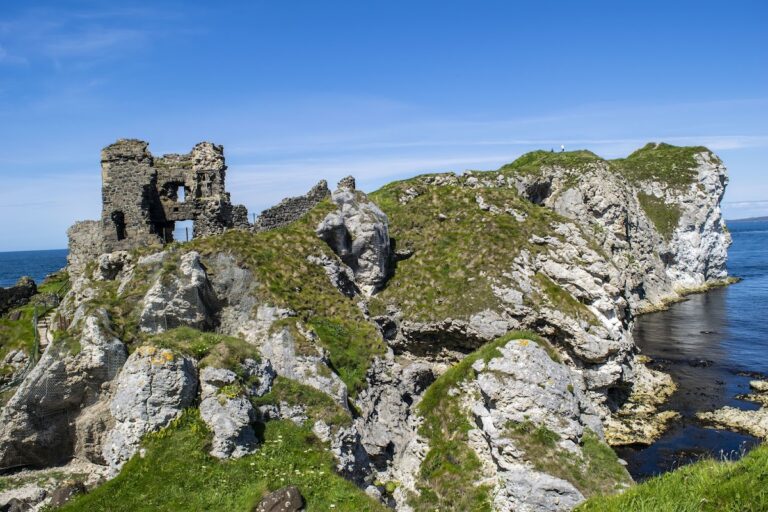
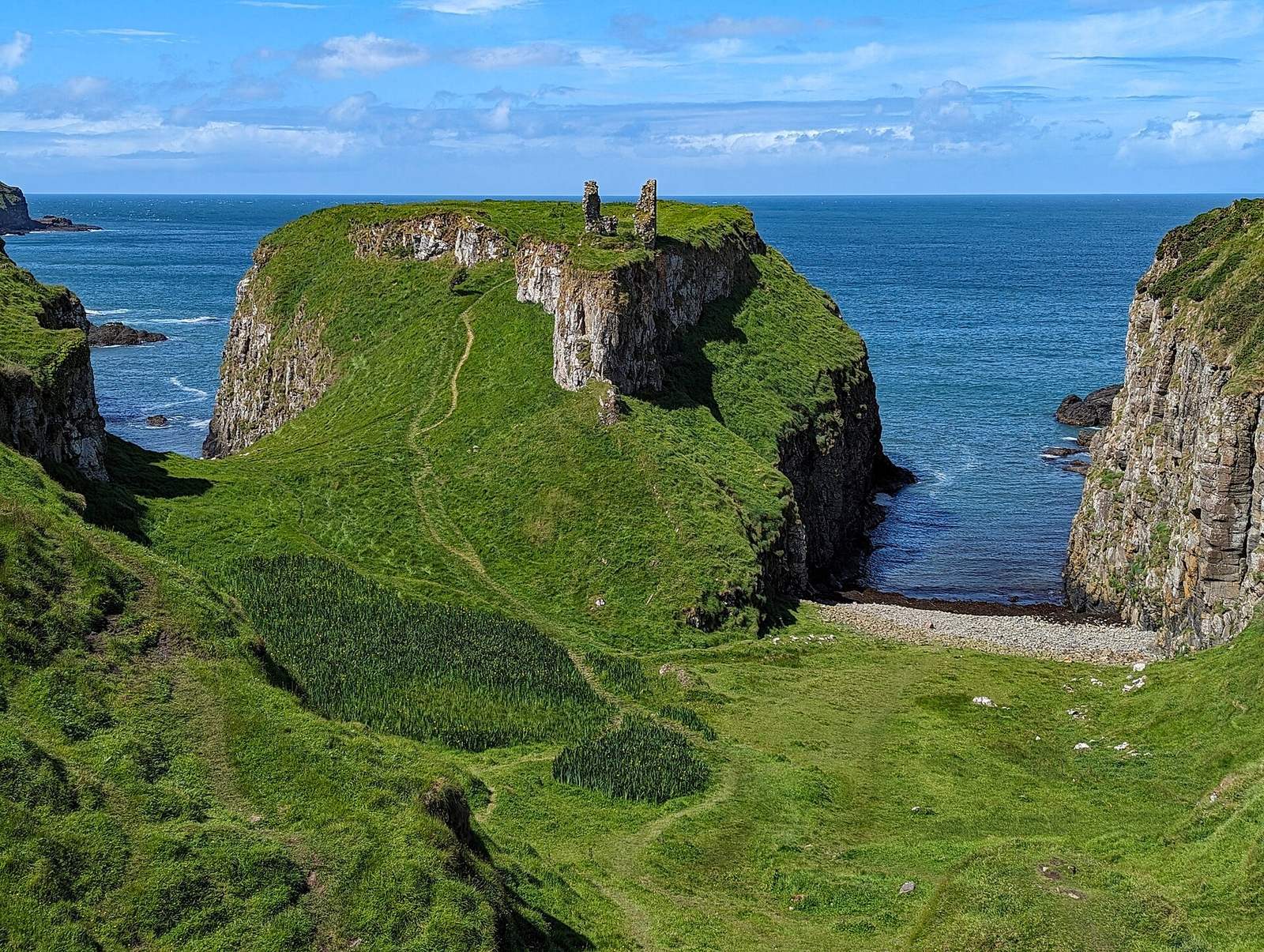
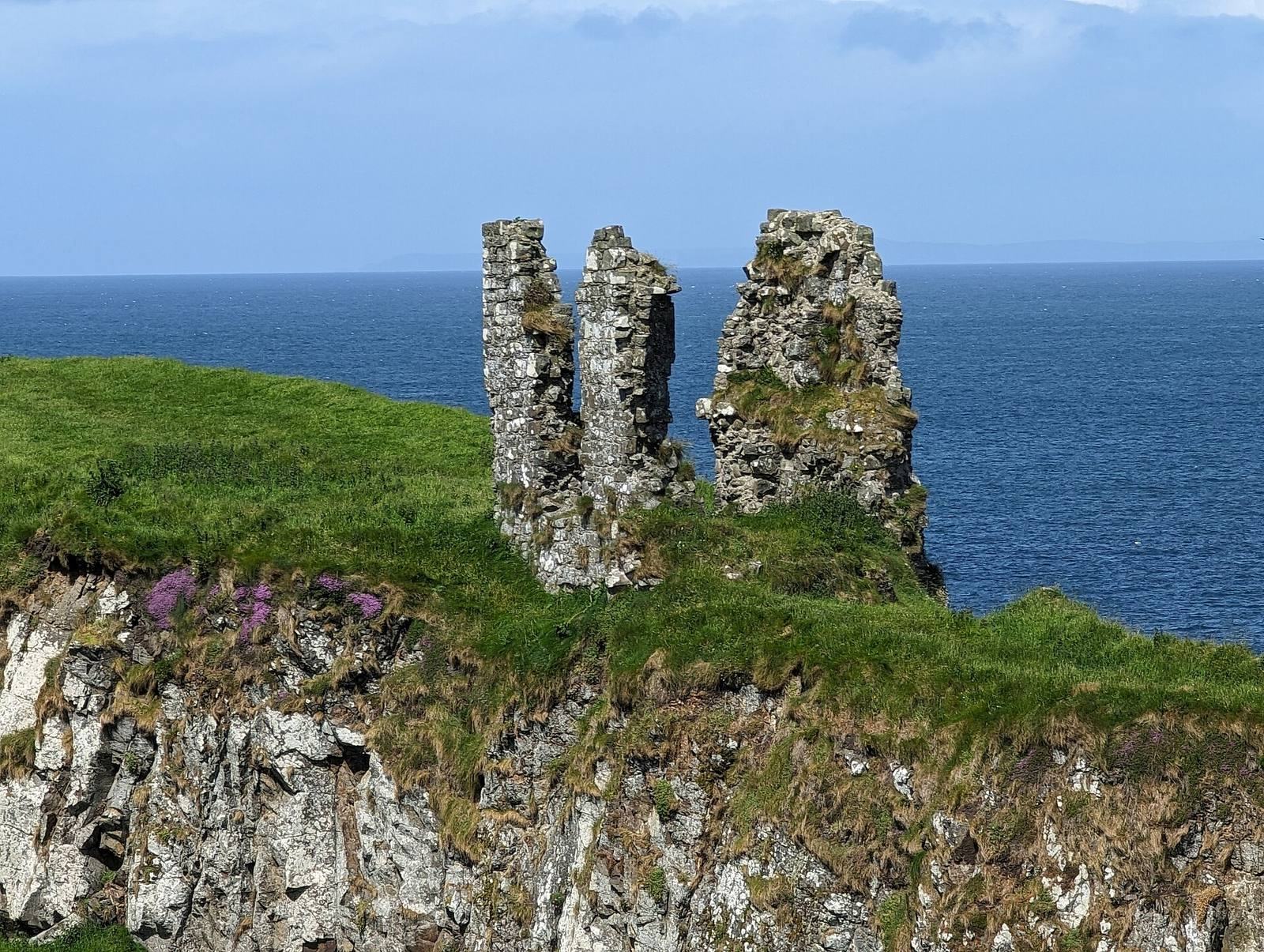
The castle occupies a small peninsula surrounded by sea and cliffs. Basalt was used in its construction, and the castle now stands in ruins. Traces of an Iron Age promontory fort, a defended settlement on a projecting headland, also survive at the site.
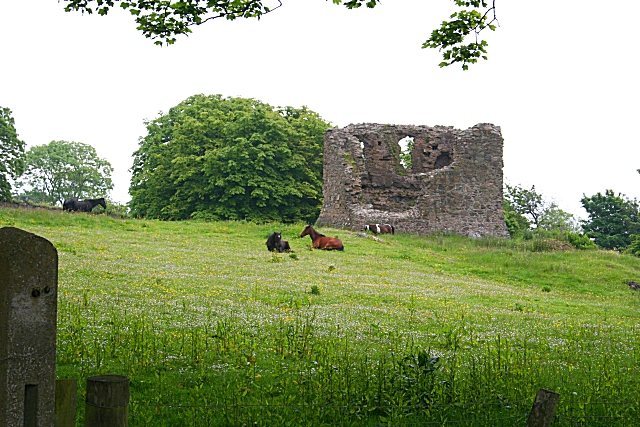
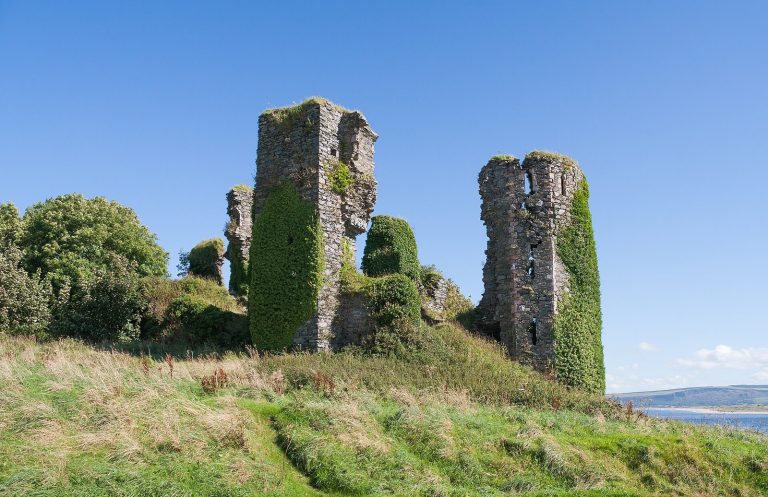
The surviving castle ruins include the gate lodge, a building associated with an entrance, also known as the Great Gate. A small residential tower stood at the site until 1978, when it collapsed into the sea.