Lumps Fort: A Coastal Defence Fortification at Southsea
Site at a Glance
- Rating
- 4.3
- Popularity
- Very Low
- Country
- United Kingdom
- Primary era
- Modern
- External website
- Open
- Eras represented
- Modern
- Civilizations
- British
- Site type
- Military
- Remains
- Fort
On this page10 sections
History
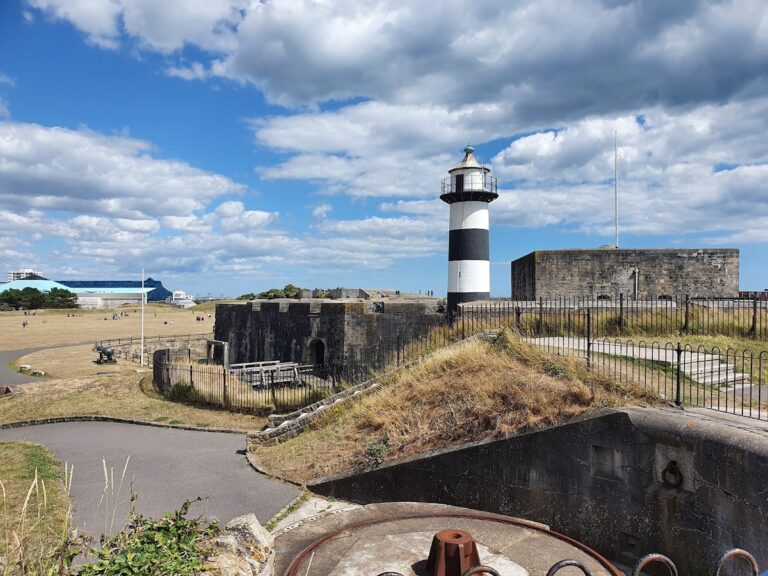
Lumps Fort is a disused coastal fortification at Southsea in Portsmouth, United Kingdom, built on Portsea Island as part of the defences of Portsmouth’s naval base. The fort dates from the eighteenth century, and an 1805 Board of Ordnance entry lists “Lumps Fort, three 32-pounder guns.”
Early fort and semaphore station
By 1822, the site had acquired a new communications role as a semaphore station on the London–Portsmouth semaphore line. Semaphore transmitted messages through optical signals between fixed stations, so clear visibility was essential. Lumps Fort’s coastal position helped avoid the smog around Portsmouth, which could obstruct direct visual communication from Portsdown Hill.
By the 1820s, the fort no longer functioned as a defensive work, and part of it fell into the sea in 1827. The semaphore station closed in 1847, when the electrical telegraph replaced the optical system.
Reconstruction as a Palmerston fort
Lumps Fort was reconstructed between 1859 and 1869 as one of the Palmerston forts forming part of the Portsmouth Harbour defence line. These nineteenth-century coastal fortifications were built or rebuilt during defence reforms associated with Lord Palmerston’s government, in response to improved artillery and the possibility of invasion. The reconstructed fort was designed for 17 guns and included a rear barrack block capable of housing 100 men.
The fort was not normally garrisoned. A master gunner generally lived there, and in 1885 that position was held by H. Orchard. Volunteer Artillery units also used Lumps Fort for training. In 1889, the City of London Artillery Volunteers carried out gun practice at the site.
Rearmament and demolition
During the 1890s, the fort received three 6-inch rifled breech-loading Mark IV guns mounted on hydropneumatic carriages. Rifled breech-loading guns had spiral grooves inside their barrels and were loaded from the rear, while hydropneumatic systems absorbed recoil and helped return each gun to position. The three guns were removed in 1906.
In 1914, the site was rearmed as a beach-defence battery and carried a 6-pounder Hotchkiss anti-aircraft gun. At the end of the First World War, the fort was demolished, leaving only an outline of the former fortification.
Second World War operations and later use
Portsmouth City Council bought the site in 1932, but plans for its development were interrupted by the Second World War. In 1942, the Experimental Party of the Combined Operations Development Centre began operating from the fort. The centre developed and tested methods and equipment for amphibious and coastal operations.
The Royal Marine Boom Patrol Detachment followed soon afterward. This specialist unit developed and trained with Sleeping Beauties, small submersible craft used in wartime special operations, and Boom Patrol Boats, small craft intended for boom-patrol work. It initially operated from two Nissen huts outside the fort beside the car park, as well as from the fort itself.
Early training took place in the Solent and involved almost daily canoe boom-patrol trips to the Isle of Wight. The detachment later conducted Operation Frankton, a Second World War commando raid using canoe-borne personnel against shipping in Bordeaux Harbour, before moving to Teignmouth in South Devon.
After the war, the site was planted as a rose garden. Its western section later became the Southsea Model Village.
Remains
Fort outline and surviving ground plan
Lumps Fort was built of brick and earth. The reconstruction of 1859–1869 formed a gun fort intended to carry 17 weapons, with a barrack block along its rear capable of accommodating 100 men. Later artillery altered the defensive arrangement, including three 6-inch Mark IV guns on hydropneumatic carriages in the 1890s and a 6-pounder Hotchkiss anti-aircraft gun when the site became a beach-defence battery in 1914.
Demolition after the First World War removed the fort as a standing structure, but its outline remained in the ground. The surviving outline represents the physical trace of the brick-and-earth fortification and its successive military uses.
Wartime structures and surrounding landscape
Nissen huts
During the Second World War, two Nissen huts stood outside the fort beside the car park. These prefabricated, barrel-vaulted structures provided accommodation or storage for the Royal Marine Boom Patrol Detachment, which also used the fort itself during its early operations.
Canoe Lake
Canoe Lake lies adjacent to the site. It was formed from a large area of marshland, opened on 17 June 1886, and used as a boating lake. During the Second World War, the lake also served for experiments on countermeasures against magnetic mines.