Northampton Castle: A Norman Stronghold and Lost Medieval Fortress


Site at a Glance
- Rating
- 3.9
- Popularity
- Very Low
- Country
- United Kingdom
- Primary era
- Medieval
- External website
- Open
- Eras represented
- Medieval
- Civilizations
- Norman
- Site type
- Military
- Remains
- Castle
On this page12 sections
History
Northampton Castle is a Norman castle in the United Kingdom, built in 1084 under the direction of Simon de Senlis, the first Earl of Northampton. Its construction continued for several years, and the castle was not mentioned in the Domesday Book, the survey of English landholding and resources completed in 1086. It became one of the most prominent Norman castles in England and is also described as one of the country’s notable Romanesque castles, a medieval architectural tradition characterized by massive masonry, rounded arches, and thick walls.
Royal and baronial conflicts
During the reign of Henry II, Northampton Castle was held by the Crown. Its position brought it into the political and military struggles between English monarchs and rebellious barons. In the First Barons’ War, a conflict between King John and groups of rebel barons, the castle served as a stronghold for the baronial faction. After John defeated the rebels, he entrusted the castle to Falkes de Breauté.
The castle was also the scene of Thomas Becket’s trial before a great council in 1164. Becket, the archbishop of Canterbury, was involved in a major dispute with Henry II over the relationship between royal authority and the church. He escaped from Northampton disguised as a monk and fled to France.
In May 1215, barons who had renounced their allegiance to King John attempted to besiege Northampton Castle, but the attack failed. Nearly fifty years later, during the Second Barons’ War of 1264, the castle was held by confederate barons opposing Henry III. Simon de Montfort, the leading commander of the baronial forces, governed Northampton while it was in their hands. After Henry III defeated the castle’s garrison at the Battle of Northampton, the fortress returned to royal control.
Crown possession and later medieval use
Northampton Castle remained a Crown possession until the reign of Edward III. During that period, Thomas Wake, sheriff of Blisworth, claimed that the castle belonged to the county under his jurisdiction. In 1452, during the reign of Henry VI, the castle was leased to Robert Caldecote for twenty years at an annual rent of £5. The agreement included rights over animals and herbage within the castle and its trenches, as well as use of a meadow and fishing in the River Nene.
Civil War, slighting, and decline
During the English Civil War, Northampton Castle was used by Parliamentarian forces. After the monarchy was restored, Charles II ordered the castle’s defences and Northampton’s town walls to be slighted in 1662. Slighting meant deliberately damaging fortifications so that they could no longer serve effectively for military defence.
The surviving parts of the castle were then adapted for legal and penal use. The remaining fortress buildings served as the county prison until 1675, and two courts were held there. During the Restoration, the period following the return of the English monarchy in 1660, the castle was in the hands of Haselrig. Parts of the site were divided among private occupants, houses were built over the trenches, and a public chapel dedicated to Saint George was established within the castle. The surviving structures gradually deteriorated.
Demolition and archaeological rediscovery
Parts of Northampton Castle remained intact into the late nineteenth century. In 1879, the London and North Western Railway demolished the castle and its foundations to build Northampton Castle railway station. This effectively destroyed most of the remaining medieval fabric. The station was rebuilt in 1963 and 1964, and the “Castle” suffix was later removed from its name because it had become Northampton’s only remaining station.
Archaeology has nevertheless recovered evidence of the earlier site. Excavations in 1961, undertaken before the station was rebuilt, revealed twelfth-century defences. More extensive work in 2012 and 2013, associated with a proposed expansion and redevelopment of the station, uncovered Anglo-Saxon material, including a brooch and pottery fragments, together with an ironstone wall. The Friends of Northampton Castle, a volunteer group established to publicise the castle and explain its history, commissioned a three-dimensional reconstruction in July 2012. Heritage poles were installed in Castle Park in July 2025 to mark the castle’s perimeter as part of a historical trail about Northampton and the castle.
Northampton Castle also has a place in literary history. It is the setting for the death of Prince Arthur in Shakespeare’s King John, where the young claimant leaps from the castle walls while trying to escape. Arthur’s actual fate remains uncertain. He was last recorded as a captive at Rouen Castle in April 1203, after which it was rumoured that King John had ordered his death. His death in France is considered more likely than death at Northampton.
Remains
Defensive layout
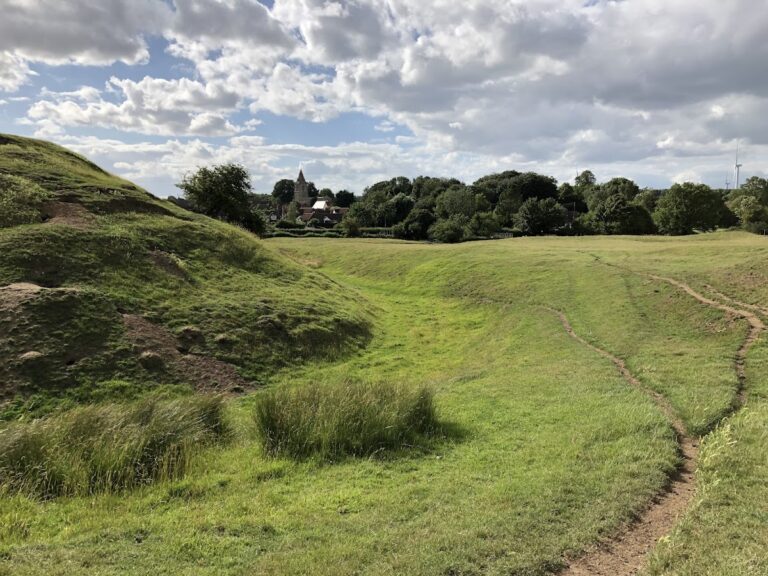
Northampton Castle stood outside Northampton’s western city gate. It was a motte-and-bailey castle, combining a raised earth mound that supported a fortified stronghold with an enclosed area for associated buildings and activities. The castle had extensive grounds and a large keep, the principal fortified tower of a medieval castle. Deep trenches defended three sides, while a branch of the River Nene formed a natural barrier along the western side.
Trenches and earthworks
Excavations in 1961 exposed a defensive ditch about 90 feet wide and 30 feet deep. Alongside it stood an earth bank approximately 80 feet wide and 20 feet high. Before the railway was built, foundations could still be traced on the southern and western sides of the site, while earth banks survived beside St Andrew’s Road. The castle gates were surrounded by earth bulwarks that were used as artillery platforms, reflecting the continued adaptation of the defences after medieval construction.
Southern bastion
A rounded bastion, a projecting fortified structure designed to strengthen a wall and allow fire along its face, survived on the southern side. It was formerly associated with the prison established in the castle after the fortifications were slighted. Its survival linked the later penal complex with the earlier defensive layout.
Surviving architectural fragment
Postern Gate
The only surviving architectural remnant is the Postern Gate, a small secondary archway intended for limited access rather than formal entry. It was dismantled from its original position and rebuilt into the wall of Northampton railway station. This fragment preserves part of the castle’s medieval architecture within the later railway site.
Archaeological evidence
The 2012 and 2013 excavations produced Anglo-Saxon archaeological material, including a brooch and pottery fragments, as well as an ironstone wall. These finds belong to evidence recovered from the station redevelopment area and extend the archaeological history of the site beyond the Norman castle itself. Together with the twelfth-century defences exposed in 1961, they provide material evidence for the occupation and construction phases represented beneath and around the former castle grounds.
Nearby sites