Torreón Los Canelos: A Spanish Colonial Watchtower in Valdivia, Chile
Site at a Glance
- Rating
- 4.4
- Popularity
- Medium
- Country
- Chile
- Primary era
- Early Modern
- Eras represented
- Early Modern
- Civilizations
- Spanish
- Site type
- Military
- Remains
- Tower
On this page7 sections
History
Torreón Los Canelos is a Spanish colonial defensive watchtower in Valdivia, Chile, built in 1774 as part of the city’s fortification system. Its construction belonged to the defensive reorganization of southern Chile after Valdivia’s destruction and repopulation, and the tower remains one of the surviving structures of the former colonial defenses.
Destruction and Spanish repopulation
The Battle of Curalaba in 1598 was a major Spanish defeat in southern Chile that led to the destruction or abandonment of several Spanish settlements. Valdivia was destroyed by Huilliche inhabitants in November 1599. In 1643, a Dutch expedition commanded by Hendrick Brouwer reached Corral Bay after allying with Huilliche communities of the Chacao Channel against the Spanish colonists of Chiloé. The expedition followed a similar strategy in the area but eventually withdrew.
Spanish repopulation began in February 1645, and Valdivia was gradually refounded at its original site in 1684. Lafkenche-Huilliche communities still controlled the surrounding territory. Valdivia and the Chiloé Archipelago were the southernmost Spanish Pacific coastal enclaves, and their strategic value to the Viceroyalty of Peru encouraged the construction of defenses against Indigenous attacks.
Construction of the defensive network
Engineer Juan Garland designed a defensive network for Valdivia in 1678 that included Torreón Los Canelos. The tower was constructed in 1774 under Governor Joaquín de Espinoza y Dávalos, completing the fortification system together with Torreón del Barro. Its position reflected Valdivia’s role as an intermediate point on the maritime route from Europe to the Pacific coast of the Americas through the Strait of Magellan and around Cape Horn.
Later uses and preservation
As its original military function declined, Torreón Los Canelos was adapted for several purposes. In 1801, its buried lower section was uncovered and left exposed for use as a maximum-security dungeon. It served as a judicial pillory, a public post used for punishment or humiliation, in 1822, as a windmill in 1834, and as a gunpowder store in 1853.
The tower was declared a Historic Monument on 24 March 1926 by Exempt Decree No. 744, and the declaration was reaffirmed by Decree No. 3512 on 31 July 1928. It forms part of Chile’s national monuments. Together with Torreón Picarte, it is described as one of the only intact surviving vestiges of Valdivia’s former fortification. Its original materials and structure provide evidence of Spanish colonial construction techniques and defensive organization in the southern territories of the Spanish Empire. A restoration project involving Torreón Los Canelos and Torreón del Barro also includes urban informational markers intended to connect the two structures.
Remains
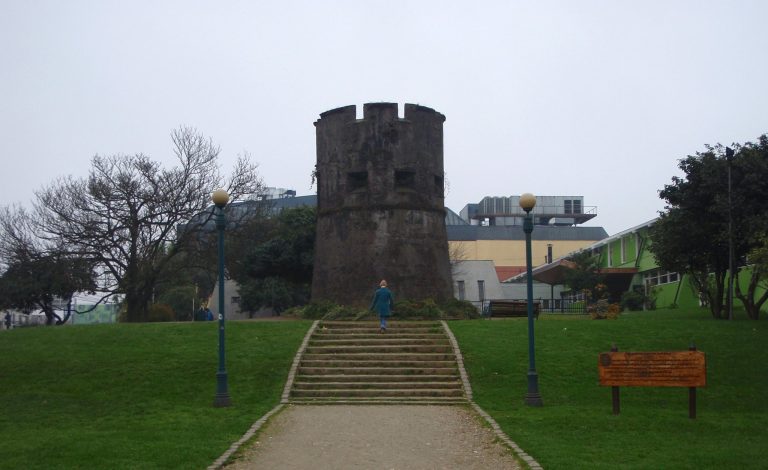
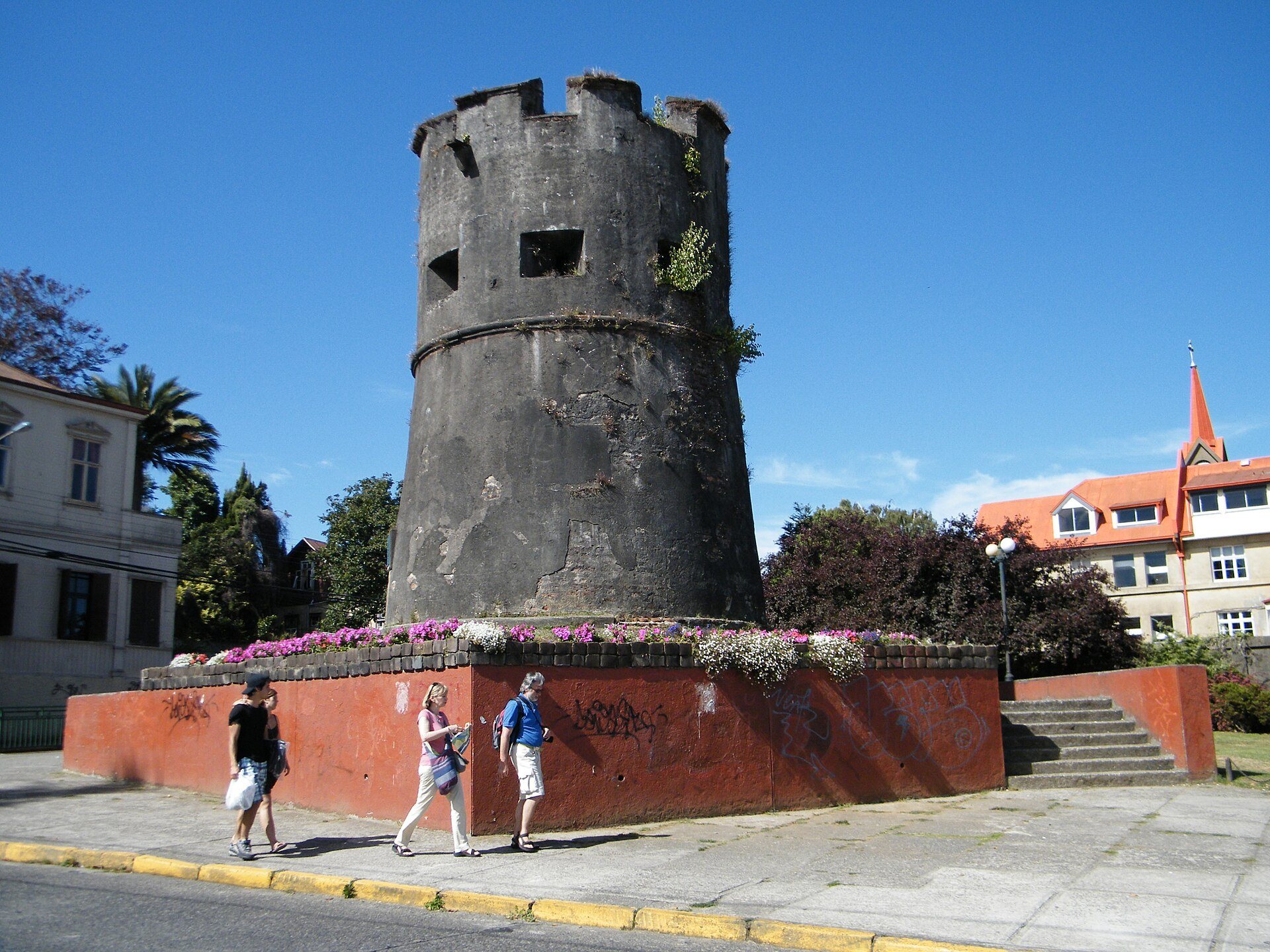
Torreón Los Canelos stands at the intersection of General Lagos and Yerbas Buenas streets, at Valdivia’s former southern entrance. The watchtower has a compact circular form with a lower sloping body and a battlement, the crenellated parapet at the top of a defensive structure. Its surviving fabric preserves the form of an eighteenth-century colonial military post.
Form and dimensions
The tower measures approximately 5.9 metres across at its base and 4.6 metres at the battlement crown. Its sloping lower body is 4.2 metres high, while the total height reaches 7.1 metres. The usable interior has a diameter of about 3.3 metres and is enclosed by walls approximately 1.25 metres thick.
Materials and interior arrangement
The structure was built from simple fired-brick masonry produced at the factory on Valenzuela Island, now called Teja Island, and bonded with lime mortar. Its outer walls retain their lime-and-sand plaster. A conical roof made of clay tiles originally covered the tower, but that roof no longer survives.
The first level was originally underground, leaving the second floor as the habitable space. A staircase and doorway provided access to that level. The lower section was exposed in 1801 and then used as a dungeon, changing the arrangement and function of the tower while leaving its main structure from 1774 in place.