Neuburg Abbey: A Benedictine Monastery in Heidelberg, Germany
Site at a Glance
- Popularity
- High
- Country
- Germany
- Primary era
- Early Modern
- Eras represented
- Medieval, Early Modern, Modern
- Civilizations
- Electoral Palatinate, German, Holy Roman Empire
- Site type
- Religious
- Remains
- Monastery
On this page12 sections
History
Foundation and medieval reforms
Neuburg Abbey is a Benedictine monastery above the north bank of the Neckar near Heidelberg, Germany, founded around 1130 as a small community associated with Lorsch Abbey. Anselm, a monk linked to Lorsch, established it beside a castle built above the mouth of the Mausbach in the 11th or 12th century. The suggestion that the castle had developed from Anselm’s estate is unconfirmed. Neuburg was the third Benedictine foundation in Heidelberg’s immediate vicinity, following two monasteries on Heiligenberg. Benedictines follow the Rule of Saint Benedict.
Pope Lucius II placed the community under his protection in 1144. By 1165, the monastery belonged to Lorsch and remained part of the Benedictine Order. Its small scale is reflected in the number of its members in 1173: one priest and four brothers. In 1195, at the initiative of Conrad of Hohenstaufen, Count Palatine of the Rhine, and his wife Irmingard, the male community became a Benedictine nunnery and was raised to abbey status. The Hohenstaufen were a medieval German ruling dynasty.
After Lorsch was dissolved in 1232, authority over Neuburg passed first to the Bishops of Mainz and later to the Bishops of Worms. In the early 14th century, reform associated with the Cistercians, a movement for change within Western monasticism, brought Neuburg into that order as a nunnery. The change had taken place by 1303 and was supported by nearby Schönau Abbey. The community experienced improved spiritual and financial circumstances and undertook extensive building work during the 14th century. By its middle decades, the number of nuns was limited to twenty.
Around 1460, under the influence of Frederick I, Elector Palatine, the nuns returned to Benedictine observance. An Elector Palatine was a ruler of the Palatinate with an electoral vote in the Holy Roman Empire. The reform strengthened discipline and released the nuns from duties involving peasant labor.
Reformation and secular uses
During the Reformation, the nuns adopted Protestantism and gradually left the convent. After Abbess Brigitta of Palatinate-Simmern died in 1562, the nunnery was formally suppressed and its property passed to the Palatinate. The community may have continued until 1568. The last nun is said to have left in 1572, when she married.
The Palatine electors put the former monastic buildings to several uses. In 1598, Frederick IV gave them to his wife, Luise Juliana of Orange-Nassau, as a country residence. Jesuits, a Catholic religious order founded in the 16th century, occupied the complex from 1622 to 1631, during a period of Bavarian control over the Palatinate. In 1672, Elector Charles I Louis established a residence for unmarried noblewomen there, including his daughters by Marie Luise von Degenfeld. After the War of the Palatine Succession, the buildings served as a poorhouse and a manufactory.
Elector Johann Wilhelm transferred Neuburg to the Jesuits in 1706. They remained until their order was suppressed in 1773, renovating the complex and constructing buildings that contribute to its present appearance. A Lazarist establishment followed; the Lazarists were a Catholic congregation associated with pastoral and charitable work. After secularization, the property entered private ownership in 1804, and the abbey church was deconsecrated.
A cultural estate
Government commissioner Philipp Ludwig Hout was among Neuburg’s first private owners and established a linen factory there. The composer Carl Maria von Weber stayed and worked at the former abbey for a time in 1810. In 1825, the writer and private scholar Johann Friedrich Heinrich Schlosser and his wife, Sophie Charlotte du Fay, bought the property as a summer residence. Schlosser was a friend of Johann Wolfgang von Goethe, though Goethe himself never visited Neuburg.
The Schlossers assembled Goethe’s letters, manuscripts, first editions, and related objects, displaying them in a museum in the former abbey’s Gothic Hall. Their household welcomed artists, scholars, and members of Goethe’s family, including Ottilie, Walther, and Wolfgang. Marianne von Willemer, a singer and Goethe’s muse, spent summers at Neuburg over many years. The estate became a center of Heidelberg Romanticism. Its largely conservative Catholic circle also gave it a reputation as a stronghold of reaction. Leopold Schmid served as the Schlossers’ chaplain from 1834 to 1836 or 1837.
After Schlosser’s death in 1851, his widow inherited the estate. When she died in 1865, it passed to her niece Marie du Fay and Marie’s husband, Franz von Bernus. Their son Friedrich Alexander von Bernus later owned it, followed by his adopted son Alexander in 1908. The von Bernus family held the property until 1926 and maintained its cultural and collecting traditions. Visitors over the years included the writer and journalist Joseph Görres, Prussian reformer Baron vom Stein, composer Johannes Brahms, poets Joseph von Eichendorff, Clemens Brentano, and Rainer Maria Rilke, as well as writers Hermann Hesse and Stefan George, philosopher Karl Jaspers, and others.
From 1908, Alexander von Bernus regularly hosted the George Circle, a literary and intellectual group formed around the poet Stefan George. The accidental death of his son Alwar, who hanged himself while playing in the abbey buildings on 19 August 1912, led von Bernus to distance himself increasingly from Neuburg and the group. He turned instead toward Anthroposophy, the spiritual philosophy developed by Rudolf Steiner, who also visited the estate. The possibility of building the movement’s planned Goetheanum, its principal cultural and educational center, at Neuburg was discussed. Von Bernus also carried out alchemical experiments in a basement laboratory in the former church, following recipes associated with Paracelsus, a Renaissance-era physician and alchemist. Klaus Mann visited in 1924.
Return to monastic life
Inflation and financial pressures in the early 1920s forced von Bernus to sell the estate in 1926. Benedictines from Beuron, led by Archabbot Raphael Walzer, reacquired it and restored its monastic use. The Beuronese Congregation is an association of Benedictine monasteries centered on Beuron Abbey. Neuburg regained abbey status in 1928, and Adalbert von Neipperg became its first abbot in 1929. He resigned in 1934, after which an administrative board directed the community. A large farm building with a barn and stables was completed in 1935, when the community numbered about fifty monks.
On 15 August 1937, Ludwig Sebastian, Bishop of Speyer, celebrated fifty years as a priest at Neuburg. The Nazi Party, Germany’s National Socialist ruling party, had mobilized about 40,000 members of its SA, a paramilitary organization, for a disruptive protest march in Speyer. Sebastian secretly left the city and held his celebration at the abbey instead. Neuburg’s monks also opposed the regime’s racist policies and faced harassment from the SA.
From 22 June 1941, the Nazi Security Service, an intelligence and security arm of the party, used Neuburg to hold some employees of the Soviet embassy in Berlin under privileged conditions. Their transfer out of the capital enabled a search of the embassy and the seizure of documents and other property for the German state. During the war, the abbey also housed residents of a care home in the Ruhr region after bombing damaged their original home. Their stay helped prevent the monastic community from being dissolved. The complex underwent extensive renovation after the war.
Albert Ohlmeyer, Neuburg’s second abbot, led the community from 1948 to 1977. The church was restored and enlarged, and dedicated in 1960. Walzer returned to Neuburg from 1964 to 1966 and died there. Later superiors included Maurus Berve, who served from 1977 to 1986, and Franziskus Heereman, from 1988 to 2016. In 2011, the church’s redesign received the Hugo Häring Award from the Baden-Württemberg branch of the Association of German Architects. Neuburg remains a Benedictine abbey affiliated with the Beuronese Congregation; its monks undertake liturgical and pastoral work and provide care for guests.
Remains
Setting and monastic complex
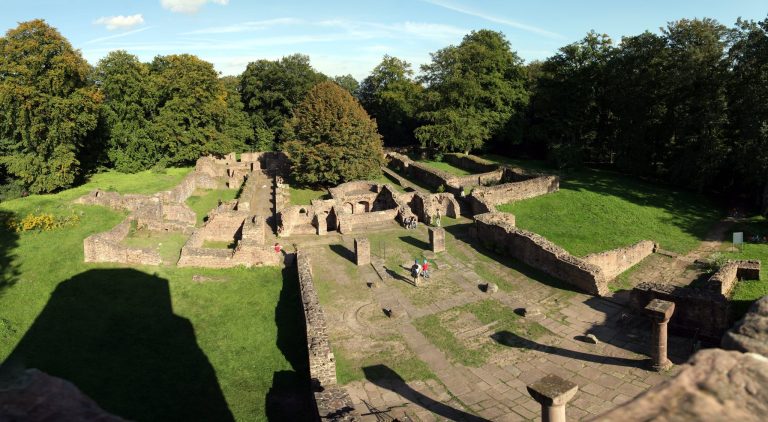
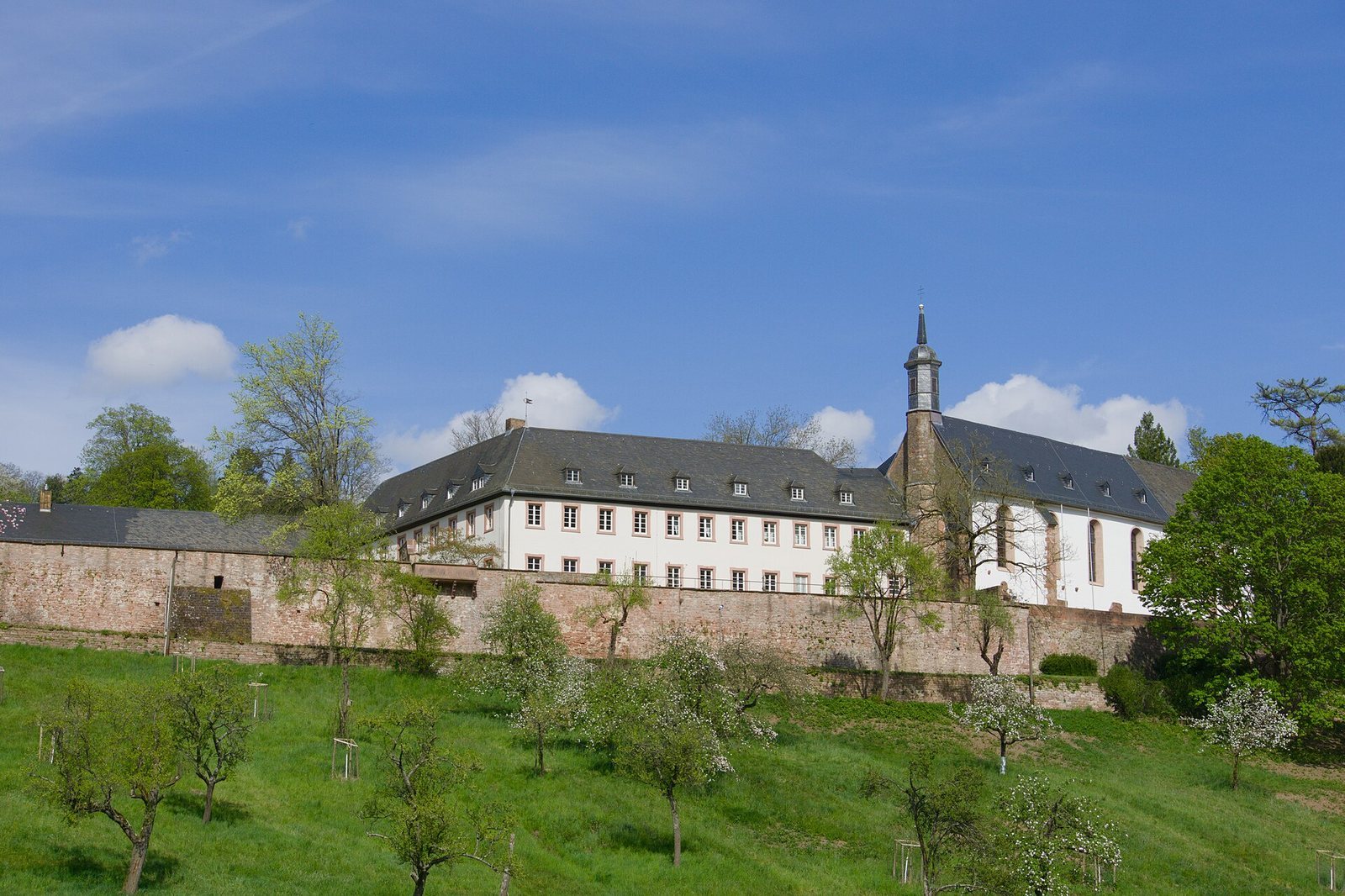
The abbey stands on the southern slope of the Köpfel, above the Neckar’s north bank, west of Heidelberg’s Ziegelhausen district and toward Neuenheim. The Mausbach joins the Neckar close to the site. The historic monastery nursery occupies a terrace above the main complex.
Abbey church
Worship space and windows
The church is arranged as one continuous room rather than as separate areas for clergy, monks, and other worshippers. Its single floor is made from Douglas fir grown in Heidelberg’s municipal forest. The casing around the altar and the reading stand, or ambo, are made of Corten steel, a weathering steel that develops a protective surface patina.
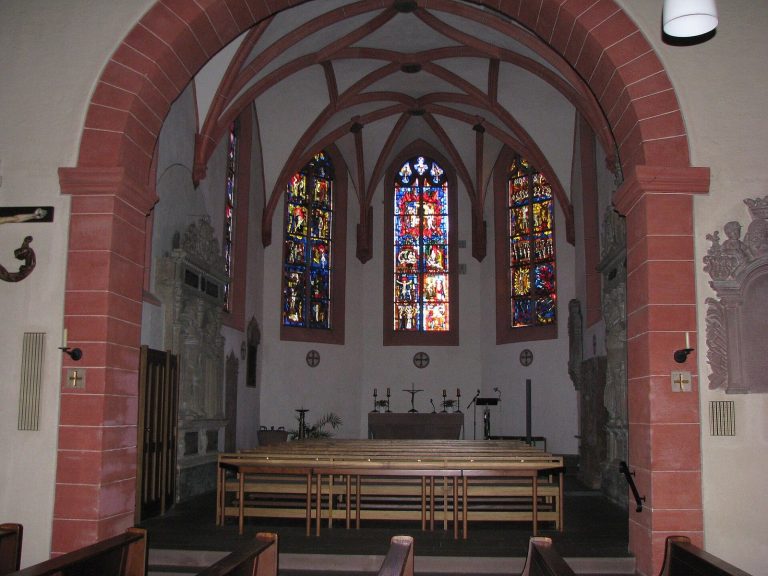
At the altar end, a central window showing Christ is flanked by images of Mary on the left and Benedict on the right. Valentin Peter Feuerstein designed these windows in the 1960s. Large, vividly colored windows designed by Maria Theresia von Fürstenberg fill the main worship space with colored light.
Chapels and memorials
A redesigned sacrament chapel lies on the church’s left side, through which the former Johannes Chapel can be seen. Dating to the 14th century, the Johannes Chapel is the oldest surviving building component of the monastery. It contains a 15th-century statue of Mary and a 13th-century figure of Pope Gregory the Great. A historic stained-glass window depicts Saint Bartholomew, patron of the church and monastery. A grave slab for Abbess Katharina of the Palatinate, who died in 1526, is set into the nave’s north wall.
Organ
Built in 1962 by Johannes Klais of Bonn, the organ stands on a raised gallery above the entrance. It has 34 stops, the controls that select different organ sounds, three keyboards, and a pedal. The keys operate mechanically, while electric controls select the stops. A steel frame attached to the roof structure supports the organ case.
Nursery and greenhouse
The nursery’s large red-sandstone greenhouse was built in the second half of the 18th century. Its sloping glass front originally included a feature designed to trap warmth from the sun. Between 1947 and 1950, the greenhouse was converted into a guesthouse for the abbey. From 1960 to 1990, the monastery’s horticultural work specialized in young ivy plants. Brother Ingobert Heieck assembled a collection of about 530 varieties, selected new ones, and cultivated the parent plants in a heated greenhouse. After his death, the German Ivy Society cared for the collection. In 2016, 300 varieties were transferred to the garden at Roggenburg Abbey, where they were arranged as a labyrinth.