Neuberg: A Medieval Castle Ruin in Czechia


Site at a Glance
- Rating
- 4.6
- Popularity
- Low
- Country
- Czechia
- Primary era
- Medieval
- External website
- Open
- Eras represented
- Medieval, Early Modern, Modern
- Civilizations
- Holy Roman Empire, Kingdom of Bohemia
- Site type
- Military
- Remains
- Castle
On this page14 sections
History
Neuberg is a hilltop castle ruin in Czechia, located at Podhradí near Aš. Its original core dates from the twelfth or thirteenth century, probably beginning in the early thirteenth century, and the castle is regarded as the oldest monument in the Aš region. It also gave its name to the Neuberg family, whose members held the castle during its early history.
Neuberg and the lords of Plauen
The first recorded mention of Neuberg dates from 1288, following the death of Albrecht of Neuberg. In that year, Rudolf of Habsburg, the Holy Roman Emperor, granted the castle to the lords of Plauen. They immediately returned it to the Neuberg family. In 1327, the Neuberger family transferred its directly held property to King John of Bohemia and received it back as a fief, meaning land held from a superior ruler in return for allegiance and obligations.
The castle was damaged by forces commanded for Charles IV, King of Bohemia and Holy Roman Emperor. Local nobles based at Neuberg had been raiding the imperial city of Eger, and the attack was connected with those conflicts. The castle was rebuilt soon afterward, but raids from the site continued.
The Zedtwitz period
From 1344, the related Zedtwitz family gradually acquired the Neuberg possessions in the Aš region. Neuberg passed to the Zedtwitz family in 1392. Konrad of Zedtwitz secured it in 1395 through his marriage to Hedwig of Neuberg, bringing the castle into the control of the family that would govern the region from it for several centuries.
In 1422, King Sigismund of Luxembourg granted the Zedtwitz estate independence from Cheb. The decision was probably connected with the family’s non-participation in the Hussite Wars, fifteenth-century conflicts in Bohemia associated with the religious reform movement founded by Jan Hus. The change affected the political and religious character of the Aš region. Lutheranism, a Protestant movement that spread through central Europe during and after the sixteenth-century Reformation, later became its strongest religious influence. A church dedicated to the Good Shepherd was built near the castle in the fifteenth century.
Until 1610, Neuberg was the central seat from which the Zedtwitz family governed the Aš region. The castle then burned down. The family divided its possessions and moved to new residences at Kopaniny, Doubrava, Smrčina, and Podhradí. Building material from the ruined castle was reused in the nearby residence at Podhradí, so the original appearance of the castle is no longer known.
Abandonment and preservation
After the Thirty Years’ War, the castle remained uninhabited and deteriorated. During the Second World War, its cellar vaults were converted into an air-raid shelter. The nearby upper residence burned in 1902 and was not reconstructed, while the castle and residence complex later suffered neglect, vandalism, and treasure hunting.
Discussion of safeguarding the remains began in the 1990s, and gradual repairs started after 2000. The ruined castle complex is a protected cultural monument of the Czech Republic, and the municipality of Podhradí is its current owner. Between 2015 and 2018, newly built stairs made the surviving tower accessible, and it has since been used seasonally as an observation tower.
Remains
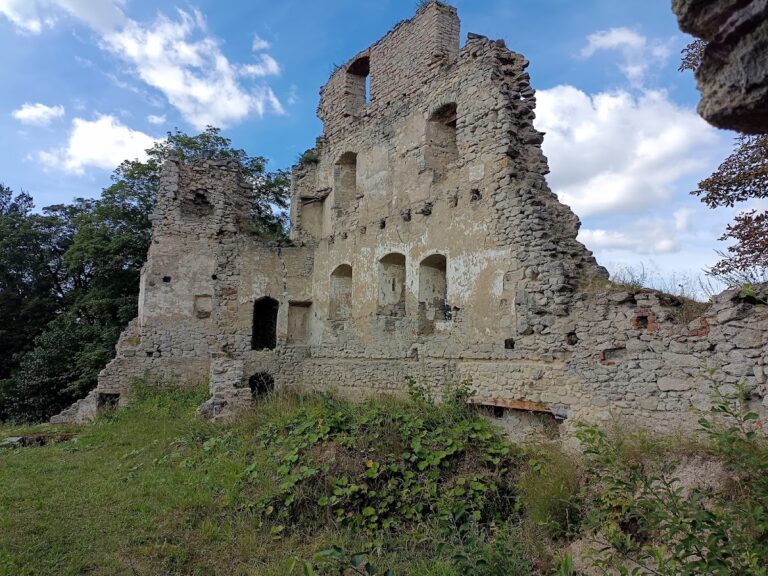
Neuberg occupies a hilltop setting and survives as a largely ruined complex divided into an upper castle, a lower castle, a circular tower, and associated remains. The principal surviving feature is the circular keep, while sections of walls and foundations preserve the outline of the former residential and defensive complex. Building stone was also removed for later construction, limiting the evidence for the castle’s complete original form.
Lower castle
Terrace and enclosing wings
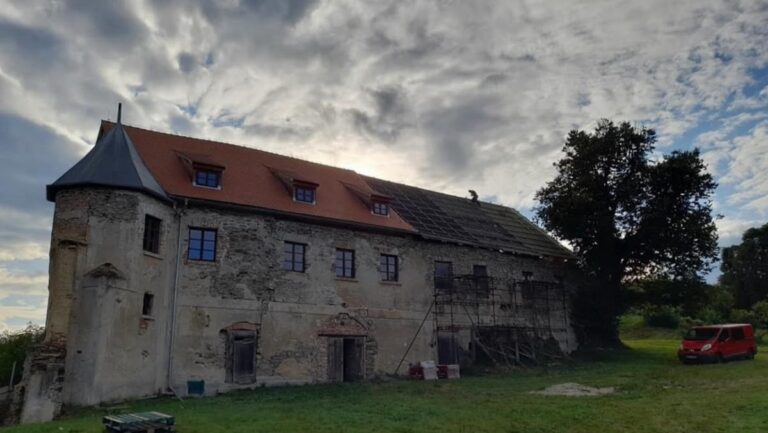
The lower castle was the first building of the complex. It stood on an artificially levelled terrace and originally consisted of three wings around a slightly trapezoidal inner courtyard. Perimeter walls survive on several sides, in places reaching the height of three above-ground storeys. Regularly spaced rectangular windows pierce these walls. The southern terrace wall is built of quarry stone, and the foundations of the southern wing remain visible.
Northeastern structure
The principal lower-castle building on the northeast side is rectangular. Its present form resulted from an early Baroque enlargement of an earlier Renaissance core. The surviving walls retain rectangular windows, linking the later building phase with the remains of the earlier residence.
Upper castle and tower
Circular keep
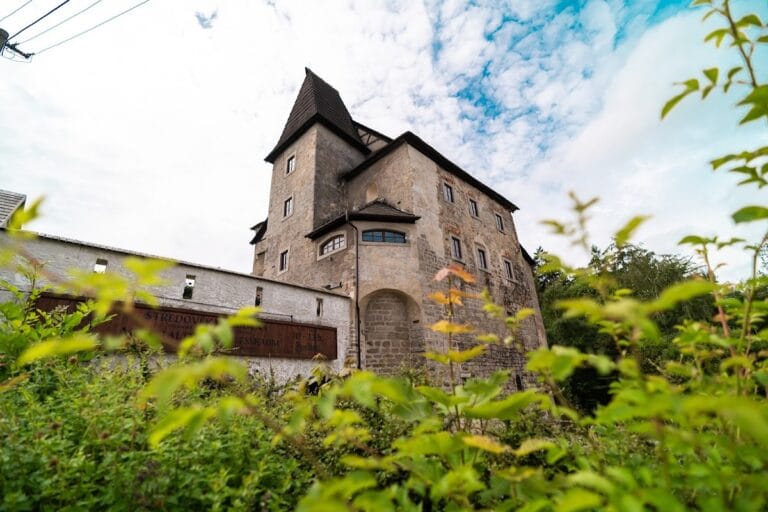
The circular keep, or principal fortified tower, is the most prominent surviving remnant of Neuberg. It is about 20 metres high and stands on a rocky spur measuring 29.5 metres in height. The tower has a circumference of 19.2 metres. Its restoration took place during the second decade of the twenty-first century, and the tower remains the main visible element of the original castle.
Upper residential complex
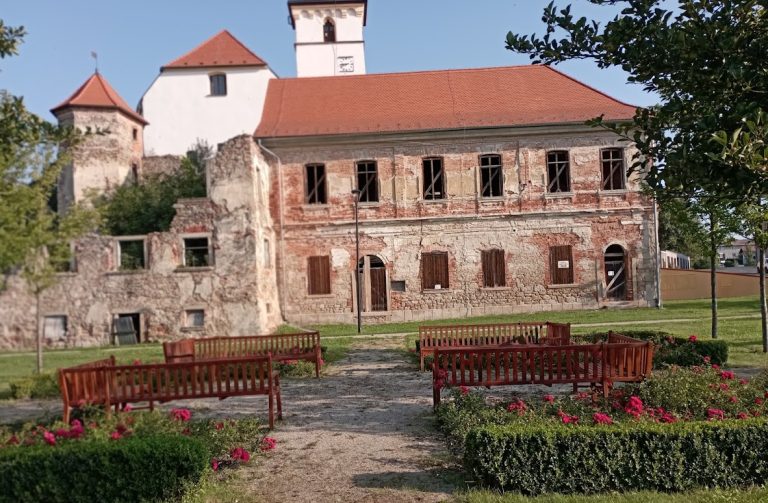
The upper castle is the best-preserved part of the former residential complex, although only sections of its external walls survive. Many rectangular-window façades retain Baroque stone surrounds with mouldings and frames. Remnants of the original plaster and stucco also remain on the walls, preserving details of the later residential appearance.
Associated remains
Brewery
A brewery was built in the castle’s southern moat. Its foundations and cellars survive as part of the ruined complex, providing evidence of an activity area outside the principal castle buildings.
Residences and Good Shepherd Church
The nearby ruined upper residence retains extensive wall remains. The lower residence deteriorated during the period of Czechoslovakia. On a nearby ridge stands the evangelical church dedicated to the Good Shepherd, built near the castle in the fifteenth century.
Nearby sites