Necarne Castle: A Victorian Gothic Estate House in Northern Ireland


Site at a Glance
- Rating
- 4.8
- Popularity
- Very Low
- Country
- United Kingdom
- Primary era
- Modern
- External website
- Open
- Eras represented
- Early Modern, Modern
- Civilizations
- British, English, Irish
- Site type
- Domestic
- Remains
- Castle
On this page9 sections
History
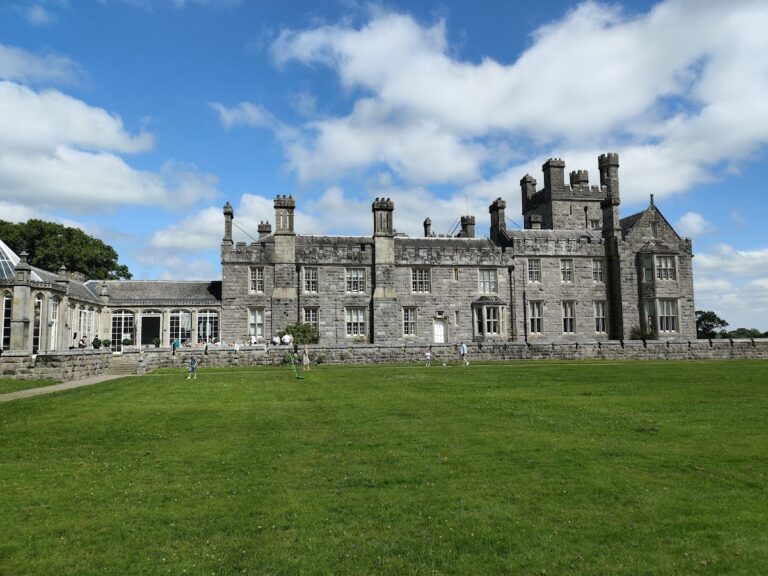
Necarne Castle is a Victorian Gothic house in the United Kingdom, standing near Irvinestown in Northern Ireland. The present building was begun in 1831 and completed in 1835, although the site originated with a fortified residence established during the early seventeenth-century settlement of Ireland.
The plantation estate
The surrounding land was known as Nakarney or Nakarna, a name whose origin remains uncertain. Following the English conquest of Ireland, land was taken or assigned to Scottish and other British colonists in 1610. Settlers were expected to build fortified residences and maintain armed forces against Irish clans seeking to recover their lands. The estate supported 24 tenants across approximately 1,000 acres, and a land patent was issued on 13 May 1611.
Edward Warde was among the earliest builders in the area around Irvinestown. Gerard Lowther acquired the estate in 1615 and is credited with constructing the first castle on the site around 1619. The original complex included a fortified house and a bawn, an enclosed defensive wall around a settler residence. Christopher Irvine received the land in 1629, after which the Irvine family retained the estate until 1922.
Traditions and the Irvine family
The name Necarne has been linked to more than one local tradition. One story associates it with scouts of Hugh Roe O’Donnell, an Irish Gaelic chieftain who resisted English rule in late-sixteenth- and early-seventeenth-century Ireland. According to the tradition, the scouts reported words interpreted as “there is no building there.” Another story says that defenders hid a small fort beneath turf during one of O’Donnell’s marches. A neighbouring field called the Turf Field or Turf Park is associated with this account.
Major George Marcus Irvine was born at Castle Irvine on 26 November 1760. He married Elizabeth d’Arcy on 31 March 1788. She was the daughter of Judge d’Arcy Irvien of Dummow Castle in County Meath, and the d’Arcy Irviens claimed descent from the Barons d’Arcy. Later owners included the Kennedy family, before Charles Cockburn d’Arcy Irvien eventually sold the castle.
The Victorian rebuilding
Captain Richard Autram Hermon of Sussex purchased the castle in 1925. A major restoration followed in 1927, and Hermon and his new wife later undertook a world cruise. Lord Mountbatten and Prince Bernhard of the Netherlands were among the castle’s visitors during this period.
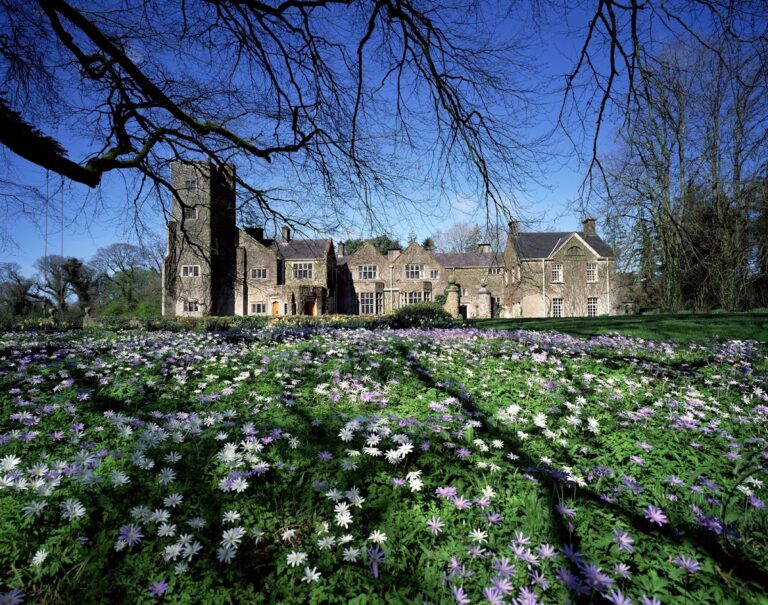
The present house is associated with a Victorian rebuilding in the 1830s. Its facade was designed by John Benjamin Keane, producing a two-storey Victorian Gothic composition that replaced or transformed the earlier plantation-era complex. The castle and its park are also described as having been rebuilt in Victorian style in 1830.
Wartime hospital and later uses
During the Second World War, Necarne Castle became a military hospital for wounded soldiers, particularly United States Navy personnel. Its capacity increased from 200 to 500 beds, and it housed the United States Army’s 28th Hospital. The building also served as a British and American army hospital. A small cemetery was established for Royal Air Force personnel who died during the Battle of the Atlantic.
After the war, the castle stood unoccupied and gradually deteriorated. Fermanagh local authority purchased it in 1981. From 1988, the Department of Agriculture leased the building as accommodation for agricultural students specialising in horse breeding. A later 25-year lease by the Department of Agriculture, Environment and Rural Affairs supported an equine training centre from the 1990s until 2023.
After the agricultural college left, the castle was described as vacant and deteriorating. Its condition led to closure of the building, while the surrounding park remained open during daylight hours. Necarne Castle is a listed building at Grade B+ level.
Remains
The site combines a two-storey Victorian Gothic castle-palace with the remains and historical footprint of an earlier fortified settlement. Necarne stands within Castle Irvine Demesne, a demesne being the land retained around a principal estate residence, including its park and associated grounds. The surrounding park lies near Irvinestown, a few kilometres from Lough Erne, in the Lakeland area.
Fortified settlement and estate grounds
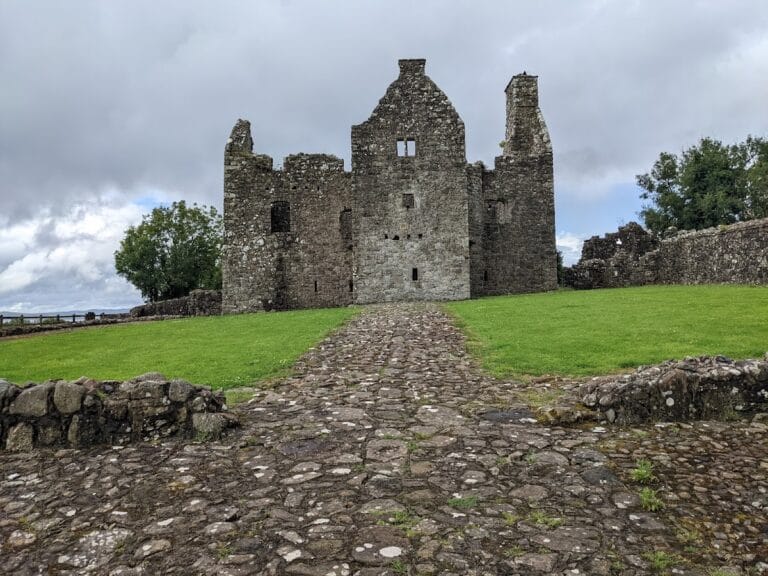
The first castle, built around 1619, formed part of a plantation-era complex that included a bawn, or fortified enclosure. This arrangement placed the residence within a defensive boundary associated with the settlement of colonists on the estate. The neighbouring Turf Field or Turf Park is physically connected with the tradition that an early fort was concealed beneath turf during one of Hugh Roe O’Donnell’s marches.
Victorian Gothic castle
The present building has a two-storey facade designed by John Benjamin Keane. It belongs to the Victorian Gothic mode, a nineteenth-century revival of medieval Gothic forms that often used pointed arches and castle-like compositions. Construction began in 1831 and was completed in 1835, while another description dates the rebuilding of the castle and park to 1830. The house later accommodated agricultural students studying equine subjects and served as an equine training centre before becoming vacant and progressively deteriorating.
Hospital and cemetery
The castle’s wartime physical history is reflected in its conversion into a hospital. The facility began with 200 beds and was expanded to 500, serving United States Navy personnel as well as British and American army patients. A small cemetery on the estate commemorates Royal Air Force personnel who died in the Battle of the Atlantic.