Enniskillen Castle: Maguire Stronghold and Military Garrison


Site at a Glance
- Rating
- 4.5
- Popularity
- Medium
- Country
- United Kingdom
- Primary era
- Modern
- External website
- Open
- Eras represented
- Medieval, Early Modern, Modern
- Civilizations
- British, English, Irish
- Site type
- Military
- Remains
- Castle
On this page12 sections
History
Maguire stronghold
Enniskillen Castle is a historic fortress in Enniskillen, United Kingdom, traditionally built for the Maguire family in 1428. The Maguires were an Irish ruling clan associated with County Fermanagh, and Hugh Maguire is traditionally credited with constructing the castle on a route toward Ulster. The exact construction date remains uncertain, while the first recorded historical reference dates to 1439. The fortress occupied an important position in the history of Enniskillen, protecting the western side of the town and routes toward County Sligo.
During the fifteenth and sixteenth centuries, the castle served as the Maguire family’s stronghold and as a centre of authority in County Fermanagh. In 1484, Sean Maguire of Enniskillen was chosen as clan chief. For most of the following century, the Maguire chiefs came from this branch of the family.
Sieges and the change of power
The castle became involved in the conflict between the English Crown and Irish forces during the late sixteenth century. Captain John Dowdall’s troops besieged it in 1594, and the fortress fell after a short assault on 2 February. A later siege that year was relieved, but the castle finally fell to the Irish in 1595. It remained in Irish hands until its capture in 1602 by Niall Garve O’Donnell, an ally of the English Crown.
In 1607, Captain William Cole was given command of Enniskillen Castle. He remodelled and refurbished the complex, rebuilt the keep, and added buildings for storage. Cole purchased the castle outright in 1623. The riverside Watergate is generally attributed to this period and was probably added around 1609. A tradition instead links it to Chonnacht Og Maguire, who owned the castle from 1566 to 1589, but a drawing made during Dowdall’s siege in 1594 does not show the gate.
During the Irish Rebellion of 1641, Rory Maguire unsuccessfully besieged the castle. The fortress sheltered Protestant settlers during the attack. In 1688, infantry and cavalry regiments were formed at Enniskillen. They later became the Royal Inniskilling Fusiliers and the 5th Royal Inniskilling Dragoon Guards, whose institutional successors are the Royal Irish Regiment and the Royal Dragoon Guards.
Garrison and museum complex
In 1796, the threat of a French invasion led to the remodelling of the castle as Castle Barracks and its conversion into a garrison fort. The 27th Regiment of Foot occupied the barracks from 1853 until it moved to St Lucia Barracks at Omagh in 1875. Following amalgamation, the regiment became the Royal Inniskilling Fusiliers in 1881.
Other regiments continued to use the barracks, and the complex became the home of the North Irish Horse, a Territorial Army unit, from November 1939. The barracks were decommissioned in 1950 and converted into a council depot. The castle was later opened as a heritage centre. It now accommodates the Fermanagh County Museum, the Inniskillings Museum, a local Heritage Centre, and the Fermanagh Visitor Information Centre. Enniskillen Castle is a State Care Historic Monument, a protected historic site maintained under Northern Ireland’s public heritage system, and is also managed by Fermanagh and Omagh District Council.
Remains
Castle layout and defensive fabric
The castle stands on the eastern bank of the River Erne, where the river reaches its broadest point, on the western part of the island of Enniskillen. Its plan is approximately square and set at a 45-degree angle, with a rounded southwestern corner. The complex is divided into a central tower keep and an enclosing curtain wall, the defensive wall linking towers and other strongpoints. Small projecting turrets called bartizans strengthen the curtain wall.
Central keep
A three-storey keep, the principal fortified tower of a castle, stands at the centre of the complex. It was formerly taller, but its battlements and upper smaller storey were removed. Only parts of the lowest storey probably belong to the fifteenth- or sixteenth-century fabric associated with the Maguire period. Its large windows date either from the 1796 conversion or from the reign of William IV, who was king of the United Kingdom from 1830 to 1837.
Courtyard buildings and moat
Much of the present complex consists of early nineteenth-century two-storey buildings arranged around a courtyard. The buildings along the western side, adjoining the river, were constructed in 1796. The current entrance passes between two two-storey buildings dating from about 1830. During the conversion to a garrison fort, a deep moat was excavated along the northern and eastern sides. Access was consequently shifted to the southeastern side, and a barracks installation was built within the castle walls.
Watergate
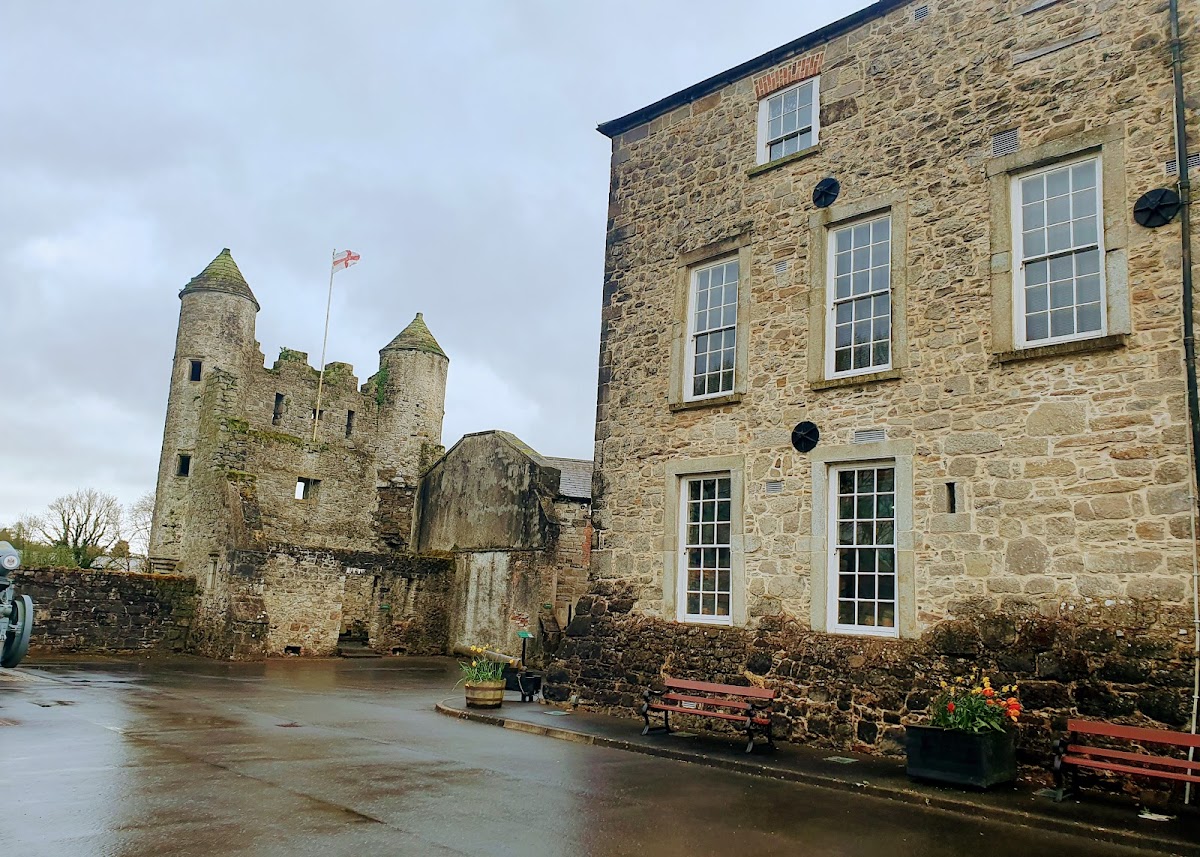
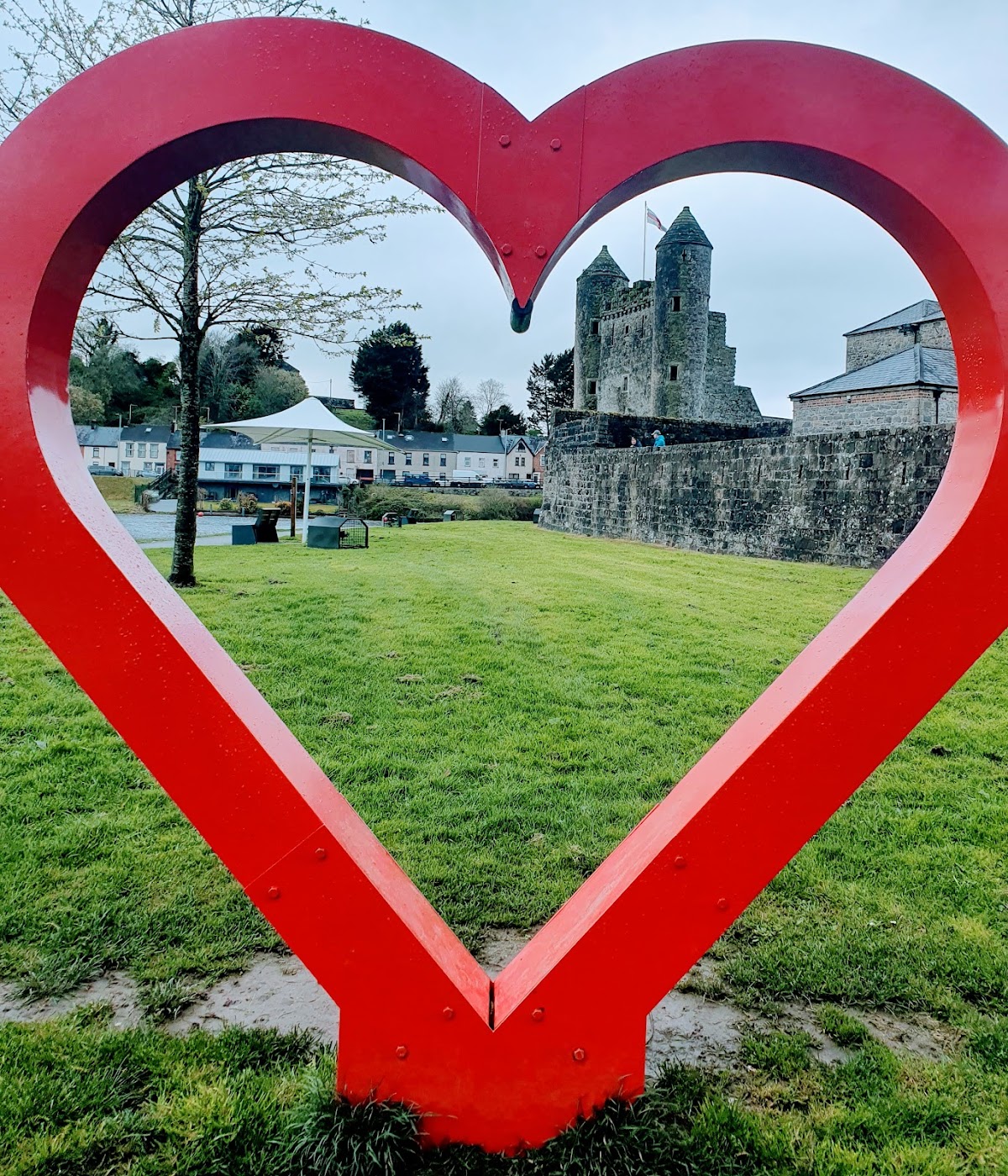
The early seventeenth-century Watergate stands on the southwestern side of the castle. Despite its name, it never provided access to the water. Its three-storey facade has stepped battlements and two relatively tall, round towers in the Scottish style. The towers project from the first floor and each has a stone conical roof.
The Watergate contains a deep well. Its two corbelled circular tourelles, small towers projecting from a larger building, and other architectural elements show a strong Scottish influence. The structure forms one of the clearest surviving expressions of the early seventeenth-century phase of the castle.
Museum collections
Fermanagh County Museum
The Fermanagh County Museum presents the history, culture, natural history, prehistory, rural life, local crafts, Belleek Pottery, and the history of Enniskillen Castle and the Maguire family. Its collections include archaeological finds, dioramas, medieval stone figures, industrial-period objects, an early Christian horn used on the River Erne, and a medieval stone head.
Inniskillings Museum
The Inniskillings Museum preserves military material associated with the Royal Inniskilling Fusiliers and the 5th Royal Inniskilling Dragoon Guards. Its displays include uniforms, medals, flags, regimental insignia, weapons, and other military objects, together with the regiments’ campaigns, including Waterloo in 1815 and the fighting at Garigliano in 1944.