Nebet Tepe: The Ancient Citadel of Plovdiv, Bulgaria


Site at a Glance
- Rating
- 4.7
- Popularity
- Medium
- Country
- Bulgaria
- Primary era
- Classical
- External website
- Open
- Eras represented
- Classical, Medieval
- Civilizations
- Byzantine, Kingdom of Macedon, Roman, Thracian
- Site type
- Military
- Remains
- Citadel
On this page13 sections
History
Nebet Tepe is an ancient citadel and acropolis in Plovdiv, Bulgaria, one of the hills on which the city was founded. The hill was first occupied by Thracians, with settlement activity reaching back to the 4th millennium BC. The early settlement was associated with Eumolpias, an ancient name linked to the origins of Plovdiv.
Thracian and Hellenistic foundations
As the settlement expanded during the Hellenistic period, the era of Greek cultural influence that followed the conquests of Alexander the Great, Nebet Tepe became the fortified elevated center of the urban community. This expansion is associated with Philip II of Macedon, the fourth-century BC king of Macedon and father of Alexander the Great. The hill therefore formed the defensive and administrative core of the growing ancient town.
Nebet Tepe was also connected in antiquity with Musaeus, a figure of Greek and Thracian literary and religious tradition who was traditionally described as the most gifted student of Orpheus. The name used today derives from the Turkish words nevbet, meaning “guard,” and tepe, meaning “hill.” It is traditionally linked to the belief that a garrison or small fortification watched over the city from the summit.
Roman and Byzantine use
The hill remained in use during the Roman and Byzantine periods. Trimontium, the ancient name particularly associated with Roman Plovdiv, continued to rely on the fortified heights as part of its urban defenses. An acropolis is also described as having been built under the Roman emperor Trajan, who ruled from AD 98 to 117.
During the Byzantine period, the later Roman Empire centered on Constantinople, a postern, or concealed passage through a fortification, was constructed beneath the northern wall. It dates to the sixth century AD and was built during the reign of Justinian I, the Byzantine emperor who ruled from AD 527 to 565. The belief that the Apostle Paul passed through this tunnel remains uncertain.
Archaeology and conservation
Archaeological research has revealed successive remains from the Thracian settlement, the ancient fortifications, later buildings, and the acropolis. Research, conservation, and presentation were undertaken through the project “Along the Fortress Walls of Philippopolis.” The Municipality of Plovdiv assigned management of the complex to the Regional Archaeological Museum in Plovdiv. Nebet Tepe is a cultural monument of national significance, and the archaeological complex is partially restored.
Remains
Hilltop layout and fortifications
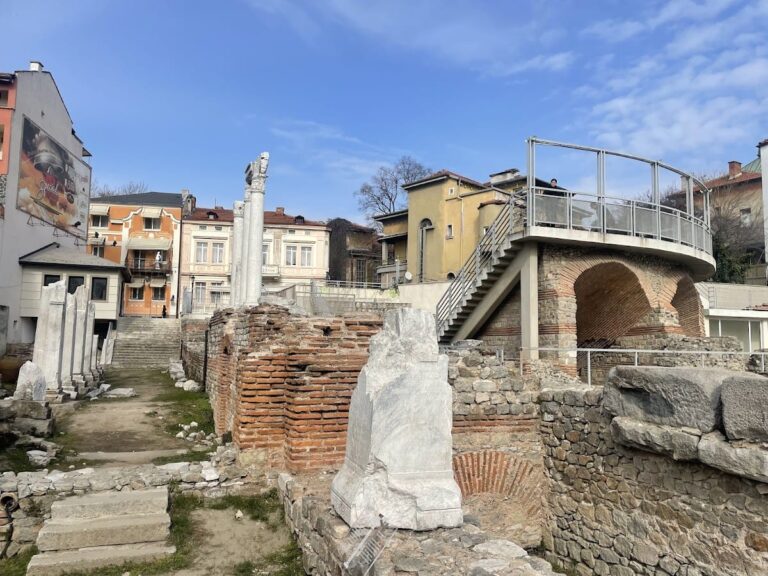
Nebet Tepe occupies a flattened hill in Plovdiv’s Old Town, rising to approximately 205 metres above sea level. Its position overlooks the Maritsa River, the Balkan Mountains, and Sredna Gora. Excavations have exposed parts of the Thracian settlement, the fortifications of ancient Trimontium, ancient buildings, and the acropolis. Surviving construction uses stone, brick, and marble.
Early city walls
The oldest identified part of the fortifications dates to the fourth century BC. It was built from large, closely fitted syenite blocks laid with minimal gaps and without mortar. This method, known as Cyclopean masonry, uses very large stone blocks with little or no binding material. The walls formed part of the defenses established when Nebet Tepe became the citadel and acropolis of the expanding ancient town.
Western tower
The western wall includes a substantial quadrangular tower and its entrance. These remains belong to the period when the hill served as the fortified center of the ancient settlement. Later stone construction is also preserved among the excavated remains.
Passages and water installations
Northern postern
Beneath the northern wall lies a distinctive postern with a staircase. The passage is a secret tunnel cut into the rock during the Roman period and constructed in the sixth century AD. It is thought to have led towards the banks of the Maritsa River, although the tradition connecting it with the Apostle Paul remains uncertain.
Southern reservoir
Water reservoirs on the hill supplied the city. A preserved rectangular reservoir in the southern part has a capacity of 350 cubic metres. Its walls were built in alternating layers of stone and brick, while the interior walls and floor were coated with waterproof material.
Roman defensive remains
First-century bastion
Excavations in 2016 exposed a Roman wall bastion dating to the first century AD. Together with the walls, towers, later stonework, and other excavated structures, it forms part of the surviving defensive fabric of Nebet Tepe.