Nagahama Hachimangū: A Shinto Shrine and Former Buddhist-Shinto Complex in Japan


Site at a Glance
- Rating
- 4.1
- Popularity
- Low
- Country
- Japan
- Primary era
- Early Modern
- External website
- Open
- Eras represented
- Early Modern
- Civilizations
- Japanese
- Site type
- Religious
- Remains
- Sanctuary
On this page8 sections
History
Nagahama Hachimangū is a Shinto shrine in Nagahama, Japan, founded in 1069 within Shin-Hōshōji and built in the Shinmei-zukuri style. Dedicated to Hachiman, a major Japanese deity associated with warriorship and later identified with Emperor Ōjin, it became the tutelary shrine of eleven villages and the center of a large Buddhist-Shinto religious complex.
Foundation and religious development
Shin-Hōshōji was traditionally attributed to the Buddhist monk Kūkai, who was said to have founded it in 814. The shrine’s foundation followed Minamoto no Yoshiie’s prayer there for victory during the Former Nine Years’ War, a campaign against the Abe brothers, Sadatō and Munetō. After Yoshiie defeated them, Shin-Hōshōji received the imperial title Shōgunzan. Under an imperial devotional commission, a sacred spirit was then transferred from Iwashimizu Hachimangū and enshrined at the new shrine.
The shrine and temple formed part of shinbutsu-shūgō, the historical integration of Buddhist and Shinto institutions and sacred spaces. The surrounding area became known as Hachiman Estate, and the shrine was also called Shōgunzan Shin-Hōshōji Hachimangū, Sakata Hachimangū, and Sakata Betsugū Hachimangū. Tradition described the combined complex as containing more than 300 temple and shrine establishments, or alternatively 73 monastic quarters. It was also reputed to have exceeded Iwashimizu Hachimangū, its head shrine, in influence.
Patronage and medieval expansion
The imperial household and military leaders strongly supported the complex. During the Muromachi period, Ashikaga Yoshinori, the sixth shogun of the Ashikaga shogunate, repaired the shrine buildings. A three-story pagoda was erected at Shin-Hōshōji, while swords and sacred horses were offered. In 1536, Emperor Go-Nara granted the shrine estates assessed at 3,000 koku, a historical measure of agricultural production. The Azai family, lords of Odani Castle, also donated estates, swords, and sacred horses.
Destruction and Hideyoshi’s restoration
The shrine and Shin-Hōshōji were drawn into the conflict between Oda Nobunaga and Azai Nagamasa during the Genki era, from 1570 to 1573. Almost the entire complex was burned, and it subsequently declined.
In 1574, Hashiba Hideyoshi, then lord of Nagahama Castle and later known as Toyotomi Hideyoshi, began restoring the complex. He exempted a site measuring two chō from east to west and one chō from north to south from taxation, and endowed the temple-shrine complex with land assessed at 70 koku. Halls and shrine buildings were rebuilt, and both Shin-Hōshōji and Nagahama Hachimangū had been restored by 1591. This rebuilding is regarded as one origin of the Nagahama Hikiyama Festival.
Hideyoshi’s restoration also brought the rebuilding of more than 20 monastic quarters around Shin-Hōshōji and Nagahama Hachimangū, including Myōkaku-in and the academic temple Shana-in. Their number later rose to about 70, then fell to more than 30 between 1596 and 1645 and to 21 between 1681 and 1684.
Modern transformation and festivals
The Meiji government’s policy separating Buddhism and Shinto formally dismantled the combined religious complex. Shin-Hōshōji and its affiliated monastic quarters were abolished, while Shana-in survived as the former complex’s academic temple. Buddhist images and documents from Shin-Hōshōji and its subsidiary temples were transferred there, and the shrine took the name Nagahama Hachimangū.
Lightning destroyed the main sanctuary in 1885, and it was rebuilt in 1889. The shrine became a prefectural shrine in 1895 and was added to the Association of Shinto Shrines’ Beppyo list in 2006. The Nagahama Hikiyama Festival, a traditional event that began in the Azuchi-Momoyama period, takes place from April 9 to 17 and includes processions of festival floats. In 2016, it was included in UNESCO’s Intangible Cultural Heritage listing of 33 Japanese yama, hoko, and yatai float festivals. The spring grand festival is held on April 15, and the annual festival on October 15.
Remains
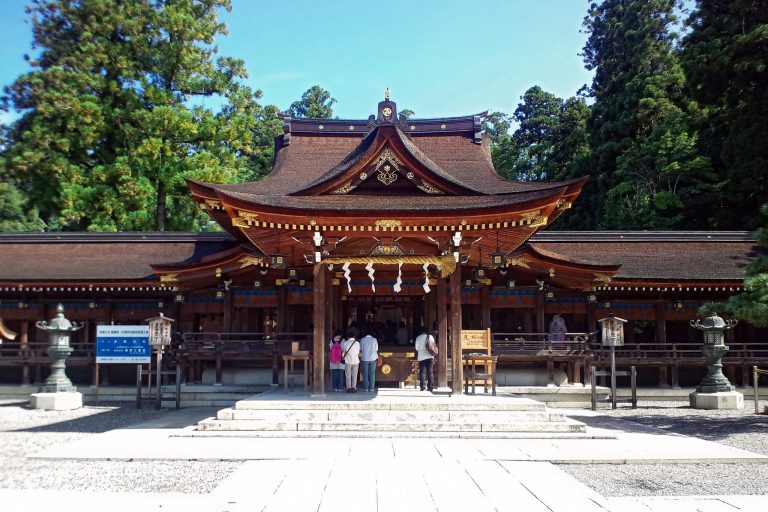
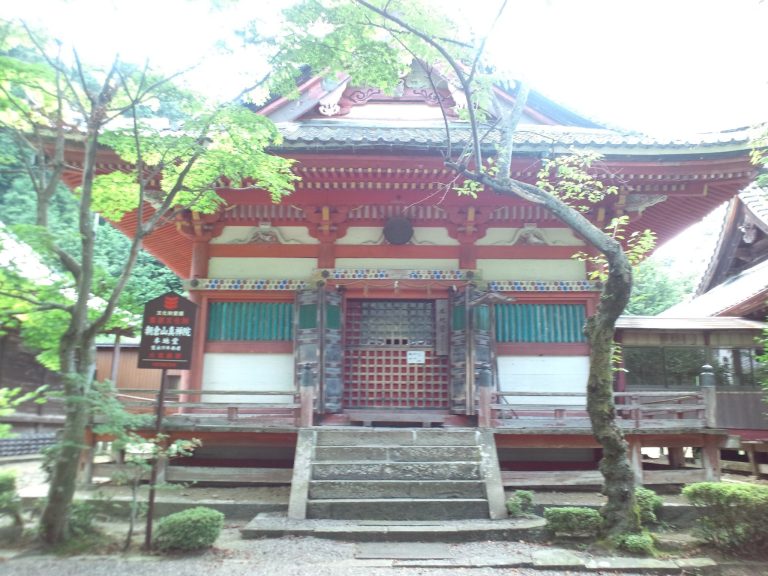
The precinct at Miyamae-chō includes the main sanctuary, affiliated shrines, and Shana-in immediately to the east. The main sanctuary follows the Shinmei-zukuri style. The surviving religious setting also preserves the connection with the former Buddhist-Shinto complex through the neighboring academic temple and the Buddhist images and documents transferred there.
Main shrine precinct
The principal deities are arranged among three sanctuaries. Hondawake no Mikoto is enshrined in the central sanctuary, Tarashinakan no Mikoto in the eastern sanctuary, and Okinaga Tarashihime no Mikoto in the western sanctuary. The precinct also contains Tsukubusuma Shrine, Tenmangū, Kōra Shrine, Kotohira-gū, Kawasogi Shrine, Suehiro Inari Shrine, Jinushi Shrine, and Kumano Shrine.
The affiliated shrines enshrine Ichikishimahime, Sugawara no Michizane, Takenouchi no Sukune, Ōmononushi, Seoritsuhime, Ukanomitama, Satahiko, Ōmiya no Me, Ketsumiko no Mikoto, Kumano Hayatama no Mikoto, and Kumano Fusumi no Mikoto. Together, these buildings form the shrine’s present group of sacred spaces.
Shana-in and the former complex
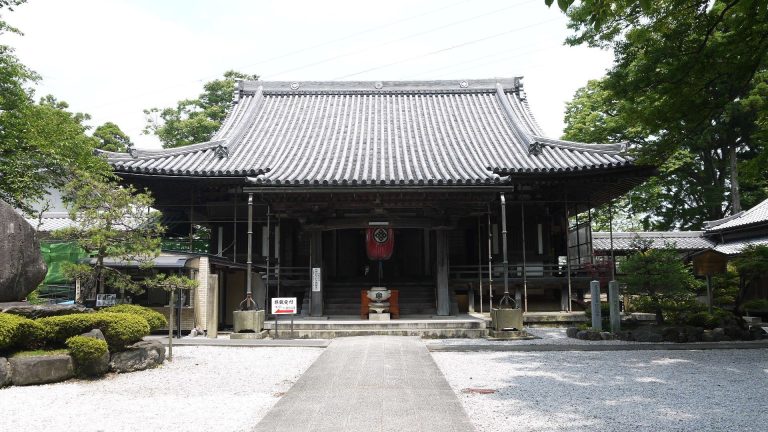
Shana-in stands immediately east of Nagahama Hachimangū. It preserves Buddhist images and documents transferred from the abolished Shin-Hōshōji complex and its former subsidiary temples, and it survives as the academic temple associated with that earlier institution.
The former complex included a three-story pagoda at Shin-Hōshōji and numerous monastic quarters surrounding the temple and shrine. The rebuilding of these quarters after Hideyoshi’s restoration shaped the larger religious setting that once extended around Nagahama Hachimangū.