Kokutai-ji Temple: Head Temple of a Rinzai Zen Branch


Site at a Glance
- Rating
- 4.2
- Popularity
- Low
- Country
- Japan
- Primary era
- Unclassified
- External website
- Open
- Eras represented
- Unclassified
- Civilizations
- Unclassified
- Site type
- Religious
- Remains
- Monastery
On this page13 sections
History
Kokutai-ji Temple is a Rinzai Zen temple in Japan, located in Takaoka, Toyama Prefecture. Its origins are traditionally traced to 1296, when the monk Jiun Myoi established a meditation hut on Mount Futakami. Today it serves as the head temple of the autonomous Kokutai-ji branch, one of fourteen autonomous branches of the Rinzai school, and is the largest Zen monastery currently operating in the Hokuriku region.
Origins and Imperial Recognition
Jiun Myoi studied under Shinchi Kakushin, also known as Hottō Kokushi, a Buddhist monk regarded as the founder of the Hottō line of Rinzai Zen. After returning to Mount Futakami in 1299, Jiun attracted monks who came to visit him. Around 1300, the original hut developed into a temple called Tosho-ji.
In the late 1320s, Emperor Go-Daigo is said to have granted the temple the imperial name Kokutai-ji. The emperor also awarded Jiun a purple robe and the honorific name Seisen Zenji. The institution’s formal name became Gokoku Machozan Kokutai Nio Mannen Zenji, incorporating the name of Mount Machozan and the phrase “Kokutai Nio Mannen Zenji.”
Ashikaga and Sengoku Periods
Under the Ashikaga shogunate, Japan’s medieval military government, Kokutai-ji was designated an Ankoku-ji. These temples formed part of a nationwide Ashikaga program that paired a temple and a memorial tower in each province and on Japan’s major islands.
During the Sengoku period, warfare connected with Moriyama Castle brought damage and decline to Kokutai-ji. Destruction was attributed to forces associated with Uesugi Kenshin. The Jinbo clan later supported restoration, and Emperor Go-Nara requested that Settei Shukuyo, the temple’s twenty-eighth head, undertake reconstruction. Kokutai-ji was probably moved from Mount Futakami to its present location on Mount Machozan around 1580.
In 1585, Maeda Toshiie ordered the confiscation of the abbot’s quarters for transfer to Moriyama Castle, where they were to be used as a study. The same order confirmed the temple’s small subsidiary temples and mountain forest as protected holdings. The letter of protection associated with this order is designated a cultural property of Takaoka City.
Tokugawa Status and Meiji Rebuilding
During the Edo period, the Tokugawa shogunate designated Kokutai-ji the head temple of the Hottō-ha branch of the Rinzai tradition. This gave the temple high formal status and close ties to the Tokugawa family, including the privilege of offering greetings to the shogun.
A monastic training hall was formally opened in 1893 under the abbot Dotsu Setsumon. Kokutai-ji declined during the early Meiji period as the Fuke sect, a Zen tradition associated with itinerant komuso monks and meditative shakuhachi music, was dissolved. The temple was incorporated into the Rinzai Shokokuji branch, but regained independence in 1905 as the Rinzai Kokutai-ji branch.
The temple was also affected by the Meiji anti-Buddhist movement. Yamaoka Tesshu, a nineteenth-century samurai, swordsman, and statesman, supported the rebuilding of the Imperial Hall and the repair of other temple buildings. These works formed part of Kokutai-ji’s recovery after the institutional disruptions of the period.
Modern Religious Life
Since Inaba Shinden became resident at Kokutai-ji in 1964, he has advocated respect for life. He proposed reconstructing a memorial Risho Tower, a Buddhist structure associated with prayers for living beings and the preservation of peace, as a symbol and center for peace and the protection of life.
Kokutai-ji is a headquarters of the Myoonkai, an organization associated with the komuso tradition. During the June 2–3 memorial observance for Jiun Myoi, komuso gather at the temple to recite sutras and perform on the shakuhachi, an end-blown bamboo flute used in this tradition.
The annual religious calendar also includes the Buddha’s Birthday ceremony on May 8, a tea-offering ceremony on June 11, the Thousand-Day Pilgrimage at the Kannon Hall on August 11, the Jizo Bon Festival at the Kannon Hall on August 24, and the November 12–13 memorial service for Hottō Kokushi. The June tea offering is conducted by the Omotesenke school of tea. Kokutai-ji is also the twenty-fourth temple on the Hokuriku Thirty-Three Kannon Pilgrimage and the third on the Ecchu Kannon Pilgrimage.
Remains
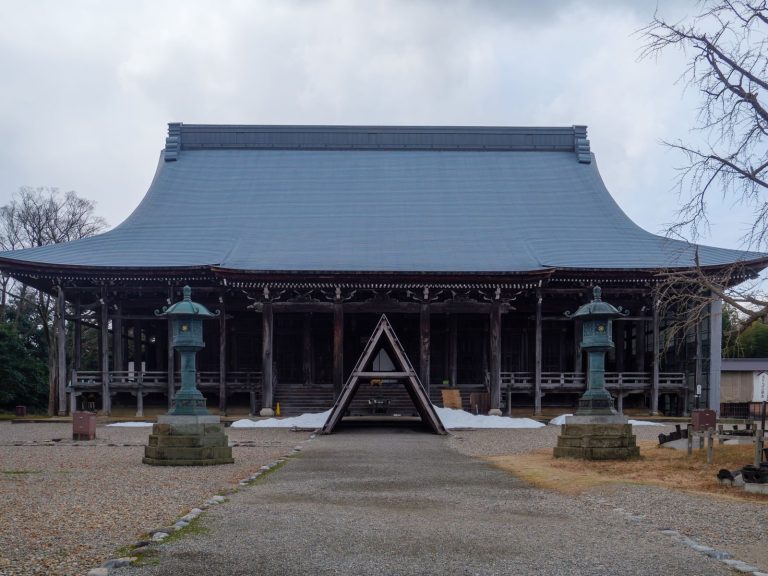
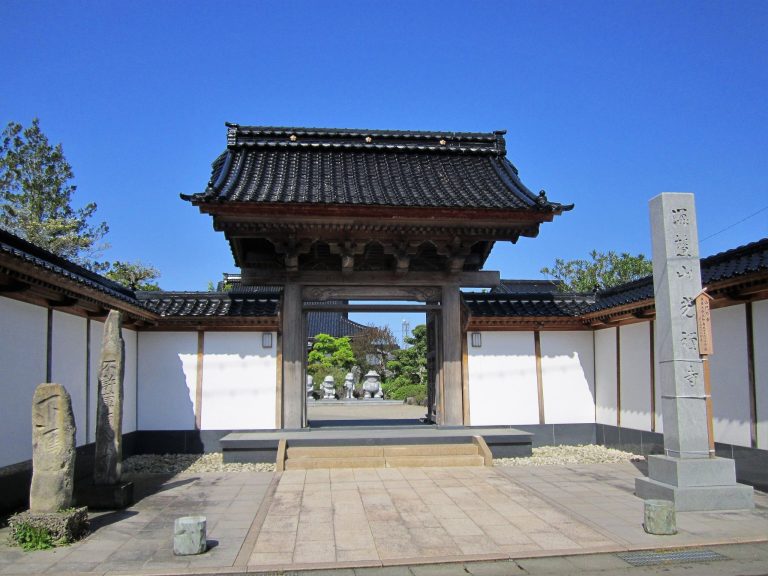
Kokutai-ji occupies a temple complex on Mount Machozan at 184 Ota in Takaoka. Its original foundation hut stood on Mount Futakami, southeast of the present site. The present complex contains facilities for Zen practice, worship, memorial observances, and pilgrimage. Its principal image is Shaka Nyorai, the Buddha Shakyamuni.
Temple Halls and Religious Spaces
Zendo
The complex includes a zendo, or Zen meditation hall, used for seated Zen meditation. Its presence reflects Kokutai-ji’s continuing function as a Rinzai Zen monastery and training institution.
Kannon Hall
The Kannon Hall is dedicated to Kannon, a bodhisattva associated with compassion. It is the setting for the Thousand-Day Pilgrimage on August 11 and the Jizo Bon Festival on August 24. The latter honors Jizo, a Buddhist protector especially associated with children and the dead.
Imperial Hall
The Imperial Hall was rebuilt during the Meiji-period repairs supported by Yamaoka Tesshu. It forms part of the temple’s present group of buildings and represents the rebuilding that followed the pressures placed on Kokutai-ji during the early Meiji period.
Historical Objects and Records
Maeda Toshiie’s Letter
The 1585 letter of protection issued by Maeda Toshiie records the removal of the abbot’s quarters for use at Moriyama Castle. At the same time, it protected Kokutai-ji’s small subsidiary temples and mountain forest, providing evidence of the temple’s institutional holdings during the late Sengoku period.
Armor Associated with Kondo Isami
A suit of armor associated with Kondo Isami, a nineteenth-century swordsman and commander of the Shinsengumi, was found at Kokutai-ji during a survey of the temple’s cultural properties in October 2020. The armor is described as having been donated by Yamaoka Tesshu, linking the object to the figure who supported the temple’s Meiji-period rebuilding.