Kōgen-ji Temple: A Jōdo Shinshū Temple and Home of an Eleven-Headed Kannon

Site at a Glance
- Rating
- 4.1
- Popularity
- Very Low
- Country
- Japan
- Primary era
- Early Modern
- Eras represented
- Early Modern
- Civilizations
- Japanese
- Site type
- Religious
- Remains
- Temple
On this page7 sections
History
Traditional Foundations at Dōganji
Kōgen-ji Temple is an Ōtani-branch Jōdo Shinshū Buddhist temple in Nagahama, Japan, dedicated principally to Amida Buddha. Its associated Dōganji Kannon Hall preserves the religious identity of an earlier center traditionally founded by the monk Taichō in 736. According to tradition, Emperor Shōmu ordered Taichō to pray against a smallpox epidemic in the capital. Taichō carved an Eleven-Headed Kannon, a form of the compassionate bodhisattva Kannon with multiple heads representing different protective aspects, and established a religious center where prayers were offered for protection from disease, long life, and the welfare of the people.
Another tradition attributes the creation of a seven-hall temple complex at Dōganji to Saichō in 790, under imperial orders. Saichō founded the Tendai school, a major Japanese Buddhist tradition. A separate predecessor temple at the site is associated with Kūkai, founder of the Shingon school, and is said to have been established during the Enryaku era, between 782 and 806. These traditions connect the site with two influential Buddhist lineages before its later affiliation with Jōdo Shinshū.
Warfare and Sectarian Transformation
In 1570, warfare between the Asai and Oda forces resulted in the burning of Dōganji’s buildings. To protect the Eleven-Headed Kannon, the resident priest and nearby inhabitants buried the image. The following year, the Iguchi clan, retainers of the Asai clan, constructed a hall at the site and enshrined the Kannon with seated images of Shaka Buddha, the historical Buddha, and Dainichi Buddha, the central cosmic Buddha of esoteric Buddhism. The hall had no resident priest or sectarian affiliation, and local people maintained it as the village’s tutelary-Buddha institution.
During the Keichō era, between 1596 and 1615, the separate predecessor temple traditionally linked with Kūkai became associated with Kyōnyo and reportedly changed from Shingon Buddhism to Jōdo Shinshū, a Pure Land tradition centered on devotion to Amida Buddha. That temple was later discontinued, and Kōgen-ji was established. The Dōganji Kannon Hall continued as a separate precinct belonging to the temple, allowing the Kannon to remain associated with Kōgen-ji while its main hall followed Jōdo Shinshū practice.
Protection as a Cultural Property
In 1888, Kuki Ryūichi and other investigators from the Imperial Household Ministry’s national treasure survey examined the Eleven-Headed Kannon and praised it as one of Japan’s outstanding sacred images. The statue received a national-treasure designation on December 28, 1897, under the first national treasure system created by the Ancient Shrines and Temples Preservation Law. That earlier category corresponded approximately to the present Important Cultural Property category.
The Kannon had previously been owned by the local community. In 1900, responsibility for the image passed to neighboring Kōgen-ji because the village could no longer hold a national treasure. Since Jōdo Shinshū generally permits only Amida Buddha in the main temple hall, the head temple authorized the Kannon to remain in a detached hall and precinct. The Kannon Hall was rebuilt in 1925 with features modeled on Heian-period architecture, the architectural tradition associated with Japan’s courtly and Buddhist culture between 794 and 1185. In 1942, the detached precinct and hall were formally incorporated into Kōgen-ji under the Religious Organizations Law.
The Eleven-Headed Kannon received its present national-treasure designation under the Cultural Properties Protection Law in 1953. From that year, directors of the Takatsuki National Treasure Preservation Support Association took turns maintaining the Kannon and the seated Dainichi Buddha each day. Kōgen-ji’s protected holdings include the wooden Eleven-Headed Kannon and the wooden seated Dainichi Buddha, among other cultural properties.
Remains
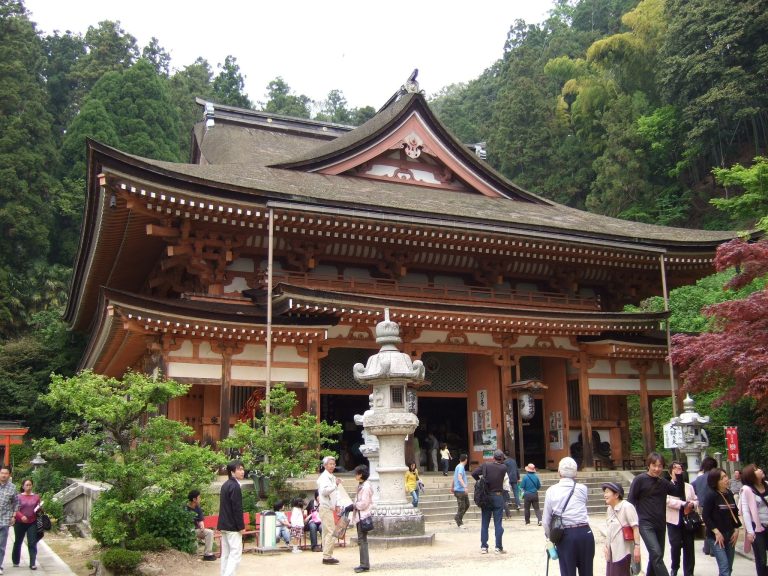
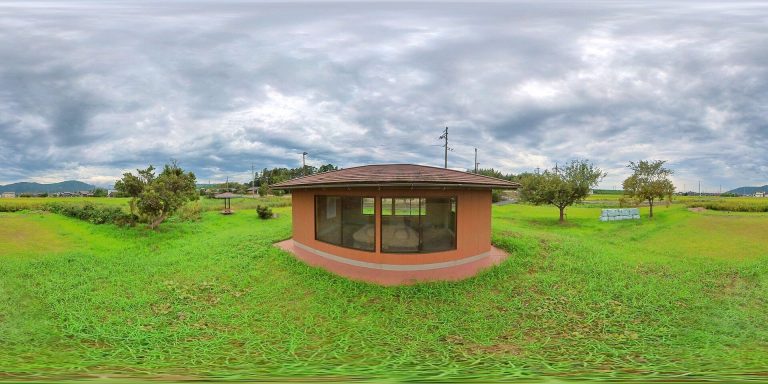
Dōganji Kannon Hall
The surviving complex includes the detached Dōganji Kannon Hall, which belongs to Kōgen-ji but stands apart from the temple’s main hall. Reconstructed in 1925, the hall incorporates architectural features modeled on the Heian period. Its separate position reflects the historical arrangement by which the Kannon remained enshrined in its own precinct while Kōgen-ji’s principal worship centered on Amida Buddha.
Eleven-Headed Kannon
The Eleven-Headed Kannon is a standing wooden image carved mainly from a single block of Japanese cypress. Including its uppermost head, it measures 194 centimeters in height and stands on a lotus pedestal. The left leg bears the body’s weight, while the right is relaxed, and the waist turns slightly to the left. The right arm hangs beside the body with its palm facing forward and fingers extended. The left arm bends at the elbow to hold a ritual water vessel at chest level.
Most of the statue, including the core of the lotus seat and detached portions of the celestial robe, was carved from one piece of wood. The uppermost head, the small Buddha figure on the front of the crown platform, the sections of both arms below the wrists, the water vessel, and the chest ornament were made separately. The small Buddha figure, lower hands, and vessel are later replacements. The hair was partly formed with wood-powder lacquer, while the surface retains the natural, unpainted wood without pigment or gold leaf. The body was hollowed from the back and sealed with two cover boards, one above the other.
The image’s eleven heads form an unusual arrangement. Large wrathful faces with protruding fangs flank the principal face. The crown platform bears two bodhisattva faces, two wrathful faces, and two protruding-fang faces, while the rear carries a great-laughter face. The summit has another bodhisattva face, bringing the total to eleven. Unlike the more usual summit Buddha form with spiral hair, this head has tied hair and a five-wisdom crown representing the five wisdom Buddhas. Seated Buddha figures appear at the fronts of the tied hair on the other upper heads.
Drum-shaped ear ornaments and long decorative cords extend from the crown platform down to the forearms. The balanced body, full modeling of the chest and thighs, and twisted posture with one relaxed leg have been described as suggesting Indian and Central Asian artistic influence. The image was moved from the Kannon Hall to a storage repository in 1974. Historically, it was enshrined together with seated images of Shaka Buddha and Dainichi Buddha.