Hōgon-ji Temple: A Buddhist Pilgrimage Temple on Chikubushima


Site at a Glance
- Rating
- 4.4
- Popularity
- Medium
- Country
- Japan
- Primary era
- Early Modern
- External website
- Open
- Eras represented
- Medieval, Early Modern, Modern
- Civilizations
- Japanese, Kamakura shogunate, Toyotomi regime
- Site type
- Religious
- Remains
- Temple
On this page17 sections
History
Hōgon-ji Temple is a Buddhist temple on Chikubushima Island in Japan, within Nagahama, Shiga Prefecture. Traditionally founded in 724 during the Nara period at the command of Emperor Shōmu and through the efforts of the monk Gyōki, it became a center of Benzaiten and Kannon worship and remains the thirtieth temple on the Saigoku Kannon Pilgrimage.
Foundation and early traditions
Hōgon-ji’s formal name is Iwakin-san Hōgon-ji, and the temple belongs to the Shingon-shū Buzan-ha school. Its principal image is a normally concealed sacred image of Benzaiten, the Japanese Buddhist form of the Indian goddess Sarasvati, associated with water, music, eloquence, learning, and good fortune. The temple is also popularly known as the Chikubushima Kannon.
The traditional foundation story relates that Amaterasu appeared to Emperor Shōmu in a dream and instructed him to establish a temple on Chikubushima, an island sacred to Benzaiten. The deity promised peace, plentiful harvests, and prosperity. Shōmu then directed Gyōki, an influential Nara-period monk associated with temple building and public works, to visit the island and enshrine an image of Benzaiten at the neighboring Tsukubusuma Shrine.
Tradition places Gyōki’s proposal for a Kannon hall in 725. A later lord of Azai County is said to have continued the plan by enshrining a Thousand-Armed Kannon. The Chikubushima Engi, compiled in 931, gives a different sequence. It places Gyōki’s arrival in 738, when he built a small chapel for the Four Heavenly Kings, and dates the creation and enshrinement of the Thousand-Armed Kannon to 753, attributing the work to Azai Naomakai, lord of Azai County.
From Hongō-ji to a syncretic complex
The temple was originally called Hongō-ji and stood under the authority of Tōdai-ji. Around the tenth century, during the early Heian period, it entered the sphere of Enryaku-ji on Mount Hiei and became a Tendai institution. Chikubushima subsequently served as a training place for Tendai monks.
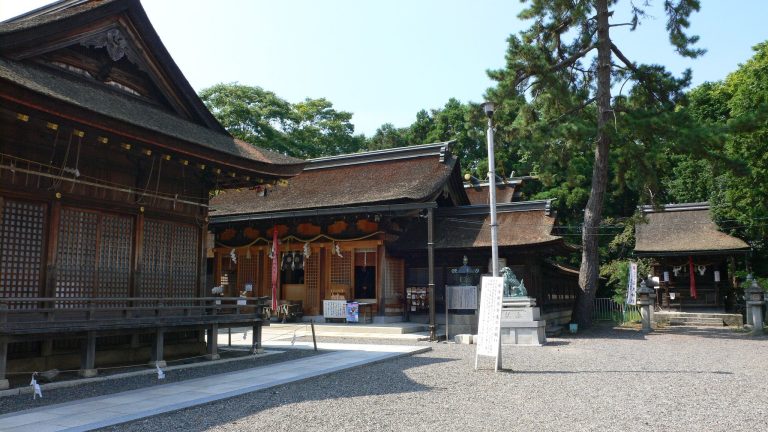
From the late Heian period through the early modern period, Buddhist and Shinto worship on the island developed as an integrated religious system. The deity of Tsukubusuma Shrine, Azaihime-no-Mikoto, was associated with the Azai clan and with the waters of Lake Biwa, and came to be identified with Benzaiten. Ichikishimahime-no-Mikoto was likewise enshrined and identified with Benzaiten. Temple and shrine gradually became a combined complex known as Chikubushima Daijingū-ji or Chikubushima Gongen, while the island prospered as a destination for Kannon and Benzaiten worship.
Fires and Toyotomi-period rebuilding
Fires destroyed the island’s shrine and temple buildings in 1232, 1454, and 1558. The complex was rebuilt after each disaster. Following the fire of 1558, Toyotomi Hideyori ordered Katagiri Katsumoto to restore the buildings in 1602.
This early-modern reconstruction included the Karamon Gate, Kannon-dō, two connecting corridors, and the former temple main hall, which is now the honden, or main sanctuary, of Tsukubusuma Shrine. The Karamon was moved from the Toyokuni Mausoleum in Kyoto. The former main hall is variously associated with the Toyokuni Mausoleum, Toyokuni Shrine, or the Higurashi Palace, also called the Imperial Envoy Hall, of Fushimi Castle. The Karamon may preserve the former Gokuraku Bridge of Toyotomi-period Osaka Castle, a possibility raised after a 2006 discovery of an Osaka Castle screen with architectural details corresponding to the gate.
Pilgrimage and religious separation
During the Edo period, Hōgon-ji remained an important destination for Benzaiten worship and a temple on the Saigoku Kannon Pilgrimage. This Buddhist route links thirty-three temples dedicated to Kannon, the bodhisattva associated with compassion. Hōgon-ji is its thirtieth stop and is also traditionally counted among Japan’s three great Benzaiten sacred sites, together with Itsukushima Shrine and Enoshima Shrine.
The Meiji government’s Shinbutsu Bunri policy, which separated Shinto institutions and worship from Buddhism, ended the earlier integrated arrangement on Chikubushima. The former Buddhist main hall, also known as the Benzaiten Hall, was treated as the honden of Tsukubusuma Shrine. In 1871, the Ōtsu Prefectural Government ordered the abolition of Hōgon-ji as a Buddhist temple. The temple resisted, maintaining that Benzaiten was a Buddhist deity rather than a Shinto kami. The complex was divided between Hōgon-ji and Tsukubusuma Shrine in 1874, and its property was divided between them in 1883.
After the separation, Hōgon-ji had no main hall until the present hall was built in 1942. The Karamon, Kannon-dō, and the two connecting corridors underwent comprehensive conservation between 2013 and 2020. The work included reroofing, repairs to painted sculpture, renewed lacquer, gilding of metal fittings, and restoration of earlier color schemes. It was the first conservation project of comparable scale since 1946.
Chikubushima and Hōgon-ji continue to be associated with Benzaiten worship and pilgrimage. The temple’s cultural properties include National Treasure status for the Karamon and the Preface to the Lotus Sutra, as well as Important Cultural Property status for the Kannon-dō, both corridors, and the stone five-story pagoda. Chikubushima is designated a National Historic Site and Place of Scenic Beauty. The present Benzaiten Hall was registered as a tangible cultural property in 2025.
Remains
Chikubushima lies near the northern end of Lake Biwa. The island measures approximately 2 kilometers around and covers about 0.14 square kilometers. Steep cliffs surround it except at the southeastern landing place. Hōgon-ji and Tsukubusuma Shrine occupy the island alongside a small number of other buildings and shops. The temple precinct rises from the landing place by steep stone steps and includes halls, corridors, pagodas, trees, and a collection of religious and historical objects.
Upper precinct and Benzaiten Hall
Benzaiten Hall
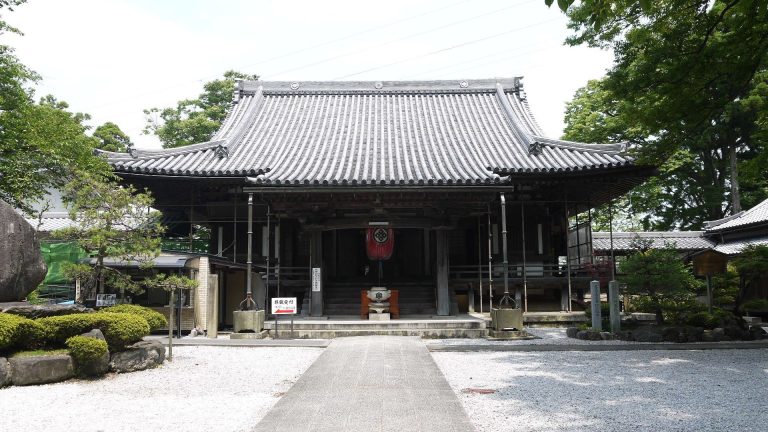
The present main hall, or Benzaiten Hall, stands on high ground at the top of the stone steps and is the largest building in the temple precinct. Built in 1942 in a Heian-period architectural style, it is a single-story wooden structure with a cypress-bark roof and a building area of approximately 439 square meters. It enshrines the principal Benzaiten image. Paintings by Arai Kanhō cover the front and side walls, including The Celestial Deities and The Flying Celestials.
The hall incorporates features associated with Japanese adaptations of Chinese architectural forms. These include post-and-lintel construction, complex bracket systems, curved roofing, projecting rafters, and an apparent mokoshi, a subsidiary roof or structural tier that can make a building appear to have more than one story. The building resembles an Amida hall, with three front bays and a pyramidal roof converging at a central point. Its steeply angled and strongly curved roof is described as helping to drain rainwater and as having a traditional protective function.
Pagodas and smaller halls
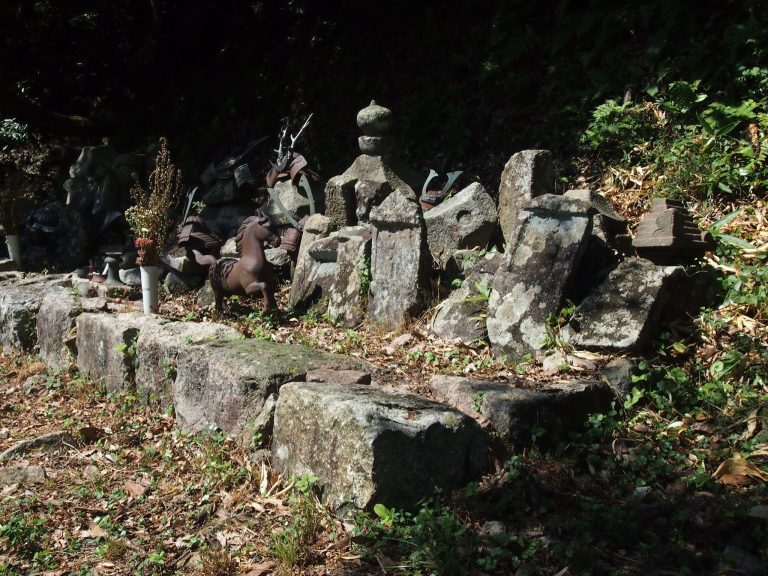
A three-story pagoda stands opposite the Benzaiten Hall. Its predecessor burned during the early Edo period, and the present pagoda was reconstructed according to the original plan in 2000. Orange and red coloring, three bays, curved roofs, and tiered bracket complexes define the structure, while a central core extends upward to the finial. The precinct also contains a late-Kamakura-period stone five-story pagoda, an Important Cultural Property.
A separate small stone pagoda has four levels, with images of Buddhas on its lower sides and an umbrella-shaped upper finial. Its stones are believed to have come from Mount Hiei. Other buildings in the precinct include Sanryū Hall, Myōon Hall, a tengu hall, the Rain-Jewel Hall, the Treasure House, the Kannon Installation Hall, the Bell Tower, the Goma Hall, the abbot’s quarters, Black Dragon Hall, the Moon-Designated Hall, and another hall. Black Dragon Hall was built in 1970, while the Treasure House dates from 1977.
Associated features
The Rain-Jewel Hall enshrines Uho Dōji, a deity of syncretic Ryōbu Shinto understood as the earthly manifestation of Amaterasu. The Kannon Installation Hall houses thirty-three images modeled on the principal images of the temples on the Saigoku Kannon Pilgrimage. A sacred spring called Zuishōsui was excavated in November 2002 after a revelation attributed to the principal Benzaiten image instructed that a well be dug there.
The precinct includes a mochi tree traditionally said to have been planted by Katagiri Katsumoto in 1602, as well as a saikachi tree. These features stand within a complex whose physical arrangement preserves the religious history shared by Hōgon-ji and Tsukubusuma Shrine.
Former temple and shrine connection
Kannon-dō
The Kannon-dō is an Important Cultural Property connected directly with the former temple main hall, now the honden of Tsukubusuma Shrine. It houses a concealed standing image of the Thousand-Armed Kannon attributed to the Kamakura period. The image is ordinarily opened to view once every sixty years. A regular opening took place in 1977, followed by special openings several times after 2000, including in 2009 and 2010.
The building has an irimoya roof covered with cypress bark. Its wooden members are entirely coated with lacquer, and vivid ceiling paintings depict chrysanthemums, paulownia, and other motifs. Because the hall occupies a slope, it uses kake-zukuri, a construction method in which posts and brackets support a building above sloping or projecting ground.
Karamon Gate
The Karamon is a National Treasure positioned beside the route from the landing place, partway up the steep stone steps, where it connects with the Kannon-dō. Attributed to the Azuchi-Momoyama period, it is a one-bay, single-door gate with a cypress-bark roof. Its polychrome carvings and gilded metal fittings feature peonies, flowers, clouds, phoenixes, Buddhist imagery, and lion-dog motifs.
The gate has a karahafu, a curved gable characteristic of traditional Japanese architecture, and uses post-and-lintel construction with elaborate bracket systems. The Karamon, Kannon-dō, and the low- and high-roofed corridors are traditionally understood to have been transferred to Chikubushima in 1602 from the Toyokuni Mausoleum or a related Toyotomi building. Conservation investigations during the 2013 to 2020 repairs found it highly likely that the four structures had originally formed one integrated building.
Connecting corridors
The low-roofed corridor, commonly called the Boat Corridor, connects the Kannon-dō with the former main hall and the present honden of Tsukubusuma Shrine. It is an Important Cultural Property. A tradition holds that its timbers came from the Nihonmaru, Toyotomi Hideyoshi’s flagship. The high-roofed corridor forms its counterpart and likewise links the Kannon-dō with the shrine honden. Together, the corridors preserve the direct architectural relationship between the former temple and shrine complex.
Collections and religious objects
Treasure House collection
The Treasure House preserves objects connected with Hōgon-ji’s history, including tapestries, pipes, Nō masks, swords, and Buddhist images. One Benzaiten tapestry shows the deity with two arms, a biwa, and a halo. Its soft, curved forms emphasize Benzaiten’s musical and divine attributes.
The Nō masks are associated with the play Chikubushima, whose setting is the island and whose central figure is Benzaiten. The drama concerns a court official’s pilgrimage and an old couple traveling in a fishing boat. The woman is revealed as Benzaiten, while the man is revealed as the Dragon God of Lake Biwa.
Sutra and documentary holdings
The National Treasure called the Preface to the Lotus Sutra, also known as the Chikubushima Sutra, is an eleventh-century decorative sutra written on paper embellished with gold- and silver-ink designs of flowers, birds, and other motifs. It is deposited on loan at the Nara National Museum.
An inscription dated 1565 appears on a Benzaiten image in the rear sanctuary of the present main hall. The recorded collection also includes a Benzaiten painting, a seated Fudō Myōō image, a seated Benzaiten image, a ritual metal gong, a copper water vessel, a bronze seal, Buddhist scriptures, and the Chikubushima Documents. These documents comprise 312 items dating from the Kamakura through Edo periods.