Mustansiriyya Madrasa: An Abbasid Center of Higher Learning in Baghdad
Site at a Glance
- Popularity
- High
- Country
- Iraq
- Primary era
- Medieval
- Eras represented
- Medieval, Modern
- Civilizations
- Abbasid, Ottoman
- Site type
- Religious
- Remains
- Madrasa
On this page9 sections
History
The Mustansiriyya Madrasa, an institution of Islamic learning, was founded in Baghdad, Iraq, in 1233 by Abbasid caliph al-Mustansir. The Abbasids were a dynasty that ruled from Baghdad for much of the medieval period. The madrasa opened for study on 6 April, in a ceremony accompanied by a feast. Its principal subject was Islamic law, and it brought together the Hanafi, Shafi‘i, Maliki, and Hanbali schools, the four major Sunni traditions of Islamic jurisprudence. It was regarded as the first Islamic university to unite all four in one institution, and its example influenced Cairo’s al-Salihiyya Madrasa, established nearly a decade later.
Teaching and student life
Al-Mustansir financed the building at a cost of 700,000 dinars. Its curriculum included religious studies, medicine, pharmacy, mathematics and algebra, literature, grammar, philosophy, and health, alongside its main focus on Islamic law. Students were selected from schools and cities across Iraq and the wider Islamic world, including Andalusia, Egypt, Konya, the Levant, Isfahan, and Khurasan. A course of study lasted ten years, and graduates received certificates that qualified them for state employment.
Senior scholars and prayer leaders from Iraq, the Levant, and Egypt taught at the madrasa, with assistants serving some of them. The institution paid its employees and was directed by a headmaster chosen by senior state officials. Abd al-Rahman al-Tikriti became its first headmaster in 1233. Assistants helped him oversee the school, while a supervisor carried out duties comparable to those of a financial inspector. The staff also included a secretary, a treasurer, workers, and servants. Ibn al-Athir’s historical account suggests that Christian and Jewish scholars may also have taught there, since non-Muslims were not barred from teaching and Abbasid caliphs encouraged their participation.
The complex included a Dar al-Qur’an, for studying and reciting the Qur’an, and a Dar al-Hadith, for studying reports about the Prophet Muhammad’s words and actions. A designated reciter and assistant served the Qur’anic school. Hadith classes met on Mondays, Thursdays, and Saturdays for ten students, led by a senior scholar and a Qur’an reciter. The institution also had a medical school and hospital. A senior physician led medical instruction and worked with ten students, giving them opportunities to study and practise medicine within the complex.
A bathhouse, pharmacy, food store, kitchen, and student residences supported life at the madrasa. Thirty orphans lived there. Students, including the orphans, received equal wages, bread, and stew, as well as food, lodging, clothing, and a monthly allowance.
Library, Mongol sack, and Ilkhanid rule
Al-Mustansir endowed the madrasa with an initial library collection estimated at 80,000 volumes. Later estimates of 400,000 to 450,000 volumes may be exaggerated. For roughly two centuries, the library drew scholars and jurists. Its books survived the Mongol capture and plunder of Baghdad in 1258, although the attack damaged parts of the madrasa and briefly halted teaching. Instruction resumed later that year.
The institution’s standing declined after the thirteenth century. Under the Ilkhanids, a Mongol dynasty that ruled much of Iran and Iraq, Ibn al-Fuwati returned to Baghdad in 1281 and became the madrasa’s director. In 1393, its library collection was combined with that of the Nizamiyya Madrasa in Baghdad; the books were later dispersed or lost. During the Ottoman capture of Baghdad in 1534, books from the city’s palaces and libraries were taken as spoils and became part of the royal library in Istanbul.
Timurid destruction and later uses
The Central Asian conqueror Timur devastated Baghdad in 1392 and again in 1400. The destruction halted teaching at the Mustansiriyya and damaged the city’s schools. Thousands of books were lost, and many scholars left for Egypt, the Levant, and other regions. Timur also took writers, engineers, and architects to Samarkand.
The madrasa reopened for study in 1589, following a long interruption, but closed again in 1638. The al-Asifyah Mosque-Madrasa was then established in its place and connected with the Mustansiriyya. Daud Pasha, an Ottoman-era governor of Baghdad, renovated the al-Asifyah complex in 1826. Ottoman rule in Baghdad had begun in 1534 and lasted until British control in the early twentieth century. From the late eighteenth century into the early twentieth, the Mustansiriyya served military purposes, including as a rest and supply station and a store for soldiers’ uniforms. In the eighteenth century, it also operated as a caravanserai, an inn and service stop for travelling merchants, and was known as Khan al-Muwasilah.
Restoration and heritage status
The Iraqi Directorate of Antiquities regained ownership in 1940, and the Iraqi government restored the complex in 1960. The Directorate took oversight in 1973, with reconstruction and conservation continuing afterward. Modern businesses around the site were demolished as part of efforts to recover its original perimeter. The madrasa is now part of Al-Mustansiriyya University. It is included on Iraq’s tentative UNESCO World Heritage list as part of historic Baghdad and was added to the Islamic World Educational, Scientific and Cultural Organization’s list in 2013 for its place in Islamic history.
Remains
Plan and courtyard
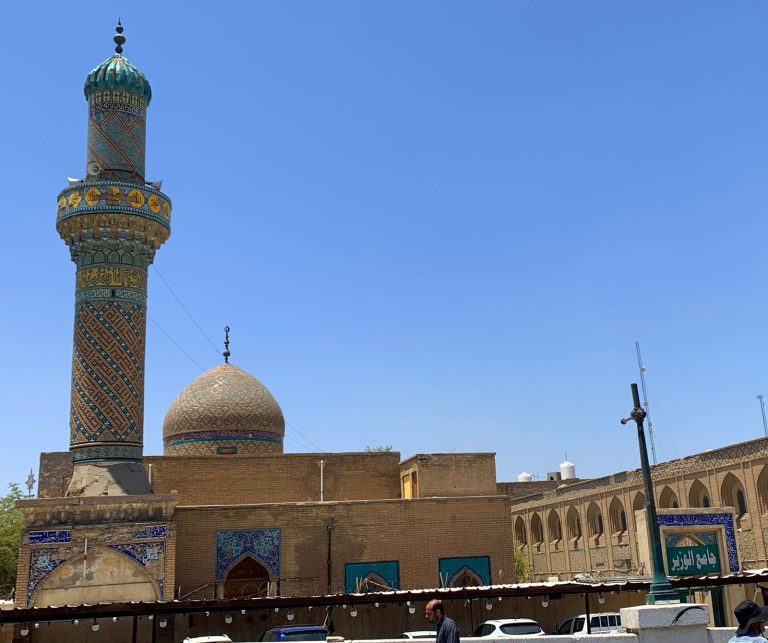
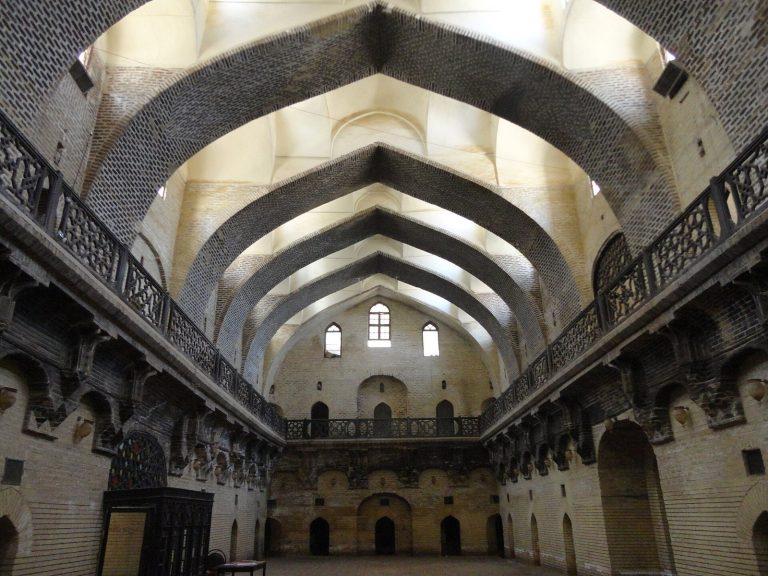
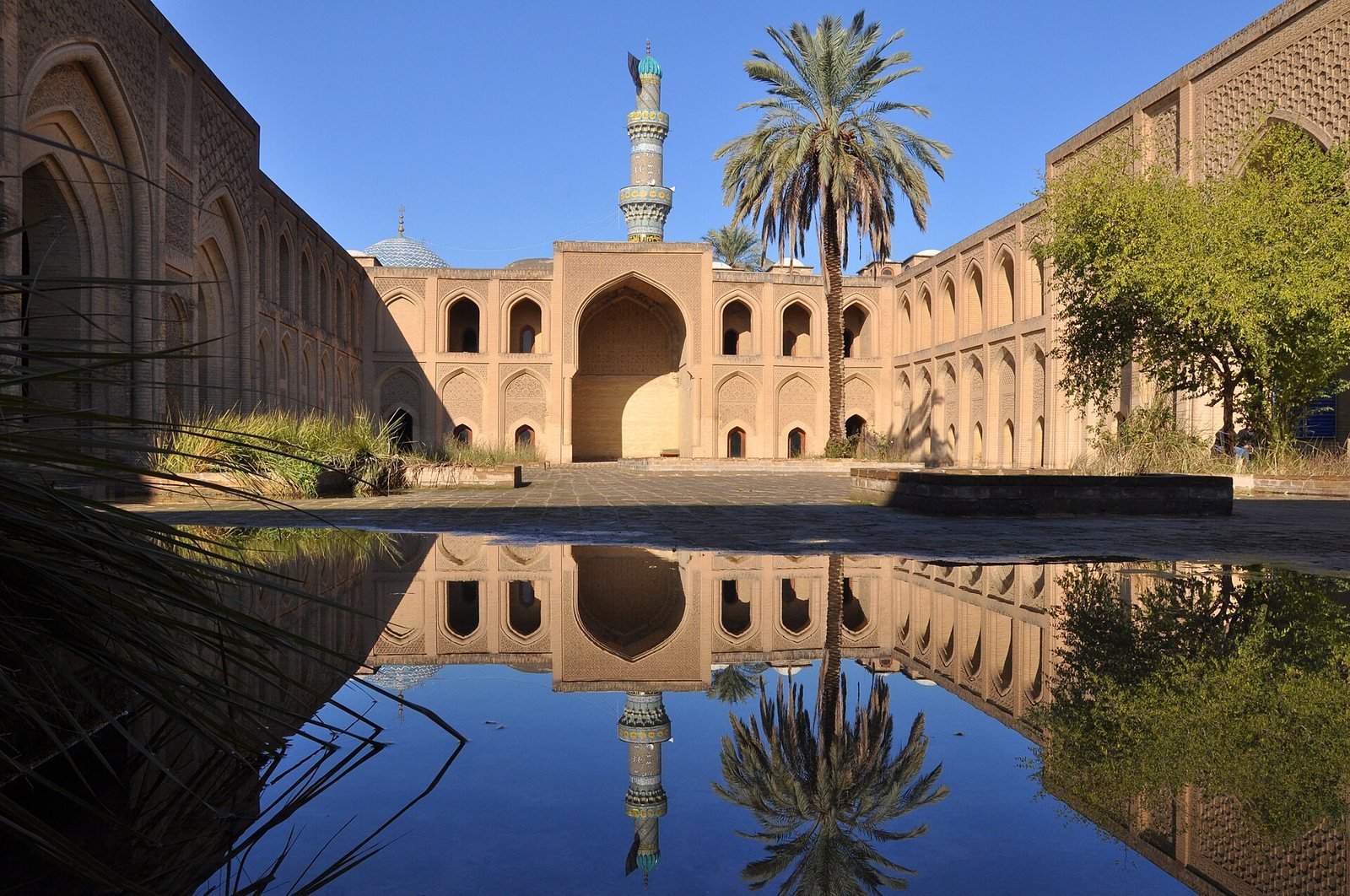
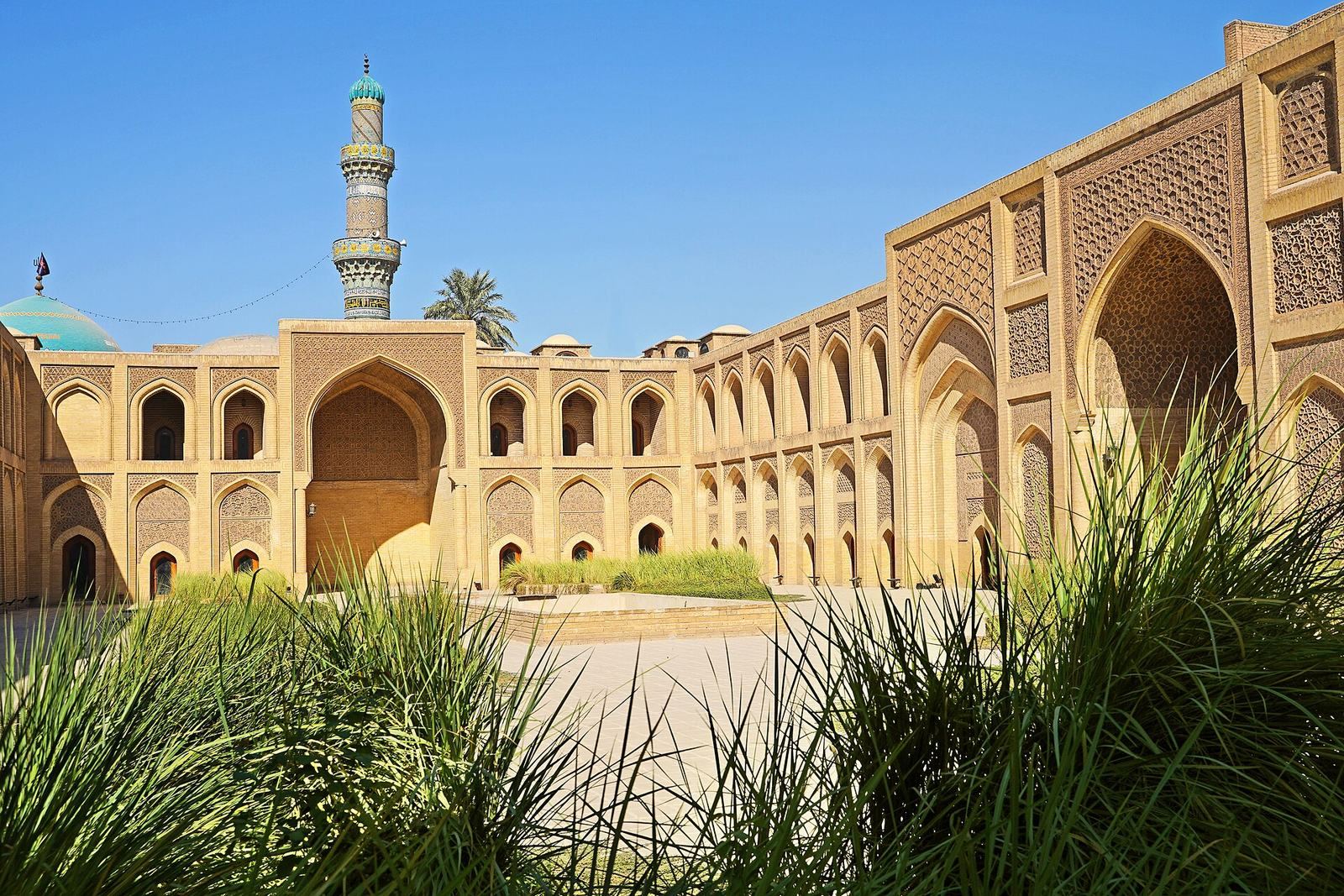
The 4,836-square-metre complex stands on the left bank of the Tigris in Baghdad’s Rusafa district, on the river’s eastern side. It is beside the Abbasid Caliph’s Palace and near the Nizamiyya Madrasa. The two-storey rectangular building is constructed of brick and arranged around a large courtyard, following a four-iwan plan. An iwan is a vaulted hall open on one side. The building contained 100 rooms of different sizes, as well as iwans and halls, with a separate corner assigned to each of the four schools of Islamic law. A large fountain stood at the courtyard’s centre. The complex also has a second-floor corridor, multiple domes, and minarets. An iron fence now surrounds it on all sides.
Facades and entrances
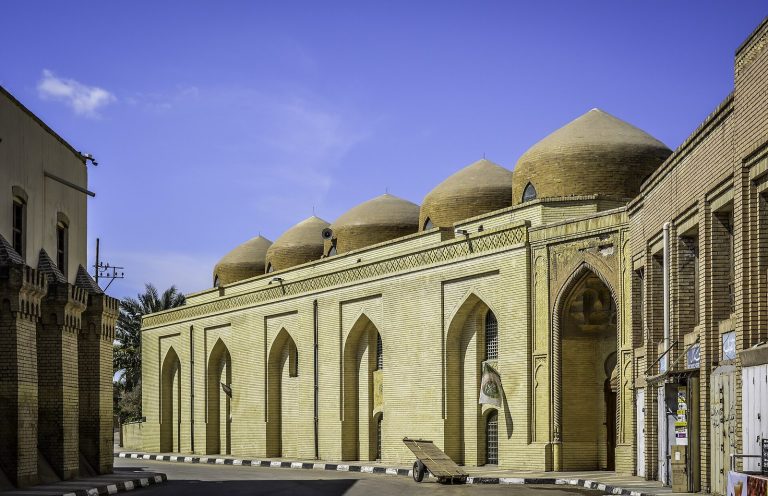
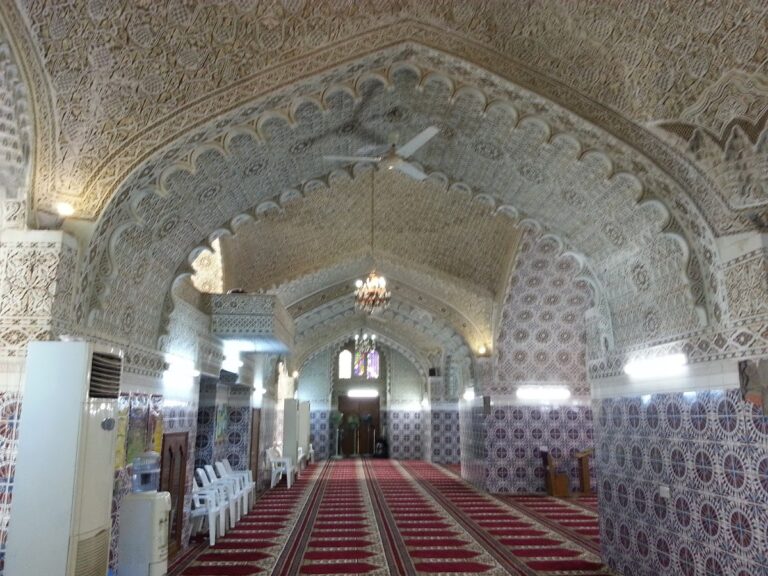
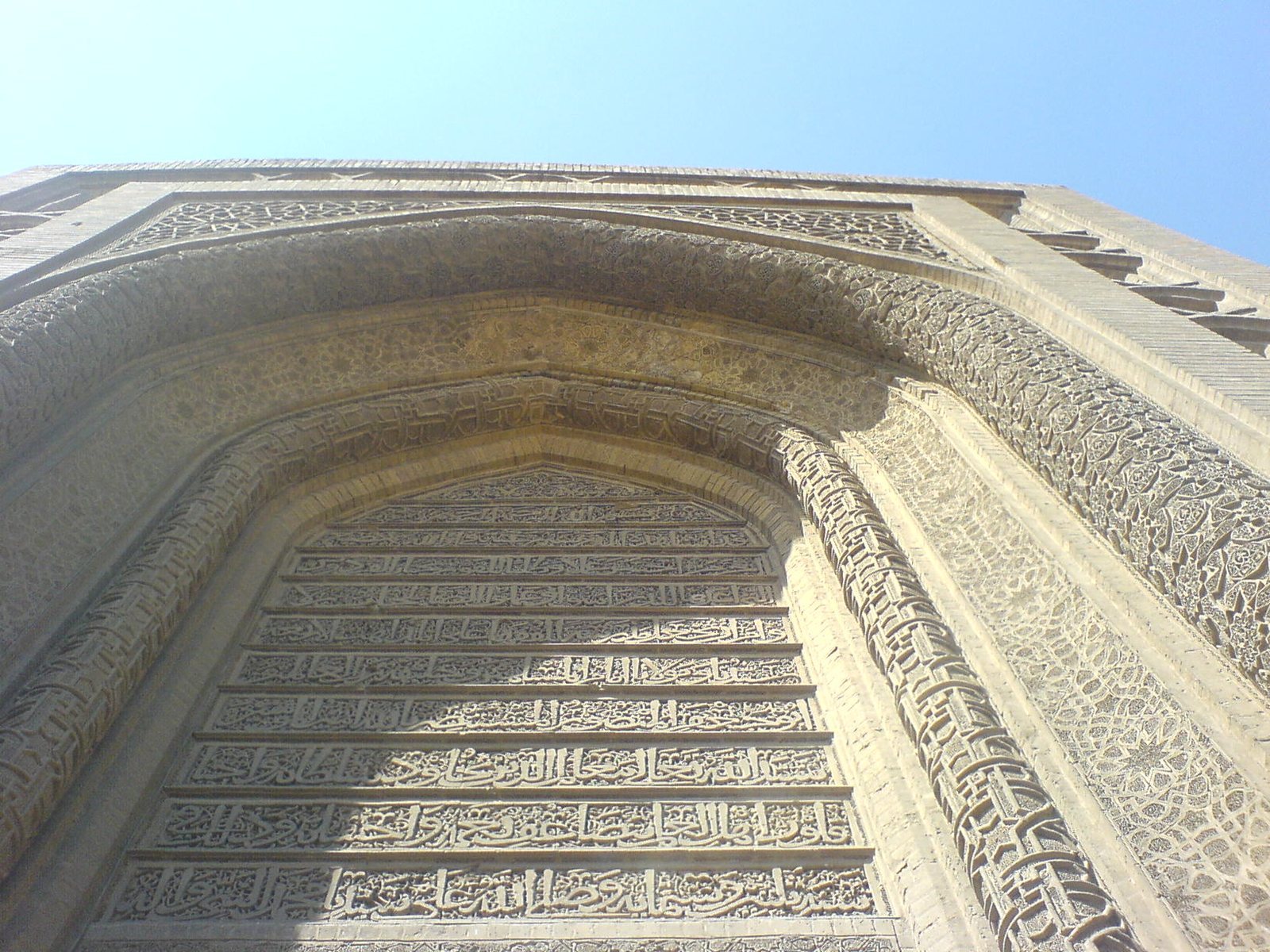
The exterior has a three-part facade decorated with arabesque patterns and carved brick. Three conical arches frame the main entrance, which incorporates star and polygon designs and an inscription naming al-Mustansir as patron. Leaf and greenery motifs on the arches recall earlier Umayyad and Abbasid styles. Other entrances feature geometric patterns, including zigzags, squares, and designs centred on water. An inscription at the southwestern entrance concerns the nineteenth-century Ottoman sultan Abd al-Aziz, while a gate bears Qur’anic verses. The building’s ornament also includes muqarnas, tiered three-dimensional architectural decoration.
Water-powered clock
A monumental water-powered clock was completed in 1235 and placed in the entrance hall. It was attributed to Ali Ibn Tha‘lab and was said to draw on clocks in Damascus. Its circular display represented the heavens, with decorated bronze arches and doors and two golden falcons, each positioned above a golden bowl. Two concealed bronze balls sat behind each falcon. At each hour, a falcon released a ball, which opened a door; the doors changed from gold to silver as the balls returned to their starting points. Golden planets moved across the display to imitate the sun’s passage and setting.
At night, illuminated discs representing planets appeared one after another. Each reached full brightness over the course of an hour, marking the passage of time until sunrise. The clock announced the hours and prayer times by day and night.