Qumaria Mosque: A Late Abbasid Mosque in Baghdad


Site at a Glance
- Rating
- 4.5
- Popularity
- Very Low
- Country
- Iraq
- Primary era
- Medieval
- Eras represented
- Medieval, Modern
- Civilizations
- Abbasid, Mamluk, Ottoman
- Site type
- Religious
- Remains
- Mosque
On this page10 sections
History
Qumaria Mosque is a historic mosque in Baghdad, Iraq, built in 1228 during the late Abbasid period in the city. The Abbasids were a caliphal dynasty that ruled Baghdad and much of the Islamic world from 750 until the Mongol conquest in 1258. Attributed to the Abbasid caliph al-Mustansir, the mosque is regarded as one of Baghdad’s oldest mosques and as a distinctive surviving expression of the city’s Abbasid religious heritage.
Name and Abbasid foundation
The mosque’s name has several proposed explanations. One tradition connects it with Qamariya, a woman from the family of the Abbasid caliph al-Nasir, or with land that she owned. Another interpretation links the name to a place on Baghdad’s western side that was known by 1156, before the mosque was built. Mansur al-Qumri has also been proposed as the source of the name. These explanations reflect the mosque’s connection with the western bank of the Tigris and with Baghdad’s later Abbasid landscape.
The mosque belongs to the later Abbasid period in Baghdad, when the city remained the seat of the Abbasid caliphate. Its foundation under al-Mustansir placed it within the religious and architectural history of Abbasid Baghdad.
Damage, restoration, and rebuilding
Repeated floods damaged the mosque, and it also suffered during the Mongol siege of Baghdad led by Hulagu. Hulagu’s forces captured the city in 1258, ending Abbasid political rule there. About ten years after the siege, Ata-Malik Juvayni restored the mosque. Juvayni was a Persian historian and administrator of the Mongol Ilkhanate.
The building later deteriorated and collapsed as flooding and erosion weakened its foundations and structural bases. Said Pasha, the Mamluk governor of Baghdad, rebuilt the mosque after the collapse and reoriented it toward the qibla, the direction of prayer toward the Kaaba in Mecca. He commemorated the rebuilding in poetic verses placed on the prayer hall’s mihrab, the recessed feature that marks the direction of prayer. The verses are dated to 1821.
Further rebuilding or renovation phases are associated with Deli Hussein Pasha, governor of Baghdad, in 1654, and with Aisha, daughter of Baghdad governor Ahmad Pasha, in 1763. Iraq’s Ministry of Awqaf and Religious Affairs carried out another repair in 1980. Successive governments have continued to renovate the mosque, which remains an active place of worship and part of Baghdad’s old religious heritage.
Remains
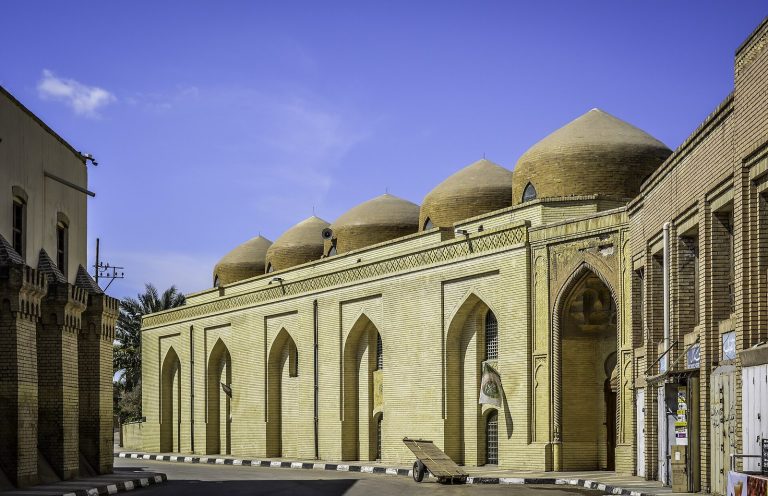
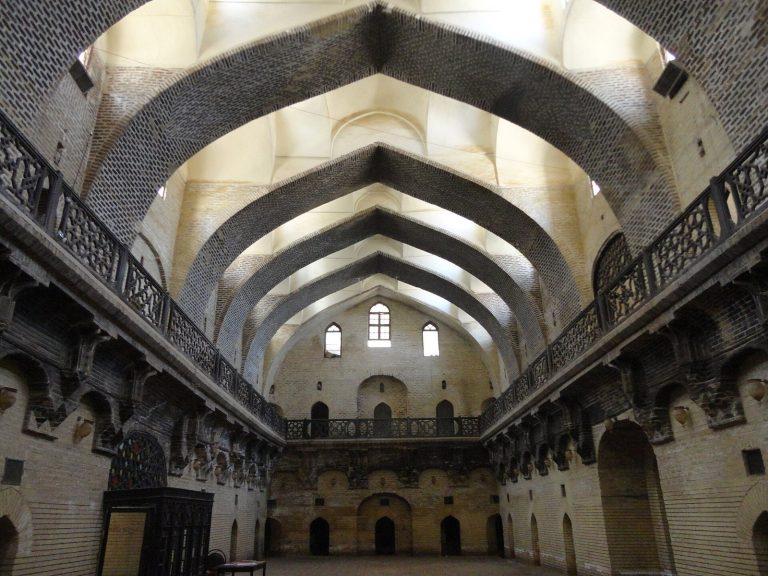
Qumaria Mosque occupies approximately 2,000 square metres. Its Abbasid architectural character is expressed through the use of brick, plaster, and tiles. The complex includes a spacious prayer hall for about 400 worshippers, one minaret, and six thin domes. Rebuilding and renovation have altered the structure over time, while the minaret and traces preserved in its base retain evidence of the earlier mosque.
Prayer hall and inscriptions
Prayer hall
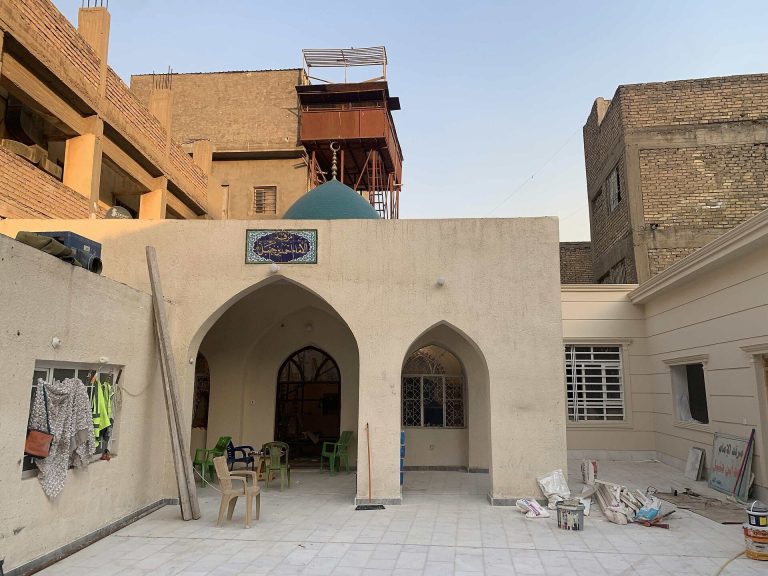
The prayer hall forms the principal interior space and is oriented toward the qibla established during Said Pasha’s rebuilding. Its mihrab carries poetic inscriptions that record the reconstruction of the mosque and describe the restoration of the prayer hall and its pillars. The inscriptions connect the surviving prayer space with the building’s nineteenth-century rebuilding phase.
Wall inscriptions and ablution area
Other wall inscriptions are attributed to Sheikh Abd al-Rahman al-Suwaidi. They refer to Aisha al-Khair, the ablution area, flowing water that quenches the thirsty, and believers receiving a purifying drink. The ablution area served the ritual washing performed before Muslim prayer, giving the inscriptions a direct connection with the mosque’s religious functions.
Minaret and domes
Minaret
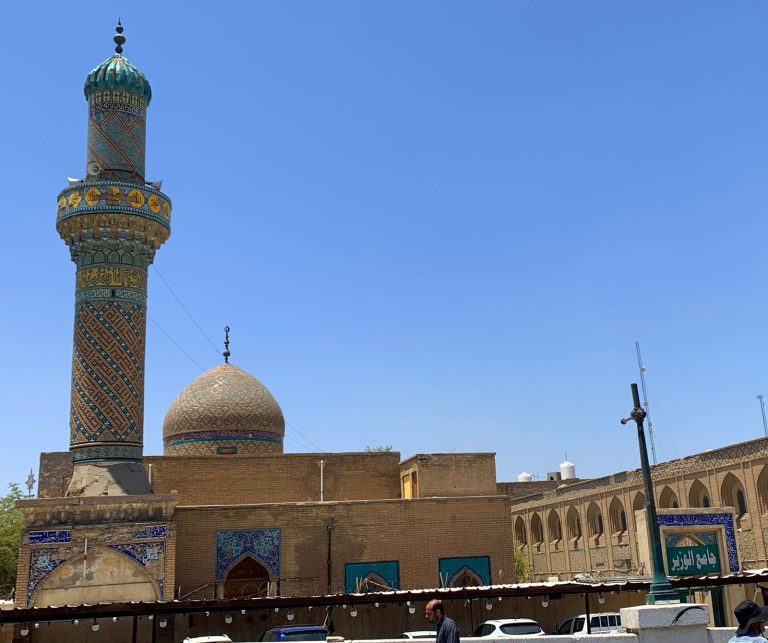
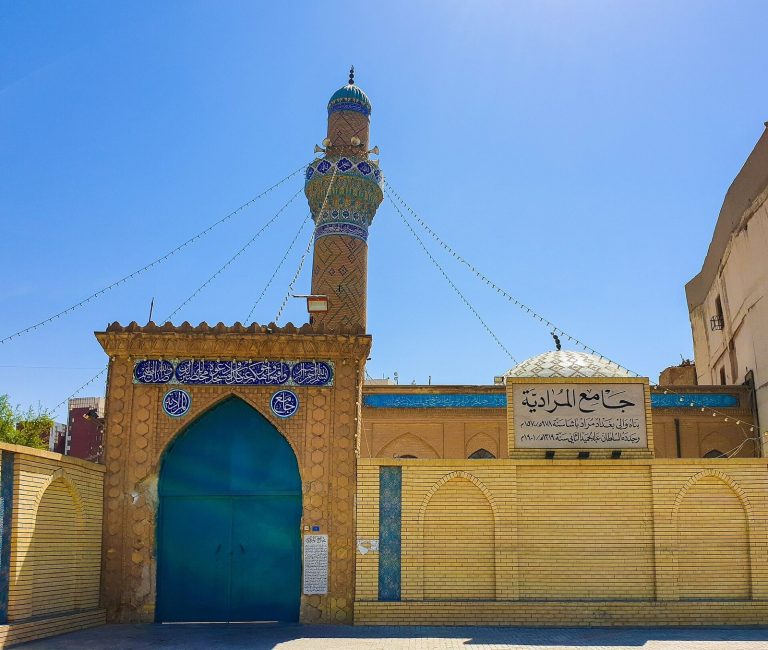
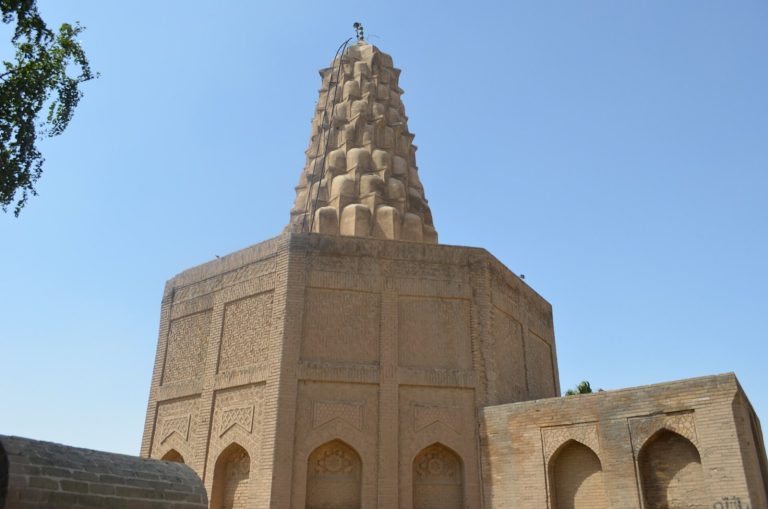
The surviving minaret is built of brick and plaster and has a cylindrical form unlike those normally associated with traditional Baghdadi minarets. Its upper section is described as reducing pressure on the base. Blue-and-white tiles with geometric designs decorate the minaret, whose decoration is relatively sparse. Traces of the earlier construction remain around its base.
Domes
Six thin domes form part of the complex’s roofscape. Together with the brick, plaster, and tiled surfaces, they preserve the mosque’s Abbasid architectural vocabulary within a building shaped by later rebuilding and repair.