Museum of the Risorgimento: Milan’s Historical Museum of Italian Unification


Site at a Glance
- Rating
- 4.5
- Popularity
- Low
- Country
- Italy
- Primary era
- Early Modern
- External website
- Open
- Eras represented
- Early Modern
- Civilizations
- Habsburg
- Site type
- Civic
- Remains
- Palace
On this page14 sections
History
The Museum of the Risorgimento is a state historical museum in Milan, Italy, devoted to the Risorgimento, the nineteenth-century movement through which the Italian states were politically unified. Its historical narrative begins with Napoleon Bonaparte’s first Italian campaign in 1796 and ends with the capture of Rome in 1870.
Origins and early locations
The museum’s collections grew from Risorgimento artefacts and documents assembled in Milan and its surrounding area for the General Italian Exhibition in Turin in 1884. Contributors included Carlo d’Adda, Cesare Correnti, Gian Alfonso Casati, Enrico Guastalla, Giovanni Visconti Venosta, Gerolamo Induno, and Eleuterio Pagliano.
The institution was officially founded and opened on 24 June 1886 in the exhibition hall of the Public Gardens near Porta Venezia. In 1896 it moved to the Rocchetta rooms of Castello Sforzesco. Bombing during the Second World War prompted a temporary relocation in 1943 to the ground floor of Casa Manzoni. In 1950, the museum moved to Palazzo Moriggia, which remains its permanent home.
A civic and scholarly institution
The museum forms part of Milan’s Civic Historical Collections together with Palazzo Morando. The Civic Historical Collections at Palazzo Moriggia also include a contemporary-history laboratory, a library, an archive, a conference hall, and two rooms for temporary exhibitions. They support scholarly meetings, publish scholarly works, and organize educational and cultural programs.
Palazzo Moriggia is also the seat of the Milan committee of the Institute for the History of the Italian Risorgimento, an organization devoted to studying and documenting Italy’s unification movement. The institute publishes the journal Il Risorgimento. The building also houses the Italian-Swiss committee responsible for publishing the works of Carlo Cattaneo, an Italian intellectual and republican political thinker.
The museum’s historical scope
The collections cover Napoleon Bonaparte’s campaigns in Italy, the Italian Republic of 1802–1805, the Napoleonic Empire, and the Restoration, the period after Napoleon’s fall when European monarchies were re-established and conservative governments sought to restore the pre-Napoleonic political order. Later sections address the Five Days of Milan, the March 1848 uprising against Austrian rule; the short-lived Roman Republic of 1849; the second and third Italian Wars of Independence in 1859 and 1866; and Giuseppe Garibaldi’s campaigns.
The permanent exhibition was substantially redesigned in 1998, renewing the presentation of this political and military history while preserving its chronological framework.
Remains
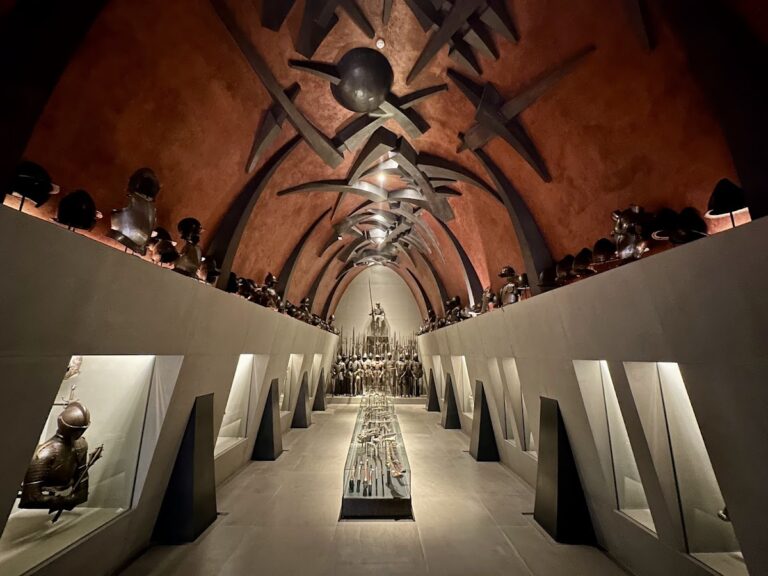
The museum occupies the eighteenth-century Palazzo Moriggia on Via Borgonuovo in Milan. Its exhibition route is arranged chronologically through fourteen historical rooms and a newer arms hall, linking political events, personal possessions, flags, weapons, paintings, and sculpture across the period of Italian unification.
Napoleonic and Restoration collections
Napoleon’s campaigns and the Italian Republic
The opening room contains artefacts from Napoleon Bonaparte’s first campaign in Italy in 1796–1797, including one of the original standards of the Lombard Legion of Mounted Chasseurs from 1796. Material from the Italian Republic of 1802–1805 leads into objects associated with Napoleon’s coronation as King of Italy in 1805, including his green-and-silver mantle and royal regalia.
The imperial period and Restoration
The museum holds a substantial group of paintings, sculptures, and other objects from the Napoleonic imperial period of 1804–1814. Objects from the Restoration after 1814–1815 include several possessions of Silvio Pellico, the Italian writer, patriot, and political prisoner associated with the Risorgimento.
Revolutionary Milan and the Roman Republic
The Five Days of Milan
Material from the Five Days of Milan in 1848 includes the bell from the tower in Piazza dei Mercanti. It broke while ringing continuously to call the population to revolt. The collection also preserves the original tricolour flag, the green, white, and red emblem of the Italian national movement and state, that flew over Milan Cathedral on 20 March 1848.
Paintings of the uprising include Carlo Canella’s The Battle at Porta Tosa during the Five Days, The Austrians’ Retreat from the Customs House at Porta Tosa, and Carlo Bossoli’s The Uboldi Nobleman’s Armoury Plundered by the Milanese Insurgents.
The Roman Republic
The museum preserves an original tricolour flag used by the Roman Republic in 1849. It bears the inscription “God and the People.” The republic is also represented by Pietro Bouvier’s painting Garibaldi and Major Leggero Carrying the Dying Anita.
Wars of Independence and unification
Garibaldi and the wars of 1859 and 1866
Objects from the second and third Italian Wars of Independence in 1859 and 1866 include a Bible given to Giuseppe Garibaldi by English noblewomen and a poncho with a red shirt that belonged to him. Garibaldi was an Italian revolutionary and military leader whose campaigns were central to unification.
Paintings connected with the second war include Gerolamo Induno’s Battle of Magenta, Eleuterio Pagliano’s Capture of the Solferino Cemetery, and Domenico Induno’s Milan at the News of the Armistice of Villafranca. Gerolamo Induno’s Embarkation of the Thousand at Quarto concerns Garibaldi’s 1860 Expedition of the Thousand.
Venice and the capture of Rome
Gerolamo Induno’s Entry of Victor Emmanuel II into Venice depicts the conclusion of the third Italian War of Independence. Victor Emmanuel II became the first king of unified Italy. The capture of Rome in 1870 is represented by Carlo Ademollo’s The Breach at Porta Pia and Luigi Riva’s The Roman Plebiscite.