Gisselfeld: A Renaissance Manor and Estate in Denmark


Site at a Glance
- Rating
- 4.3
- Popularity
- Low
- Country
- Denmark
- Primary era
- Early Modern
- External website
- Open
- Eras represented
- Early Modern, Modern
- Civilizations
- Danish
- Site type
- Domestic
- Remains
- Castle
On this page17 sections
History
Gisselfeld is a Renaissance manor and estate in Denmark, rebuilt by the statesman Peder Oxe between 1547 and 1575. The present castle developed from a medieval stronghold and became one of the country’s oldest and best-preserved Renaissance castles. Its main building stands in Braaby Parish in Faxe Municipality, while the wider estate extends across several municipalities.
Medieval origins and the Falk family
Gisselfeld was first mentioned at the end of the fourteenth century. Its first known owner was Bo Falk, who held it in 1370. The small medieval stronghold then stood about two kilometres northwest of the present manor, beside an older fort that may have been the demolished Valgestrup.
The estate passed from Bo Falk to his son Peder Falk and then to his grandson Eskild Falk. Eskild’s daughter Ida married Mogens Axelsen Gøye, and their son Eskil Gøye owned Gisselfeld from 1450. Eskil also held Krenkerup and Turnbyholm, together with the fiefs of Aalholm and Lindholm. From 1489 he served as rigsmarsk, a senior Danish military office broadly comparable to marshal of the realm.
The Oxe succession and Renaissance rebuilding
After Eskil Gøye died in 1506, Gisselfeld passed to his son Henrik Gøye. Henrik had served as governor during the siege of Copenhagen, but financial difficulties led him to mortgage the estate to relatives, including his brother Mogens Gøye. In 1526 he sold Gisselfeld to his brother-in-law Johann Oxe. Mogens Gøye challenged the legality of the sale, beginning a dispute that continued for many years.
The estate was plundered during the Count’s Feud, a Danish civil war and succession crisis fought from 1534 to 1536. Johann Oxe was killed by rebellious peasants. Mogens Gøye lost his legal case in 1541, and after his death in 1544 the estate passed not to his children but to his grandson Peder Oxe, the son of Johann Oxe and Mogens Gøye’s daughter, Mette.
Peder Oxe was a humanist who enjoyed the favor of King Christian III. He demolished the old castle and began the present Renaissance manor in 1547. Political instability led him to design it as a fortified residence rather than simply as a country house. Oxe also obtained high jurisdiction over Gisselfeld and nearby villages, eighty farms, and six watermills. He worked to increase agricultural production by introducing new vegetable varieties and cultivating fallow land.
Oxe fell from favor in 1558 for reasons that remain unknown. He reportedly used a hidden cellar refuge before fleeing abroad, and the unfinished estate was confiscated. From exile he plotted against Frederick II, who had succeeded Christian III in 1559. The king recalled Oxe in 1566 for his military abilities during the war against Sweden, restored his property, and appointed him Lord High Steward. Oxe then completed Gisselfeld.
Inheritance, confiscation, and expansion
Oxe and his wife, Mette Rosenkrantz, had no children. After Oxe’s death, Mette became the owner. When she died in 1588, her niece Karen Banner inherited Gisselfeld and married Henrik Lykke of Overgaard. The Lykke family administered the estate until 1661, when Kai Lykke was deprived of his rights after spreading a rumor that Queen Sophie Amalie had committed adultery. He fled before a death sentence for lèse-majesté, an offense against the dignity of the sovereign, could be carried out, and the Crown confiscated his estates.
After a short period of Crown ownership, Gisselfeld was granted in 1671 to Count Hans Schack as a reward for his military service in the wars against Sweden. Schack incorporated seven surrounding parishes into the estate and cleared several formerly independent farms, including the entire village of Hesede. This created one of Denmark’s largest estates. After his death, his descendants sold the impoverished property to Adam Levin von Knuth, who reorganized it successfully and re-established Hesede as an independent tenant farm. Knuth’s family owned Gisselfeld until 1699.
The convent foundation
Christian Gyldenløve acquired Gisselfeld in 1699. His will of 1701 and 1702 provided for a convent for unmarried noblewomen, preferably from his own family. The foundation was to take effect only after the death of his widow, Dorothea Krag, whose residence was to remain at Gisselfeld. Gyldenløve died unexpectedly in 1703, so the estate stayed with his descendants, the Danneskiold-Samsøe family, until Dorothea Krag’s death in 1754.
Under Friedrich Christian Danneskiold-Samsøe, Gisselfeld Adelige Jomfrukloster I Sjælland was established in 1754. Descendants of the Danneskiold-Samsøe family have administered the institution since 1755. Its first prioress was Friedrich Christian’s cousin, Friederike Louise Charlotte Danneskiold-Samsøe.
Gyldenløve’s original plan to house the women on the castle grounds was abandoned for financial reasons. The conventual women, members of a religious or quasi-religious women’s foundation, were therefore not required to live at Gisselfeld. They could choose their own residence and received annual pensions from the foundation’s lands and assets. Membership was limited to noble, unmarried women, who paid an entry sum of approximately three times the annual pension. Membership could end, including through marriage. The original sixteen places increased to thirty in 1851. The serving count of Samsø managed the convent and estate as chief director and received accommodation in the castle.
Legal status and cultural associations
During the seventeenth century, Gisselfeld successively belonged to separate birks, special Danish legal districts with their own courts and jurisdiction. Its legal administration was therefore distinct from Braaby Parish and the former Ringsted Hundred. Special inheritance laws enacted in 1701 and 1702 regulated succession to the castle and estate.
Members of the Danneskiold-Samsøe family continue to occupy part of the castle, while another part houses collections. The estate’s governing arrangements changed in 1996, when a board established by the Ministry of Justice and the Directorate of Civil Rights replaced the count as its governing body. The count contested the change in a widely publicized legal case.
The Danneskiold-Samsøe family also assembled a large porcelain collection at Gisselfeld during the eighteenth century. It included the first set of the Flora Danica service, produced by the Royal Porcelain Factory under the direction of Christian Conrad Sophus Danneskiold-Samsøe. The writer Hans Christian Andersen stayed at Gisselfeld several times between 1839 and 1842. A diary entry from 5 July 1842 associates the estate with his inspiration for “The Story of a Duck,” published on 11 November 1843 as The Ugly Duckling.
Remains
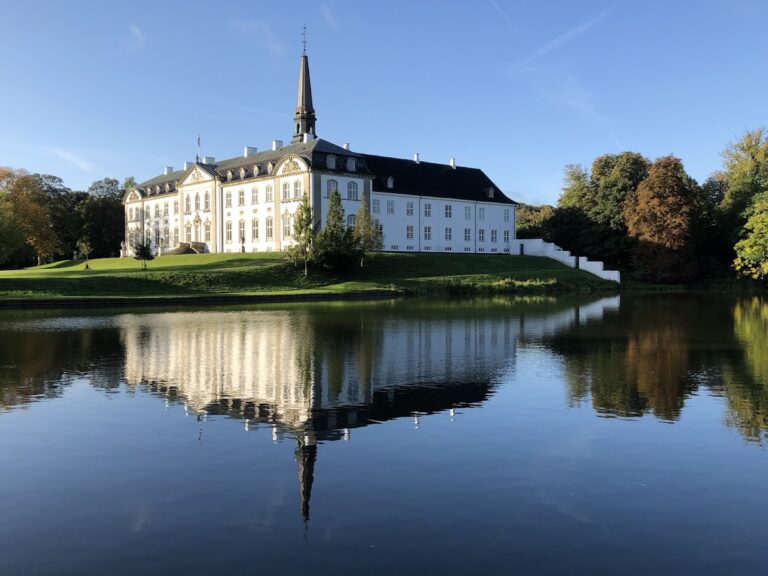
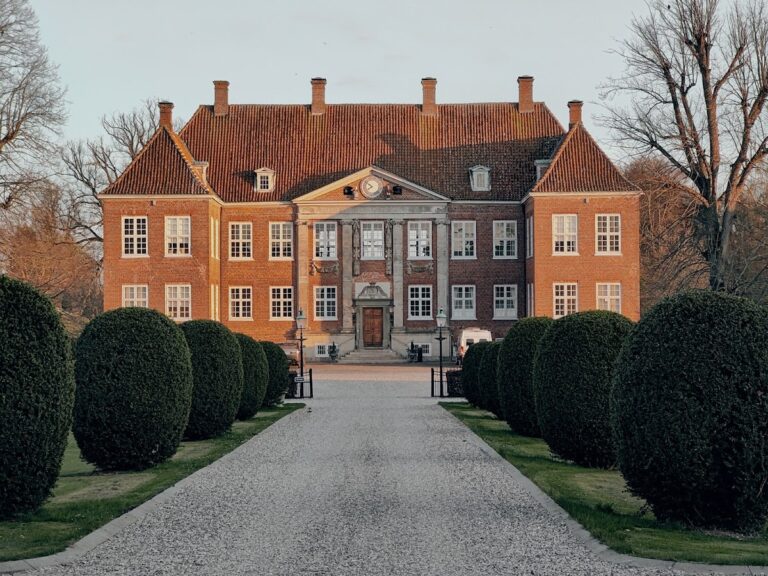
Gisselfeld combines a three-storey red-brick manor with surviving defensive works, farm buildings, gardens, and a large park. The castle is surrounded by water on three sides, with the Gårdsø, or estate lake, along the north side. The estate covers 3,850 hectares, including 2,400 hectares of forest, and includes Hesede, Edelesminde, Brødebæk, and Gødstrupgård, as well as almost the whole of Vester Egede Parish.
Manor and fortified enclosure
Renaissance manor
The present manor is built of red brick and rises three storeys beneath prominent stepped gables. Thick outer walls, loopholes, and a projecting tower over the main gate give the building the defensive character associated with northern European Renaissance manor houses. It originally consisted of four interconnected wings, with a chapel in the south wing, which was later demolished.
The north wing, containing the gate, is the oldest surviving part of the manor. An inscription above the entrance commemorates Peder Oxe’s relocation and rebuilding of Gisselfeld from 1547. The east and west wings were completed after his return from exile and before his death. A stair tower stands on the courtyard side of the west wing. The façade was temporarily rendered white, but the red brick was exposed again in 1869.
Defensive works
Peder Oxe’s building campaign included a curtain wall, drawbridges, loopholes, and machicolations, projecting openings in a defensive wall or tower through which defenders could pour materials onto attackers below. A moat surrounded the fortified residence, and water still borders the manor on three sides. These features express the political insecurity that shaped the castle’s construction in the sixteenth century.
Farm buildings and Grev Knuths Hus
Farm buildings stood beyond the moat, alongside an orchard, a herb garden, and fishponds used for carp breeding. Remains of two towers and a large barn survive from the fortifications and agricultural buildings. Within the moat, beside the castle, stands Grev Knuths Hus, a three-winged farm building. One of its gables bears the wall anchors “ALK 1697.”
Park and garden buildings
English landscape garden
The approximately 40-hectare park was laid out as an English landscape garden by the English landscape architect H. E. Millner at the end of the nineteenth century. Its features include a pond, a waterfall, gardens, a greenhouse, and a fountain decorated with four frogs whose mouths emit water.
Paradehuset
Paradehuset is an orangery built around 1870 from cast iron and glass. Its interior was divided into three climate zones. The building now serves as a café, retaining a connection between the estate’s historic garden functions and its later use.
Skovtårnet
In the forest stands Skovtårnet, a 45-metre-high hyperboloid tower. Its design provides a 360-degree panoramic view over Zealand and forms a modern vertical element within the estate’s extensive wooded landscape.
Collections
Flora Danica porcelain
The manor houses the porcelain collection assembled by the Danneskiold-Samsøe family. Among its contents is the first set of the Flora Danica service, made by the Royal Porcelain Factory under the direction of Christian Conrad Sophus Danneskiold-Samsøe. The collection reflects the material culture associated with the family’s eighteenth-century ownership and administration of Gisselfeld.
Nearby sites