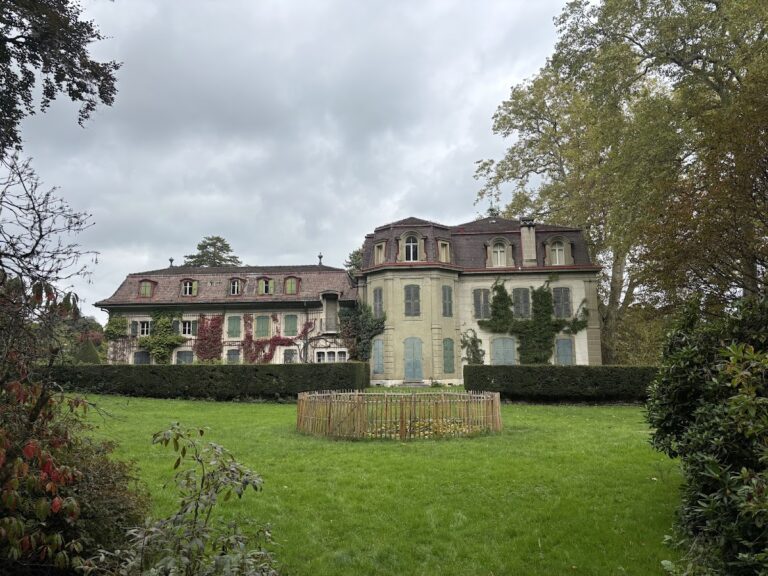
Musée de l’Athénée: A Neo-Renaissance Cultural Building in Geneva


Site at a Glance
- Rating
- 4.7
- Popularity
- Very Low
- Country
- Switzerland
- Primary era
- Modern
- Eras represented
- Modern
- Civilizations
- Swiss
- Site type
- Civic
On this page12 sections
History
Musée de l’Athénée is a nineteenth-century cultural building in Geneva, Switzerland, constructed for the Société des Arts de Genève, an institution devoted to the arts and the exchange of knowledge across scientific, medical, philosophical, theological, and industrial fields. Construction began in 1860 in the Neo-Renaissance style, and the building was inaugurated in 1864.
Origins and construction
The Société des Arts de Genève was founded in 1776 by Horace-Bénédict de Saussure, a Genevan naturalist associated with Alpine exploration and scientific observation. At a meeting of the society in 1821, Jean-Gabriel Eynard proposed that Geneva create five public buildings: a prison, an asylum for people with mental illnesses, a library, a museum, and an assembly building. Eynard contributed 3,000 contemporary francs toward the assembly building.
Construction of the Musée de l’Athénée began in 1860 on a narrow, elongated plot formerly occupied by old fortifications. Jean-Gabriel Eynard initiated and financed the project near his Geneva residence, while his partner, Anna Eynard-Lullin, supervised its execution. The architects Gabriel Diodati and Charles Schaeck designed the building, whose forms drew on Renaissance models. It was inaugurated for a ceremonial meeting of the Société des Arts on 5 January 1864, and the society moved into the building that year.
Associations with international institutions
Henri Dunant established the Red Cross in the building in 1863. A Swiss humanitarian, Dunant helped launch the international humanitarian movement through this work. The Grand Salon was also the place where the International Committee of Historical Sciences and the International Association for Aid to Children were established.
Collections and later interventions
The building was renovated in 1983 and again between 2006 and 2012. The Salle des Abeilles was renovated in 1985. In 1989, Pierre Brayer established the Brayer Foundation, whose collection is housed in one wing and is based mainly on the work of his father, Maurice Brayer, an architect associated with Geneva’s architectural life during the first half of the twentieth century.
Remains
Exterior architecture
Main facade
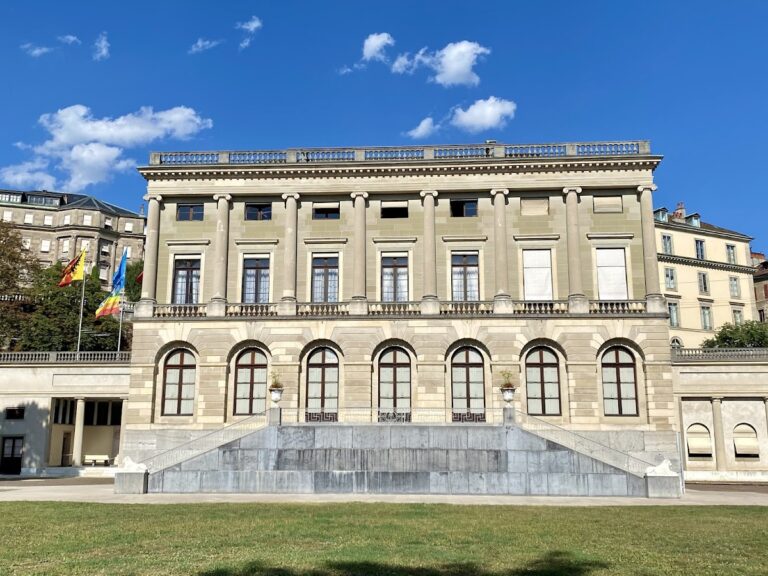
Musée de l’Athénée occupies a narrow, elongated site and resembles the neighboring Eynard residence. Its main facade is arranged as a one-storey composition with three semicircular entrances. Six monumental Corinthian columns, with elaborate capitals traditionally decorated with acanthus leaves, rise between a white-stone base and an entablature crowned by a powerful cornice. Balustrades strengthen the impression of a portico.
Facades and sculptural decoration
The windows and nine niches on the main and western facades reflect the influence of Michelangelo. Exterior busts by Charles Man, Louis Dorsier, and Frédéric Dufaux decorate the walls. They include commemorations of important figures in Geneva’s history, among them Bishop Adhémar Fabri.
Interior spaces and collections
Entrance hall and Salle des Abeilles
The entrance hall has imitation-marble decoration. On the ground floor, salons accompany the Salle des Abeilles, whose ceiling and medallions were made in imitation plaster by three artists, including Jean-Jacques Dériaz and François Puggi. The hall is used for concerts. Its profiles represent artists, physicists, physicians, philosophers, theologians, natural scientists, and industrialists, reflecting the broad objectives of the Société des Arts.
Grand Salon and staircase
The Grand Salon contains the collection of the Société des Arts. A central blind window on the south-eastern facade, a recessed feature that resembles a window but does not open through the wall, bears an inscription stating that Henri Dunant established the Red Cross in the building in 1863.
The staircase contains a bust of Jean-Gabriel Eynard by Frédéric Dufaux and Émile Chambon’s painting The Goddess Athena and the Muses Extending Their Protection over the Société des Arts, dated 1926. The first floor contains salons with overhead lighting and spaces for temporary exhibitions, while the basement houses the society’s library.
Brayer Foundation wing
A white-stone wing facing Rue Saint-Léger houses the Brayer Foundation collection. The collection is based mainly on the work of Maurice Brayer and occupies a distinct part of the wider building complex.