Mühldorf Castle: A Moated Castle and Manorial Estate in Austria


Site at a Glance
- Rating
- 4.3
- Popularity
- Low
- Country
- Austria
- Primary era
- Early Modern
- External website
- Open
- Eras represented
- Early Modern
- Civilizations
- Habsburg, Holy Roman Empire
- Site type
- Military
- Remains
- Castle
On this page12 sections
History
Mühldorf Castle is a historic castle in Austria, in the municipality of Feldkirchen an der Donau, whose surviving fabric includes a sixteenth-century main building and a Gothic gate tower. Its history is first recorded in 1347, when Mühldorf belonged to Niklas the Mühldorfer.
Medieval Lords and Fiefs
In 1347, Mühldorf was subordinate to Freudenstein Castle. After Oberwallsee was built, the property became part of Oberwallsee’s estate holdings. In 1363, the Premser family received Mühldorf as a fief from the Lords of Wallsee. A fief was property granted by a superior lord to a subordinate in return for service or allegiance.
After the Wallsee line died out, Mühldorf passed to the Liechtenstein family in 1483. Virgilius Premser was recorded at Mühldorf in 1491, and the property remained with the Premser family until 1560. Achaz Premser was the last male-line member of the family.
Early Modern Ownership
In 1563, Wilhelm Tupfer of Mitterndorf received Mühldorf as a Liechtenstein fief. Hans Georg Siegmar Stangl became its owner in 1594, after which the property passed to Rosina von Herberstein. Count Sebastian von Clam acquired the castle in 1660. A few years later it belonged to Matthias von Undorf, and in 1674 Johanna Undorf brought Mühldorf into her marriage to Johann Georg Peisser von Wertenau as her marriage portion.
Monastic Estate and Later Uses
In 1747, the Cistercian monastery of Wilhering purchased the castle and its associated lands. Wilhering belongs to a Catholic monastic order founded in the twelfth century that follows the Rule of Saint Benedict and emphasizes communal religious life. The monastery retained Mühldorf until 1980 and used the complex as a manorial farm estate.
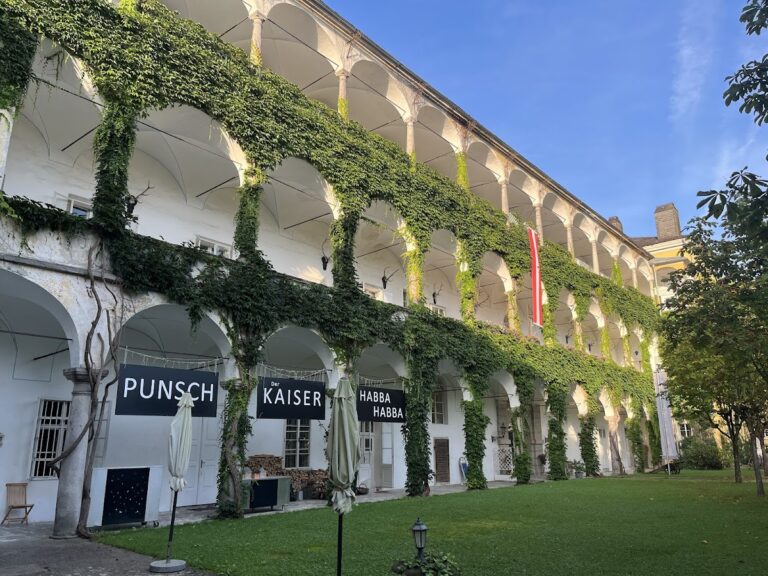
During the Second World War, parts of the ethnographic collections of the Upper Austrian State Museum in Linz were moved to the castle in 1942 and remained there until the war ended. Mühldorf later passed into private ownership and was used as a hotel and restaurant. A hotel operating in the former farm buildings from 1999 filed for insolvency in 2026.
Remains
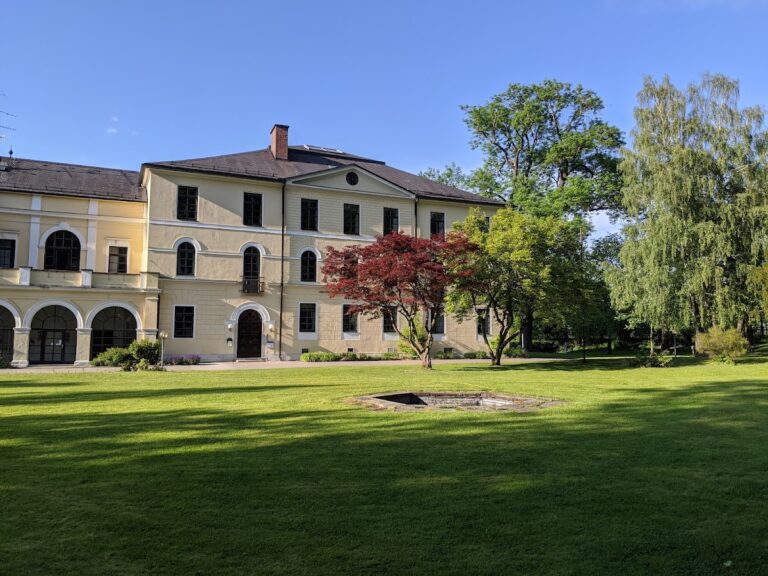
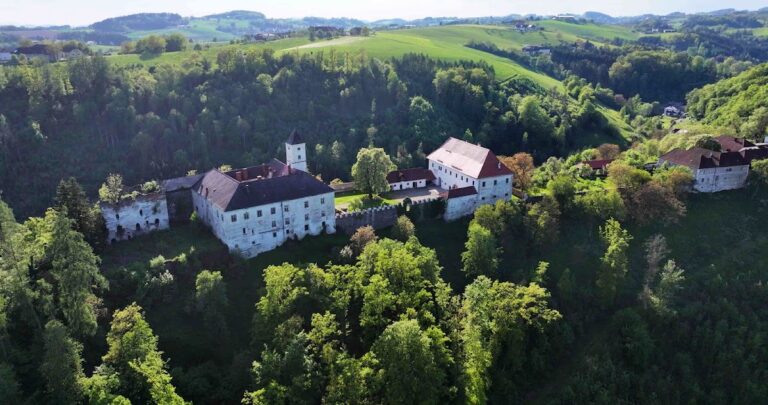
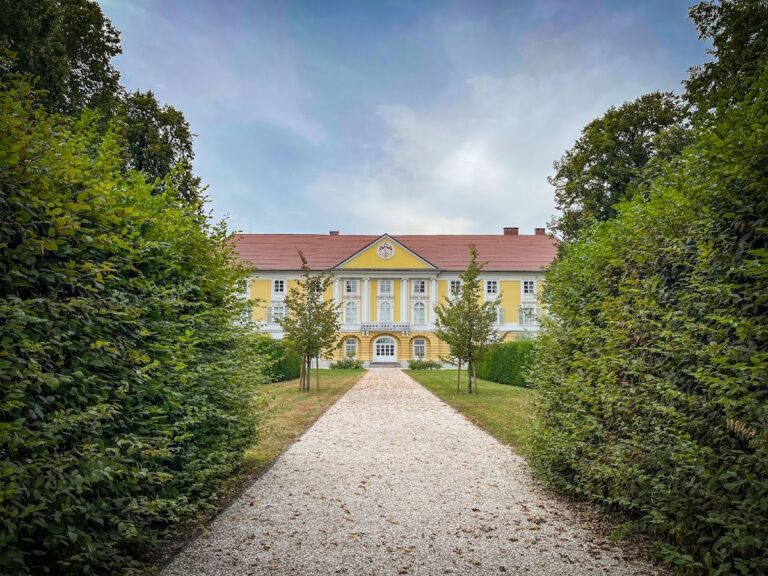
Mühldorf survives as a castle complex organized around a rectangular main building, a gate tower, later connecting wings, and former agricultural structures. A filled and levelled moat forms the grassy area before the castle, while a masonry bridge leads towards the gate tower, which stands at an angle to the approach.
Enclosure and Approach
Moat and Bridge
A 1674 engraving by Georg Matthäus Vischer shows Mühldorf as a heavily fortified moated castle. The approach formerly crossed a wooden bridge, with service buildings positioned opposite the main complex. The moat was later filled and levelled, leaving a grassy forecourt that leads across the masonry bridge to the entrance.
Castle Walls and Towers
Vischer’s engraving depicts an enclosure wall with two round towers and one square tower. Watchtowers stood on the main building, while two onion-domed towers dominated the castle buildings. The surviving Gothic gate tower contains the main portal and a smaller entrance wicket.
Buildings and Grounds
Main Building and Wings
The surviving main building dates from the sixteenth century and consists of a rectangular central block. Wings dating from the second half of the seventeenth century connect the towers to this central structure. The castle entrance is positioned on the courtyard side.
Castle Chapel
The castle chapel occupies the southwestern tower. Its altar is dated 1660, linking the chapel’s surviving furnishings to the period when Count Sebastian von Clam acquired the castle.
Rear Courtyard and Farm Buildings
Access from the rear courtyard leads to the former park, which is enclosed by a high wall. The extensive former stables now house a veterinary practice, preserving the agricultural role of part of the complex in a later use.
Nearby sites