Mühlburg: A Medieval Hill Castle in Germany


Site at a Glance
- Rating
- 4.6
- Popularity
- Medium
- Country
- Germany
- Primary era
- Medieval
- External website
- Open
- Eras represented
- Medieval, Modern
- Civilizations
- German, Holy Roman Empire
- Site type
- Military
- Remains
- Castle
On this page10 sections
History
Mühlburg is a historic hill castle in Germany, above the village of Mühlberg, and the oldest castle of the Drei Gleichen group. It is also regarded as the oldest surviving building in Thuringia. The site occupies a spur of the Schlossleite and has a history that may reach back to the period of the Thuringian kingdom and its conquest by the Franks in 531, although the location and character of any earlier fortification remain uncertain.
Early Records and Medieval Lords
A document dated 1 May 704 states that the Thuringian duke Hedan II granted a castle called Castello Mulenberge, together with estates at Mühlberg, Arnstadt, and Großmonra, to Willibrord. An Anglo-Saxon missionary and bishop, Willibrord worked to spread Christianity in parts of the Frankish and Frisian regions. The fortification named in the document was apparently not built of masonry, and it is uncertain whether it stood on the site of the present castle.
By around 1000, the spur castle belonged to the counts of Orlamünde. In 1088, Emperor Henry IV unsuccessfully besieged both Mühlburg and Gleichen. In 1130, Mühlburg and Gleichen passed to the Archbishopric of Mainz through the inheritance of the extinct male line of the counts of Weimar-Orlamünde. Mainz was an important ecclesiastical principality of the Holy Roman Empire, whose archbishop also exercised political authority. The archbishop then granted Mühlburg as a fief, a holding given under feudal obligations, to the Meinhard family. Count Meinhard I of Mühlberg received it in 1140.
Count Meinhard III took part in high-level dynastic affairs in 1211. He negotiated a marriage for Landgrave Hermann I of Thuringia and escorted the four-year-old Elisabeth of Hungary to the Wartburg on behalf of Hermann’s son Ludwig. Elisabeth was a Hungarian princess later known for Christian charitable work and canonized as a saint. The Meinhard family subsequently adopted the title counts of Mühlburg, acquired nearby Wachsenburg in 1220, and ended with Meinhard III in 1242. Mainz then reclaimed the fief.
Erfurt Stronghold
Count Berthold of Henneberg became Mühlburg’s first captain in 1248. The people of Erfurt attacked the castle unsuccessfully in 1310, then purchased it in 1357. Erfurt strengthened Mühlburg as a permanent stronghold that protected the city’s trade routes, including the Copper Road, a historic route associated with the movement of copper. The Mühlberg district remained connected with Erfurt until it passed to Saxe-Weimar around 1590.
The castle also witnessed conflicts among local nobles. In 1375, its governor, the nobleman von Hellbach, feuded with the castle’s owner, probably Count Ernst II of Gleichen. In 1521, Hermann von Hoff served as castle captain and accompanied Martin Luther to the Diet of Worms. Luther’s appearance before the imperial assembly became a defining event of the Protestant Reformation.
Later Ownership and Decline
The Duke of Weimar acquired Mühlburg in 1592 and appointed Wolf Philipp von Draxdorf as its administrator. In 1635, the duke sold the castle to the Duke of Altenburg. Mainz regained the district in 1665, by which time the castle had already deteriorated heavily.
In 1803, the town and castle passed to Prussia during the reorganization carried out under the Reich Deputation Principal Conclusion, an imperial settlement that secularized many ecclesiastical territories. French rule followed in 1806, and Prussia regained control in 1815. That same year, Mühlburg, Gleichen, and additional possessions entered the private ownership of Field Marshal Müffling as a Prussian enclave surrounded by Gotha territory.
Restoration and Cultural Memory
Between 1903 and 1907, the medieval tower was converted into a viewing tower and received its present crenellated crown. Around 1930, castle warden Richard Opel exposed the remains of the medieval chapel of Saint Radegundis to approximately chest height. In 1945, the walls were dismantled through lack of knowledge, leaving the foundations recognizable. Local residents began gradually restoring the castle in the early 1970s. The restored site now includes a small museum and is described as a historical museum.
In June 1987, a commemoration marked 1,400 years since the death of Radegundis, a sixth-century Thuringian princess who became a Christian queen and saint. A memorial stone was installed within the chapel foundations. An ecumenical service and procession to the former chapel have taken place each year on the Sunday after 13 August.
Mühlburg also entered nineteenth-century literary culture through Gustav Freytag, a German novelist, playwright, and historian. His novel The Wren’s Nest, part of The Ancestors, is set at the castle. Its portrayal is not an accurate account of Thuringian history: Mühlburg did not play a major role in that history and was not held by a family resembling the novel’s “wrens” that could have confronted the German king. The Gustav Freytag Hiking Trail links Mühlburg with Gleichen and Wachsenburg.
Remains
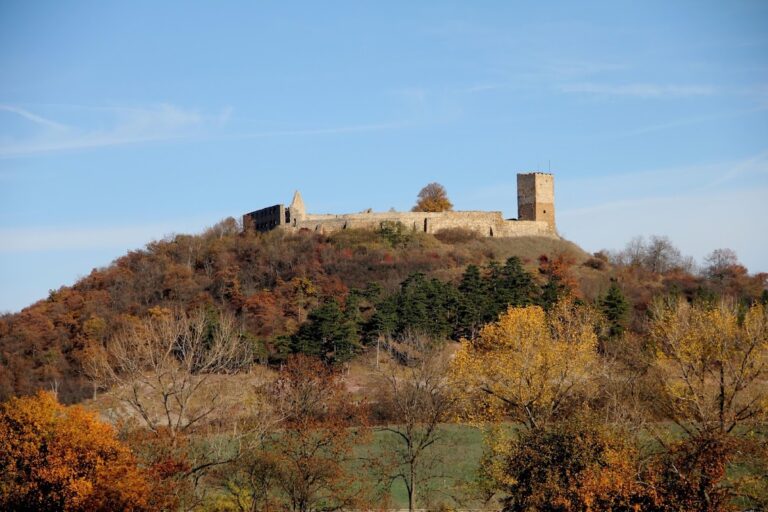
Mühlburg occupies a spur of the Schlossleite at about 375 metres above sea level, above Mühlberg and beside the ridge leading toward Wachsenburg. Its defenses were arranged in four successive obstacles, beginning with the surrounding ditch and continuing through the outer wall, the main curtain wall, and the wall of the inner castle. In the thirteenth century, this layered arrangement represented technically up-to-date construction for a strongly fortified castle.
Defensive Works
A wooden bridge crosses the neck ditch, a ditch cut across the narrow neck of a spur. The ditch is considered one of the most substantial examples of its type in Thuringia. Beyond it are the remains of the outer defensive wall, which created an additional defended zone before the main wall, followed by the main curtain wall enclosing the defended area and the wall of the inner castle. The gatehouse, once part of the outer wall, survives only in fragmentary form.
Principal Tower
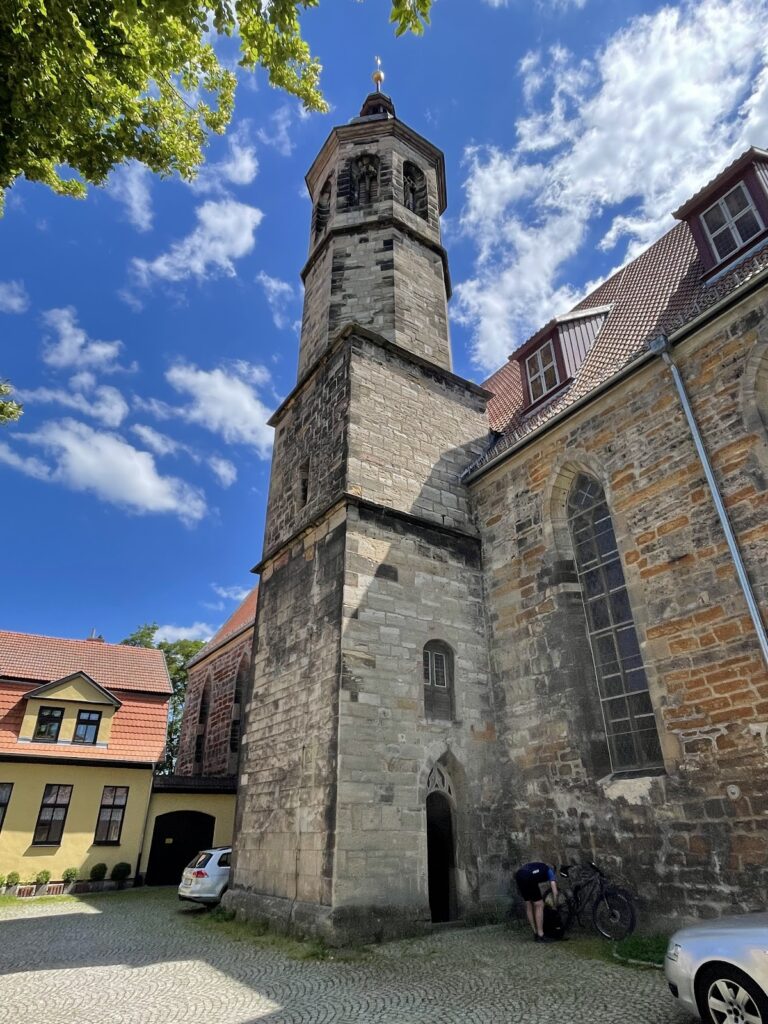
The principal tower rises 22 metres and has walls 2.7 metres thick with a diameter of 7.4 metres. Its upper crenellated crown belongs to the conversion carried out between 1903 and 1907, when the medieval tower was adapted as a viewing tower. The tower now provides views of the other two castles in the Drei Gleichen group, Gleichen and Wachsenburg.
Inner Castle and Chapel Foundations
The inner castle was built directly on exposed bedrock, a position that made undermining it virtually impossible. Near the beginning of the Schlossleite ridge stands a chapel dedicated to Saint Radegundis. Its predecessor’s foundations lie beneath the later chapel, although their age has not been conclusively established. The medieval predecessor chapel within the castle grounds survives as foundations with the memorial stone installed in 1987.
Museum and Archaeological Features
The castle grounds contain a well and a museum displaying medieval pottery and household equipment. These objects and features help convey the domestic side of the fortified site alongside its surviving defensive structures. The combination of the ditch, layered walls, tower, bedrock-supported inner castle, chapel foundations, and museum preserves the physical outline of Mühlburg’s medieval development.