Duomo di Muggia: Muggia’s Principal Parish Church in Italy


Site at a Glance
- Rating
- 4.5
- Popularity
- Low
- Country
- Italy
- Primary era
- Medieval
- Eras represented
- Medieval, Modern
- Civilizations
- Holy Roman Empire, Italian, Venetian
- Site type
- Religious
- Remains
- Church
On this page11 sections
History
The Duomo di Muggia is Muggia’s principal Roman Catholic church in Italy, dedicated to Saints John and Paul and consecrated in 1263. Its fifteenth-century remodeling created an important example of Gothic-Venetian architecture, while the building remains the parish church of Muggia within the Diocese of Trieste.
Medieval Foundation
The church was built over an earlier sacred building with three apses, or rounded sanctuary ends. Bishop Arlongo dei Visgoni of Trieste consecrated the new church on 29 December 1263. The original structure followed the Romanesque style, a medieval tradition known for massive construction, rounded arches, and relatively small openings.
Fifteenth-Century Remodeling
Between 1444 and 1467, the church underwent substantial remodeling. During the middle of the fifteenth century, its facade received a facing of white stone, combining Gothic forms with decorative traditions associated with Venice and the northern Adriatic. The principal works were completed in 1467 under the supervision of Pietro Dandolo, who served as podesta, a civic magistrate who governed a town for a limited term. He is also identified as the architect.
Modern Alterations and Parish Use
In 1865, the facade was rebuilt from the rose window upward and lowered by half a metre because it was out of alignment. The choir was lengthened in 1873, and a new high altar was consecrated in 1877. During restoration and consolidation in the late 1930s, the lateral Baroque altars were removed and the interior was returned to a simpler appearance. The Duomo continues to serve as the parish church of Muggia within the Diocese of Trieste and follows the Roman rite.
Remains
The surviving church has a three-nave interior and a white-stone facade whose Gothic elements organize the front elevation. The bell tower stands beside the church as a separate vertical feature, rising from a square base through four decorated levels.
Facade and Interior
White-Stone Facade
The facade is faced with white stone and has a trefoil-shaped upper design. This motif appears again in the arches of the large circular rose window, in the vertical stone divisions of its openings, and in two side windows uncovered beneath plaster in 1937. The rose window contains the Madonna and Child at its centre and is surrounded by three inscriptions. One commemorates the 1865 restoration, another refers to the beginning of the facade works under Bishop Nicolò, possibly of the Aldegardi family, and a third names Pietro Dandolo in connection with the completion of the work in 1466 and 1467.
Portal and Nave Interior
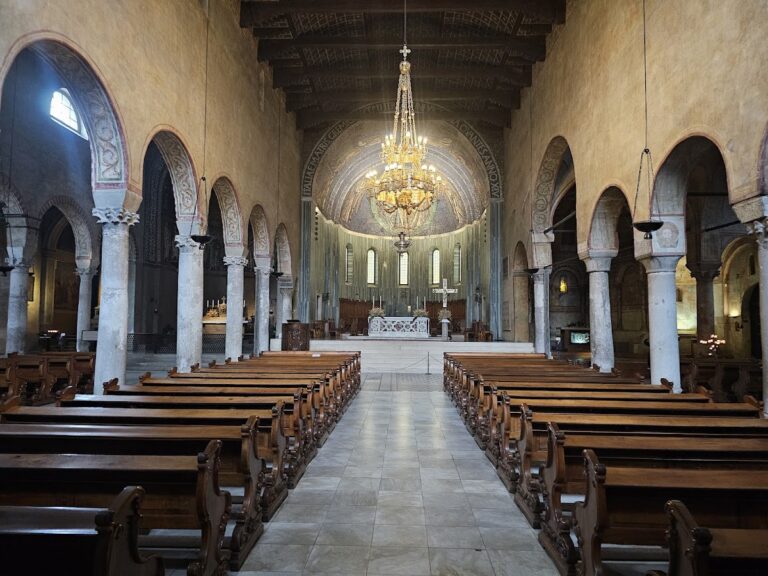
Two slender Gothic windows flank the portal. Above the doorway, a lunette, the curved space over an opening, contains a high-relief representation of the Holy Trinity adored by Saints John and Paul. Inside, the three naves preserve a fragment of an exceptional fourteenth-century fresco from a larger work that once occupied the central nave. Eighteenth- and nineteenth-century processional lanterns associated with former confraternities remain along the walls.
Organ and Bell Tower
Mascioni Pipe Organ
The choir loft on the counterfacade contains the Mascioni opus 939 pipe organ, built in 1971. Its mixed transmission uses mechanical controls for the manuals, the keyboards played by the hands, and the pedal, operated by the feet, while electric controls operate the stops that regulate the organ’s sounds. The instrument originally had 16 stops on two manuals and the pedal, and was restored and expanded to 18 stops in 1991.
Bell Tower
The bell tower rises 35 metres from a square base and is divided into four levels. Frames of Euganean trachyte decorate the levels, while the uppermost storey has mullioned windows divided by vertical stone bars. The tower probably predates the present church, and its clock has been present since the fourteenth century.