Genoels-Elderen Castle: Historic Castle and Wine Estate in Belgium


Site at a Glance
- Rating
- 4.6
- Popularity
- Low
- Country
- Belgium
- Primary era
- Early Modern
- External website
- Open
- Eras represented
- Classical, Medieval, Early Modern, Modern
- Civilizations
- Belgian, Holy Roman Empire, Roman
- Site type
- Domestic
- Remains
- Castle
On this page15 sections
History
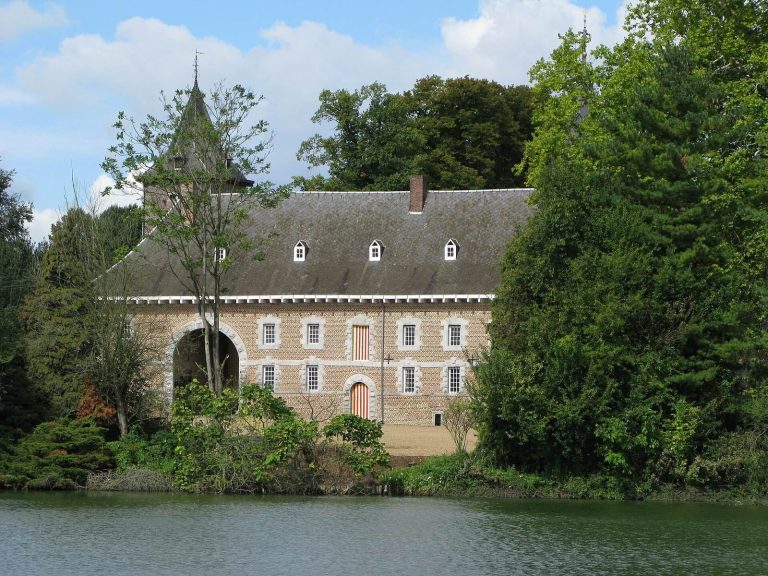
Genoels-Elderen Castle is a historic castle and wine estate in Belgium, located at Genoelselderen in Riemst near Tongeren. It stands beside the former road linking Tongeren with Cologne. The first castle was reportedly built in the thirteenth century by Godenoel of Elderen, whose name is traditionally associated with the “Genoel” prefix in the village’s name. The castle first appears in a record from 1265, while Godenoel is recorded as having died in 1305.
Medieval origins and destruction
Troops from Tongeren burned the castle in 1407. A replacement was subsequently founded by Godenoel IV of Elderen, continuing the connection between the estate and the noble family that gave it its name.
The Elderen family retained the castle until 1718. Among its prominent members were William of Elderen, a sixteenth-century canon and president of the council of the Prince-Bishop of Liège, and his great-nephew Jean-Louis of Elderen, who became Prince-Bishop of Liège in the seventeenth century. A prince-bishop combined the religious authority of a bishop with the secular rule of a prince over a territory.
Later ownership and rebuilding
Ownership passed to the d’Oyembrugge family after 1718 and to the de Borchgrave family from 1754. Count Michel-Walrame de Borchgrave restored the castle in the late eighteenth century and created a French-style garden. French Revolutionaries destroyed the castle at the end of that century, leaving the cellars as the surviving core of the earlier estate.
Count Guillaume de Borchgrave extensively remodelled the deteriorated property in 1859, giving it the appearance associated with the castle today. The estate passed to Gillain de Tirlemont in 1869. It later housed French Fathers of the Sacred Heart before being sold to the Beauduin family in 1906.
Wine estate
Around 1990, Jaap van Rennes acquired and restored the castle and established a new vineyard. The first plantings were made in February 1991, and the first wines were produced in 2000. The estate later produced wines under the controlled designation of origin for Haspengouw, with the vineyard expanding to 22 hectares, making it one of Belgium’s largest.
The estate’s four named wines are Chardonnay Wit, Chardonnay Blauw, Chardonnay Goud, and Pinot Noir Rood. Their awards included silver for Chardonnay Wit in 2001, medals for Chardonnay Blauw from several vintages, recognition for Chardonnay Goud from the 1995 to 1999 vintages, and a professional-jury award at Megavino for Pinot Noir Rood from 1995. Genoels-Elderen Castle is protected heritage in Flanders under identifier 36874.
Remains
The surviving complex combines a U-shaped castle, service buildings, formal gardens, a broader landscape park, agricultural buildings, wine-production spaces, and vineyard sections. The present architectural character reflects an eighteenth-century core, later restoration, and the extensive remodelling carried out in 1859 in Neoclassical and Louis-Philippe styles. Neoclassical architecture draws on ancient Greek and Roman forms, while Louis-Philippe style refers to the nineteenth-century French style associated with the reign of King Louis-Philippe.
Castle buildings
Main castle
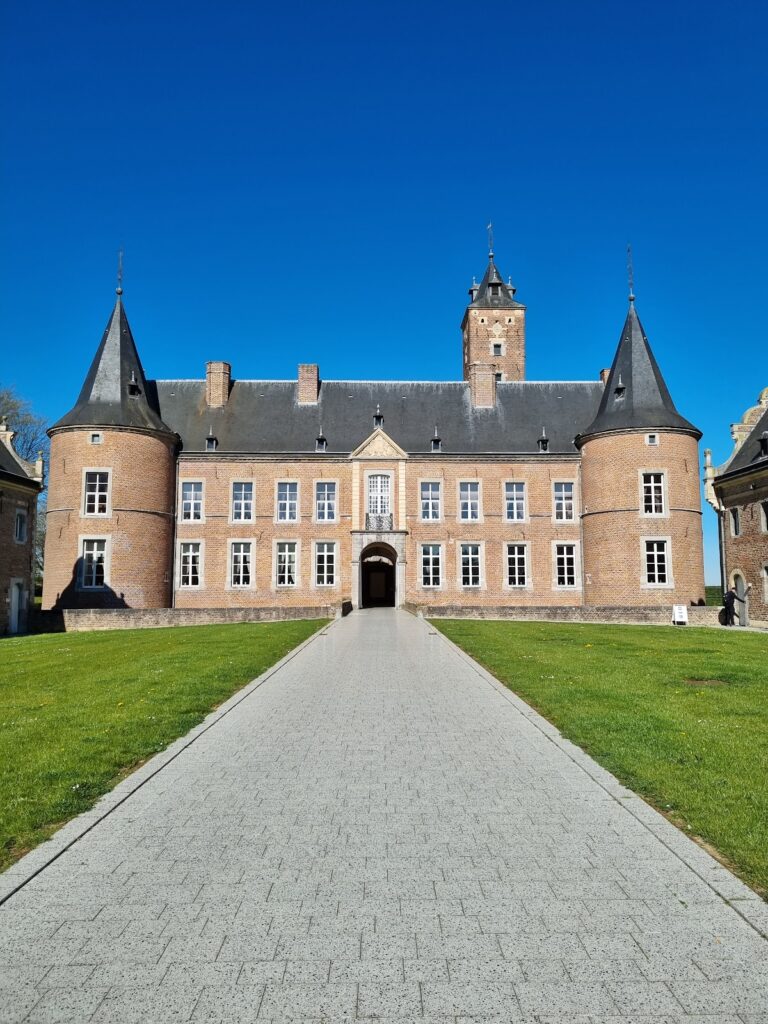
The main building forms a U with two projecting wings. Its central section has a pediment on each side. The core dates from the first half of the eighteenth century, was restored during the second half of that century, and was extensively remodelled in 1859. The resulting structure preserves the combination of earlier fabric and nineteenth-century design that defines the castle’s present appearance.
Service buildings and castle farm
Service buildings extend the wings and contain servants’ quarters, a barn, stables, and a coach house. North of the main building, a castle farm forms a separate part of the complex. The farm is described as older than the castle and displays Mosan Renaissance features.
Gardens and park
Formal garden
A French-style park occupies the space between the service buildings. Two fountains stand at the sides of the garden. One features Apollo, the Greek deity associated with music, prophecy, and healing, while the other depicts Artemis, the deity associated with the hunt and the natural world.
Landscape park and belvedere
The wider complex is enclosed by an English-style landscape park. Its southern section contains an eighteenth-century belvedere shaped as an antique temple and executed in the Louis XVI style. A belvedere is an elevated structure or viewpoint designed to overlook its surroundings. The grounds also include a rose garden, an old orangery greenhouse, ponds, a distillery, and a press house.
Cellars and vineyards
Wine-production spaces
Thirteenth-century wine cellars survive within the grounds. The original cellars were reused for wine production and later enlarged as production increased, connecting the medieval fabric of the estate with its modern role as a wine-producing castle.
Vineyard sections
The first vineyard section was planted inside the enclosing walls in February 1991 with 1,315 Chardonnay plants across 695 square metres. A second section, planted with Pinot Noir in April 1991, covers 555 square metres on a south-facing hill outside the wall. A third section was established in 1992 between the castle and the castle farm with Pinot Blanc, Pinot Gris, and Auxerrois, while a fourth was used to test varieties uncommon in northern vineyards.
The two-hectare de Vogelsanck vineyard was planted with Chardonnay and Pinot Noir in 1993 and enlarged in 1999. The four-hectare Kiezelingenbos vineyard, also dating from 1993, contains Chardonnay. From 1997 to 1998, 5.7 hectares of Chardonnay were planted at Wijngaardveld, a place-name recalling an earlier regional wine-growing tradition that was lost under the Napoleonic regime. Hommelberg contains 1.7 hectares of sun-exposed Chardonnay, and a ninth section of half a hectare was added in 2000 for Pinot Gris, producing highly aromatic white wines.
Earlier archaeological features
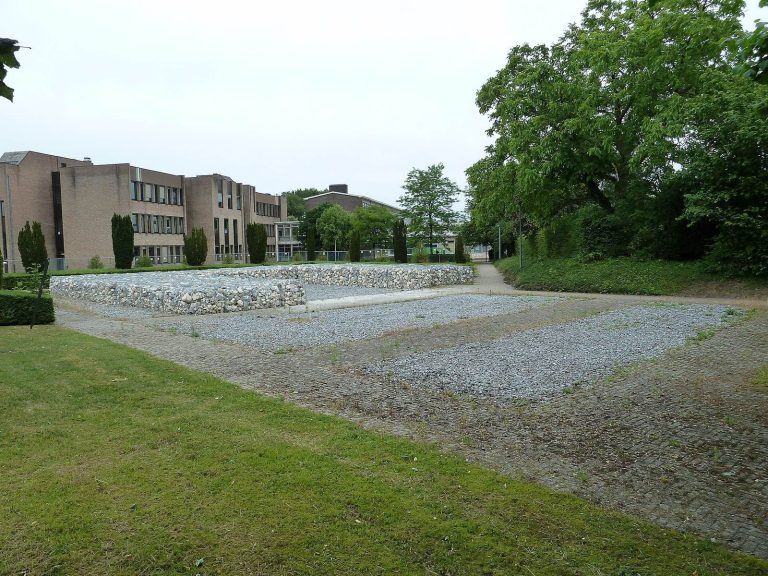
A Gallo-Roman tumulus dating from the first century stands in Kiezelingenbos behind the castle, within the private park. A Gallo-Roman tumulus is a burial mound from the period when Roman culture and institutions were established in Gaul.