Moridunum Roman Amphitheatre: A Roman Arena at Carmarthen


Site at a Glance
- Rating
- 3.7
- Popularity
- Very Low
- Country
- United Kingdom
- Primary era
- Classical
- External website
- Open
- Eras represented
- Classical
- Civilizations
- Roman
- Site type
- Entertainment
- Remains
- Amphitheatre
On this page5 sections
History
Moridunum Roman Amphitheatre is a Roman arena complex in Carmarthen, United Kingdom, associated with Moridunum, a fort and town in the Roman province of Britain. Moridunum served as the civitas capital of the Demetae, a Roman administrative district whose tribal community was centred there.
The Roman fort and town
The Roman fort at Moridunum is generally dated to around AD 75 and was abandoned around AD 120. Afterward, its associated civilian settlement developed into the town. A street grid was laid out during the first part of the second century AD, while a defensive circuit was established around AD 200 and later strengthened with stone walls. The enclosed town measured approximately 400 metres from northeast to southwest by 375 metres.
The amphitheatre stood outside the eastern or northeastern side of the Roman town, about 200 metres beyond its defensive enclosure. Burials were recorded close to the arena, placing the monument within a wider archaeological area beyond the town walls.
Excavation and survival
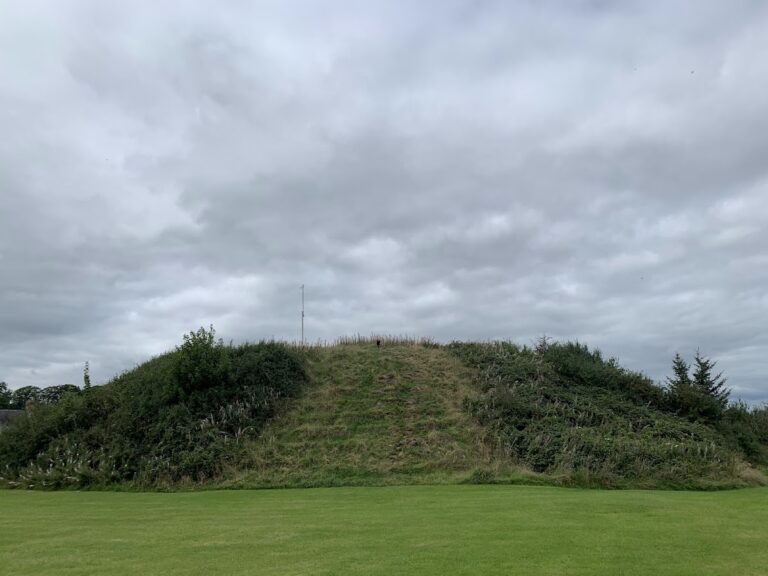
Moridunum was investigated through excavations carried out in 1968 and 1969, in 1976, 1978, from 1980 to 1984, in 1986, and in 1987. The amphitheatre itself was excavated in 1968 and has since been partly laid out for public display. It is one of seven surviving Roman amphitheatres known in the United Kingdom and represents the only above-ground Roman remains in the modern town of Carmarthen.
Remains
Arena and seating structure
The amphitheatre formed a large oval or elongated arena complex measuring approximately 91 by 67 metres overall. The central arena measured about 46 by 27 metres, while the seating area, or cavea, measured approximately 92 by 67 metres. The cavea was the seating area surrounding the arena, and here it consisted of wooden seating supported within a structure enclosed by stone walls.
The scale of the complex was considerably greater than would normally be expected for a town of Moridunum’s size. Its remains lie east of the former Roman settlement and beyond the defensive enclosure. Part of the structure has been laid out for public display, leaving the amphitheatre as a visible archaeological component of modern Carmarthen.