Morača Monastery: A Serbian Orthodox Monastery in Montenegro
Site at a Glance
- Popularity
- High
- Country
- Montenegro
- Primary era
- Medieval
- Eras represented
- Medieval, Early Modern
- Civilizations
- Ottoman, Serbian
- Site type
- Religious
- Remains
- Monastery
On this page12 sections
History
Morača Monastery is a Serbian Orthodox monastery in Morača, Montenegro, founded in 1252 by Prince Stefan Vukanović Nemanjić. Its main Church of the Dormition of the Virgin, named for the Christian feast commemorating Mary’s death, follows the Raška style, a medieval Serbian tradition combining Byzantine and Romanesque elements. Stefan was a grandson of Stefan Nemanja and son of Vukan Nemanjić, members of the Nemanjić ruling dynasty. The monastery may have been built on lands assigned to him as a dynastic appanage, or portion of a ruler’s domain granted to a family member.
Foundation and medieval role
From its foundation, the monastery belonged to the Eparchy of Zeta, an Eastern Orthodox diocese established in 1219 within the Žiča Archdiocese. In 1346, when the Peć Patriarchate, the Serbian Orthodox Church’s patriarchal institution, was proclaimed, the eparchy received the honorary rank of a metropolitanate, a senior church jurisdiction. Morača lay within the Nemanjić state, first the medieval Serbian Kingdom and later the Serbian Empire. It also served as a station on the trade route between Onogošt, the medieval name for present-day Nikšić, and Brskovo, a mining settlement.
The monastery’s founding charter was reportedly a narrow scroll about two arshins long, detailing lands associated with Rovci, a historic Montenegrin tribal region. Morača also became a place where scribes copied books and taught literacy, and where judicial sentences and important decisions by rulers were made.
Ottoman rule and reconstruction
Following the fragmentation of feudal territories, Morača and the upper Morača region lay among lands held by the Balšić, Branković, Lazarević, and Kosača families. The area came under Ottoman rule in the mid-15th century, and the monastery formed part of the Herzegovina Sanjak, an Ottoman administrative district. Around 1505, the monastery was plundered and burned. Its monks took refuge in Vasojevići, a Montenegrin highland region, and the complex remained abandoned for about seventy years.
Rebuilding began after the Peć Patriarchate was restored in 1557 and was completed around 1574. Monks Tomo and Mojsije led the work with help from local people, particularly Vukić Vučetić, a local leader. The rebuilding inscription also recorded the death of Serbian Patriarch Makarije. Painting and decoration continued into the late 16th and 17th centuries, as the monastery became an important center for maintaining Orthodox Christianity among surrounding highland communities.
Forged documents later claimed that church councils had met at Morača in 1648 and 1653. Later analysis identified the documents as fabrications unrelated to the monastery or to events there. During a famine under Abbot Dimitrije, the monastery is said to have fed people from Morača and other districts. Cloth spread across the courtyard served as a communal table, while the abbot and helpers served cornmeal porridge from large cauldrons.
A highland church center in the 18th and 19th centuries
In the 18th century, Morača was one of the leading church centers in Brda, a historical highland region of Montenegro. A joint Montenegrin–Brda state formed in 1796 and gradually expanded inland. By about 1820, Morača had passed out of Ottoman rule, a change later confirmed by a boundary settlement between the Principality of Montenegro and the Ottoman Empire.
On 11 June 1877, Ottoman forces made their final attack on the monastery. A Brda battalion defending it was led by the abbot, Mitrofan Ban, who later became Metropolitan of Cetinje. During his abbacy, from 1869 to 1879, the monastery advanced materially and spiritually. From 1878 it belonged to the Zahumlje–Raška Eparchy. That jurisdiction was dissolved in 1931 and incorporated into the Metropolitanate of Montenegro and the Littoral.
A monastery library and a scriptorium, a place where manuscripts are copied, operated continuously from the 16th century. The oldest manuscripts reliably known to have been made there date from that century, and the library grew particularly from the 19th century. Morača also developed as a pilgrimage center.
Modern history
A major restoration in 1935, carried out under Metropolitan Gavrilo Dožić and Abbot Miron Medenica, established the monastery’s present appearance. In July 1944, a session of the State Anti-Fascist Council for the National Liberation of Montenegro and Boka, a wartime representative body, took place at Morača. Montenegrin communists at the meeting opposed mentioning the Bay of Kotor separately; this position resulted in the bay’s incorporation into Montenegro.
In 1952, communists burned books and archival material from the monastery’s large library in the presence of local Communist Party officials. Morača remains part of the Serbian Orthodox Church and continues as a male monastery.
Remains
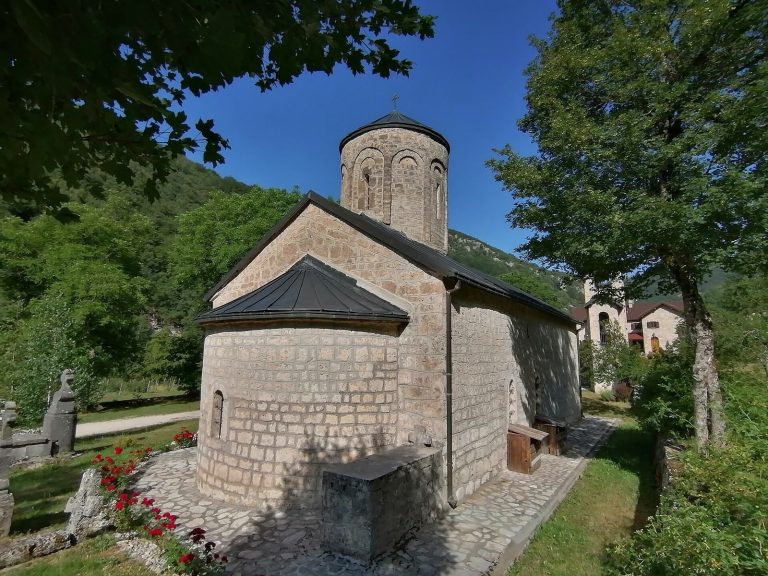
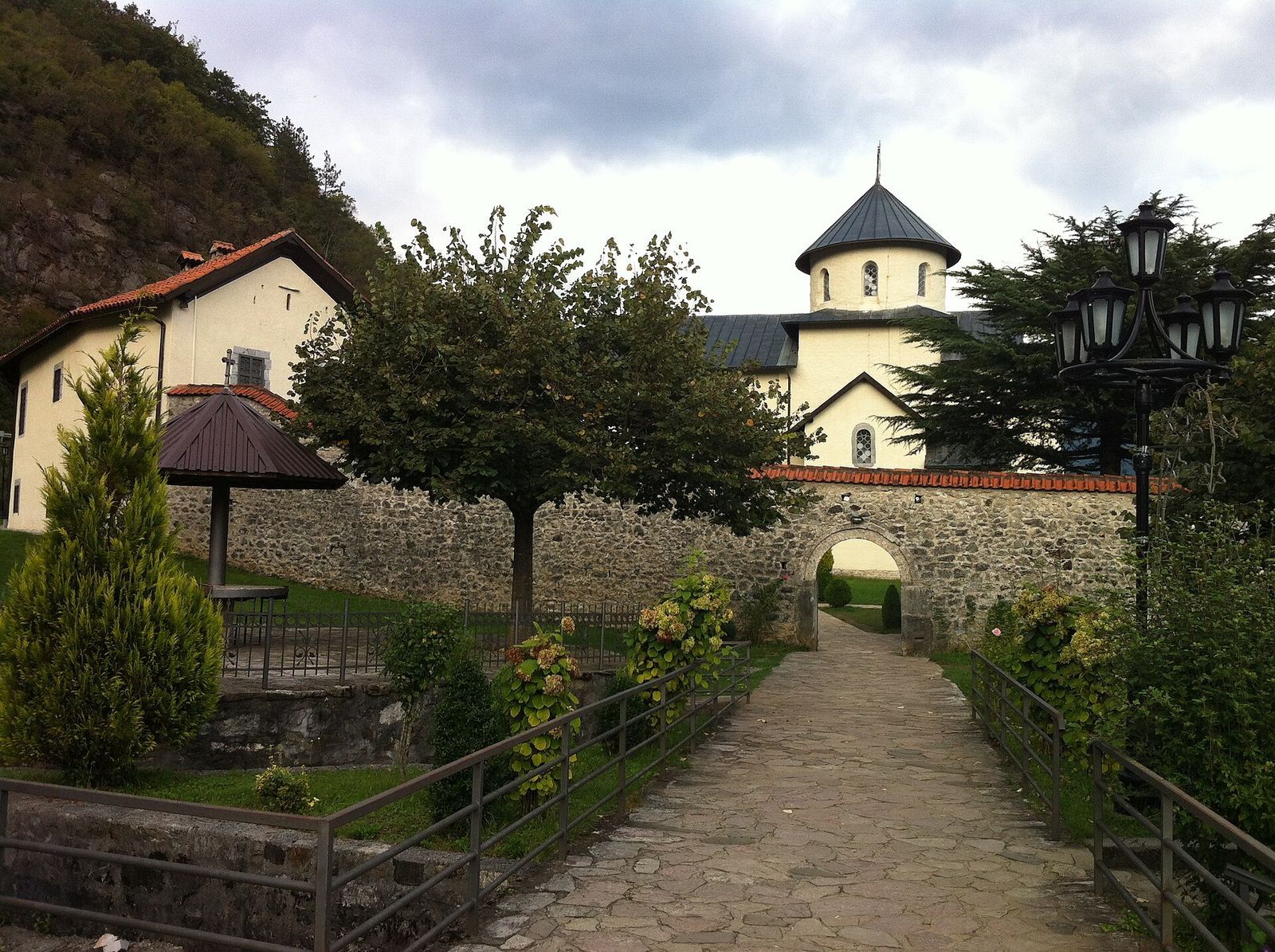
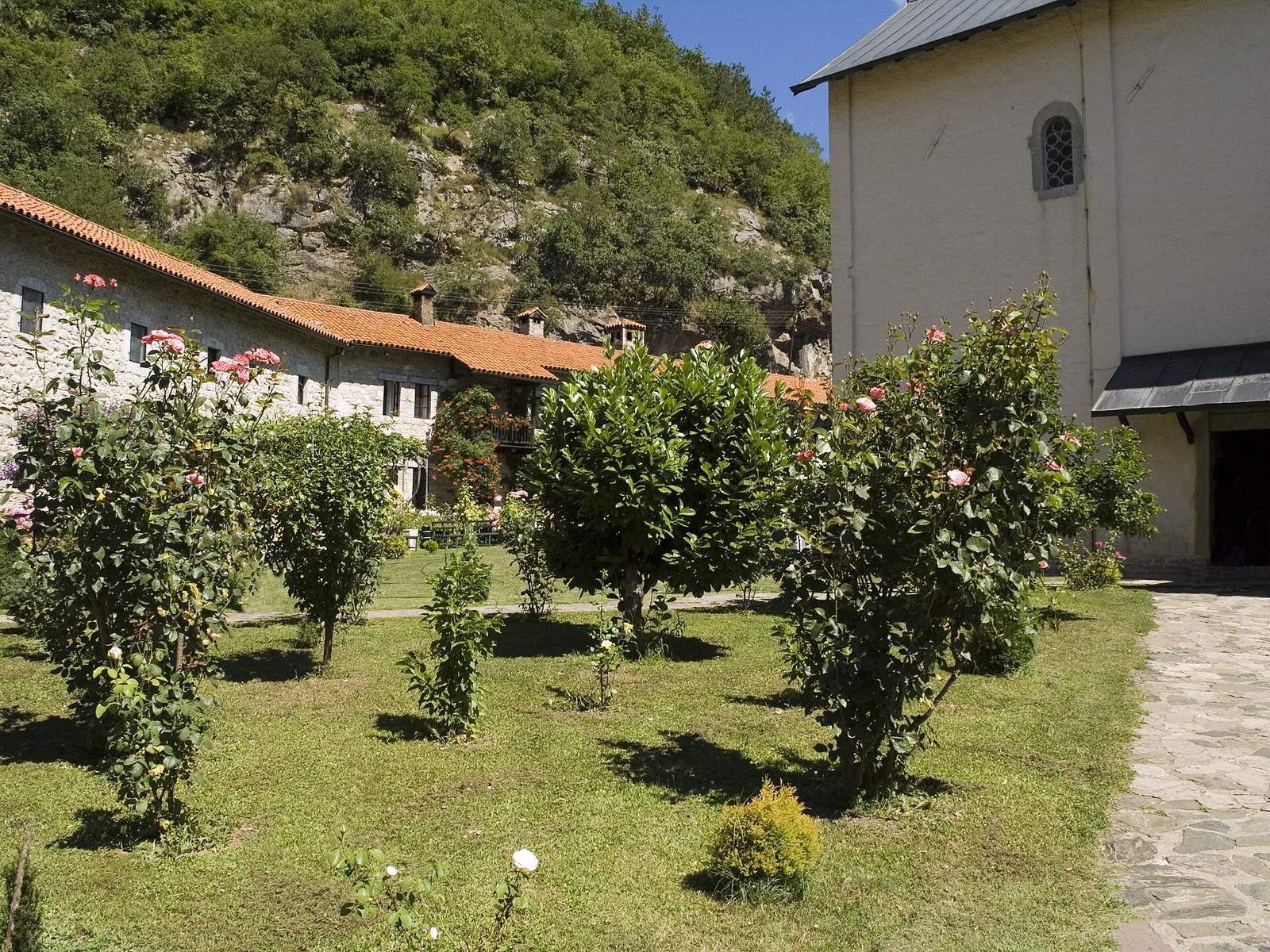
The monastery occupies a natural terrace on the right bank of the Morača River, where the river runs through a widened stretch of its canyon in central Montenegro. The Svetigora waterfall lies below the complex and flows into the river. A high wall with two gates encloses the garden precinct, which contains the main Church of the Dormition, smaller churches dedicated to Saint Nicholas and Saint Stephen, and monastic residences.
Church of the Dormition
Building and interior plan
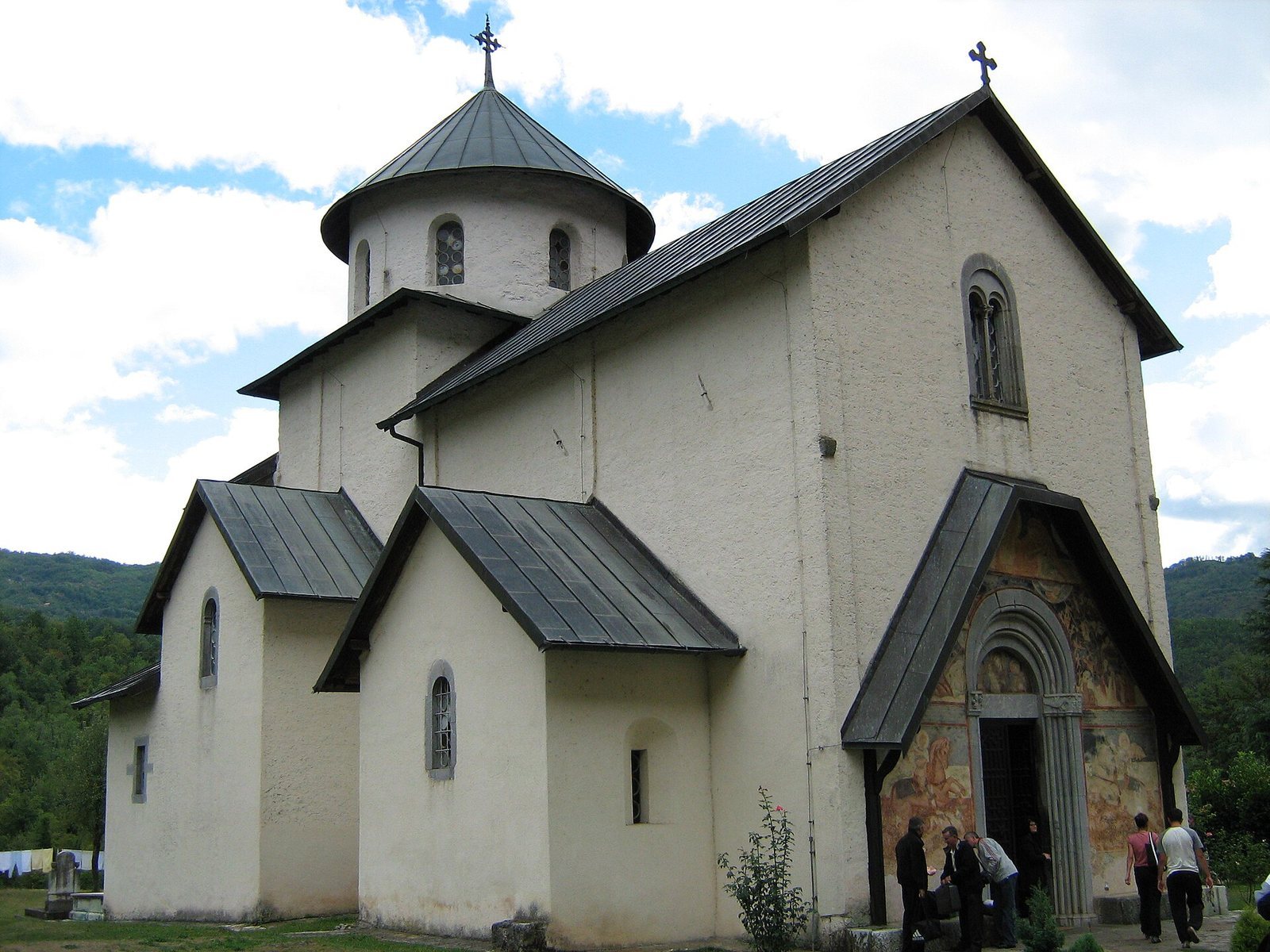
The principal church is a large stone building with a single main worship space. Its plan includes a spacious narthex, or entrance hall, a semicircular apse, side choir recesses for singers, and a dome. Its plastered walls distinguish it from churches built in the coastal style. The exterior is simple, with Romanesque features, including two principal portals in that style. The church’s founding inscription is above the western portal.
A chapel dedicated to Saint Elijah is attached to the north wall of the narthex, and its paintings date from the church’s construction. The founder is buried in the church. A 19th-century description characterized his tomb as polished marble, without an inscription or carved ornament, and said it remained sealed and unopened. An inscription may once have been fixed to a separate metal plate.
Frescoes and paintings
Only a small portion of the original 13th-century painting survives, in the diaconicon, a chamber beside the sanctuary traditionally used to prepare and store church items. It includes eleven large scenes from the life of the prophet Elijah, among them an image of ravens feeding him. A copy of that scene is placed to the left of the nave entrance. The surviving paintings have been compared in style with those at Sopoćani, a medieval Serbian monastery known for its frescoes.
Much of the original fresco cycle was damaged or lost during the first half of the 16th century, when the monastery was plundered and its lead roof removed. Later 16th-century paintings survive in better condition. A further layer, dated to 1577–1578, includes two scenes of the Last Judgment, as well as Paradise, the Bosom of Abraham, and Satan riding a two-headed beast. Artists associated with the Bay of Kotor school contributed to the later decoration. In the early 18th century, the painter Dimitrije decorated the church, and his son completed a large icon depicting the life of John the Baptist.
Icons and church doors
Icons and an iconostasis, the screen of icons separating the sanctuary from the nave, were made in the first half of the 17th century. Most are attributed to the priest Strahinj of Budimlja, Georgije Mitrofanović, and the master Kosma. Kosma is also credited with icons of Saint Simeon and Saint Sava and with a large icon showing the lives of Saint Sava and Saint Nemanja.
Marble columns stand at the entrance, and doors divide the church interior into two parts. Doors that had been hidden in a cave were returned to the church; they carry mosaic patterns made from black wood and ivory. Painted figures in the left vestibule of the altar and inscriptions on the doors have been attributed to the church’s construction period.
Other churches and monastic buildings
The smaller Church of Saint Nicholas dates to 1635 and has interior frescoes from the 18th century. The precinct also includes a church dedicated to Saint Stephen and the monastic residential buildings.
Monastic residence and collections
The monastic residence contains a treasury of icons, vestments, and other ritual objects. The monastery also preserves a copy of the Octoechos, an Orthodox service book of hymns arranged for an eight-week cycle, printed in 1493. It is the oldest printed Cyrillic book among the South Slavs. The monastery preserves relics of the hand of Saint Charalambos.