Kom Monastery: A Serbian Orthodox Monastic and Funerary Foundation in Montenegro


Site at a Glance
- Rating
- 4.6
- Popularity
- Low
- Country
- Montenegro
- Primary era
- Medieval
- Eras represented
- Medieval, Early Modern
- Civilizations
- Unclassified
- Site type
- Religious
- Remains
- Fortified Monastery
On this page10 sections
History
Kom Monastery is a Serbian Orthodox men’s monastery in Montenegro, founded in the fifteenth century as an endowment of Đurađ and Aleksa Đurašević of the Crnojević noble family. Built approximately between 1415 and 1427, it continued the Orthodox veneration of the Virgin Mary associated with the earlier Balšić dynasty and preserved the regional tradition of creating funerary churches and mausoleums for ruling families.
Foundation and the Crnojević period
Kom stood within the historical region of Zeta, a medieval principality associated with much of present-day Montenegro. For a short time, it served as the seat of the Zetan Metropolitanate, the Orthodox ecclesiastical jurisdiction of the region, governed by a senior bishop known as a metropolitan. The seat reached Kom after the abandonment of the Monastery of Saint Michael the Archangel on Prevlaka, passing through Prečista Krajinska and the Monastery of Saint Nicholas on Vranjina.
The monastery’s fortified character developed during the increasingly difficult political circumstances of the Crnojević period. Ottoman expansion, competition between Ottoman and Venetian power, and the struggle for political independence made the island’s defensible position especially valuable. Kom was also connected with the funerary traditions of the Zetan lords. A 1444 record describes Kojčin Crnojević asking the Venetian authorities in Shkodër and Kotor to return property taken from monasteries and churches around Lake Zeta, including institutions where members of ruling families were buried.
During its active period, Kom drew wealth from fertile land around the island, where vineyards, crops, and pasture supported the monastery. Much of this terrain is now flooded by Skadar Lake. The monastic community administered these properties from its island complex, while four members of the Crnojević family, including Stefan Crnojević and his wife, Mara Kastrioti, were buried at the monastery.
Ottoman pressure and later religious life
After the fall of Žabljak in 1478, Ottoman forces reached Kom’s immediate vicinity. In 1485, Ivan Crnojević transferred to the Monastery of the Nativity of the Virgin at Cetinje all estates that had previously belonged to the church at Kom. This transfer did not mark the monastery’s definitive abandonment, and Kom was active again around 1520.
The monastery came close to desolation during the seventeenth and eighteenth centuries, although the church continued to function. It received visitors and was opened for worship. In the winter of 1831, the young Petar II Petrović-Njegoš, the Montenegrin Orthodox metropolitan, prince-bishop, poet, and ruler later widely known as Njegoš, was appointed archimandrite at Kom by the Metropolitan of Prizren. An archimandrite is a senior Orthodox monastic title, usually associated with the superior of an important monastery or a distinguished monk.
Restoration and renewed worship
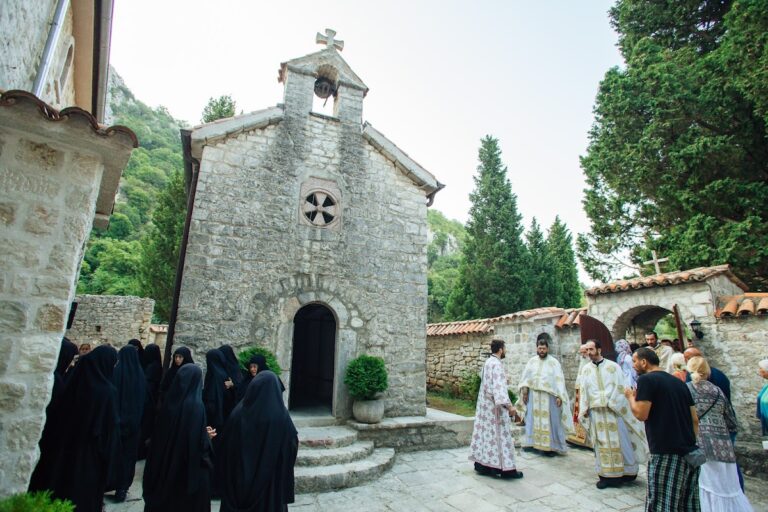
Worship was restored in the mid-twentieth century on the feast of the Dormition of the Virgin Mary, the Orthodox commemoration of her death and bodily assumption. People from the Ceklin area attended, while priests, monks from neighboring monasteries, and local residents helped maintain the church both structurally and liturgically. Older inhabitants remembered large communal gatherings at Kom.
Partial research, building repairs, and fresco conservation took place during the 1980s. A renewed restoration of the monastery and its spiritual life began in 1998, after Hieromonk David Mišeljić and Monk Chrysostom Nešić arrived with the blessing of Amfilohije Radović, Metropolitan of Montenegro and the Littoral. Mišeljić became the first superior of this renewed phase, but serious illness led him to move in 1999 to Jovan Do, the skete of Saint John the Baptist and a dependency of Ostrog Monastery. He died in a hospital in Germany in 2004. From 1999, Chrysostom Nešić continued the gradual restoration with assistance from local believers.
Remains
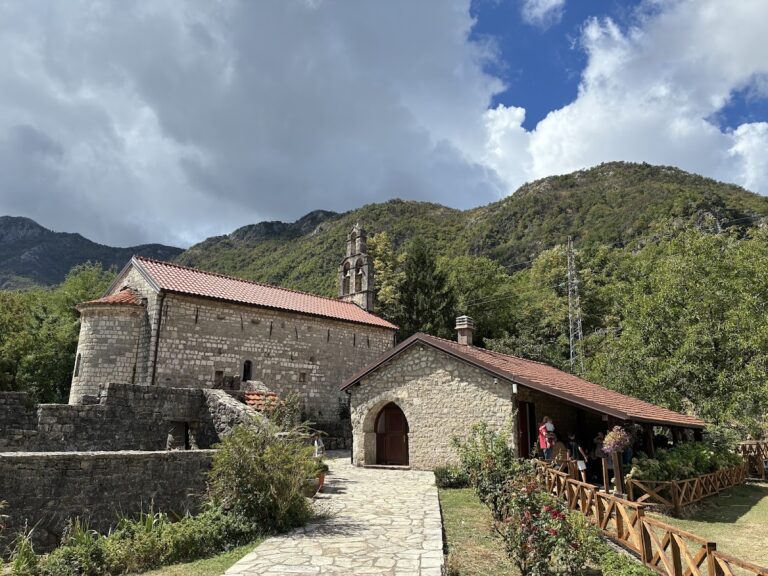
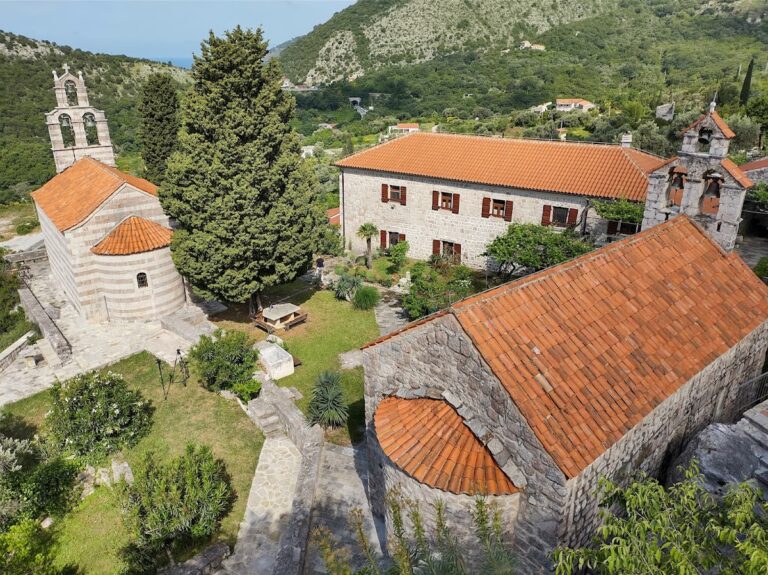
Kom Monastery occupies the small island of Odrinska gora near Žabljak Crnojevića, where the Crnojević River enters the western part of the marshy northwestern reaches of Skadar Lake. The complex combines a simple single-nave church, defensive walls with two gates, and surviving monastic buildings. Its setting also preserves the physical context of land once used for vineyards, fields, and grazing, although parts of that former territory now lie beneath the lake.
Church and frescoes
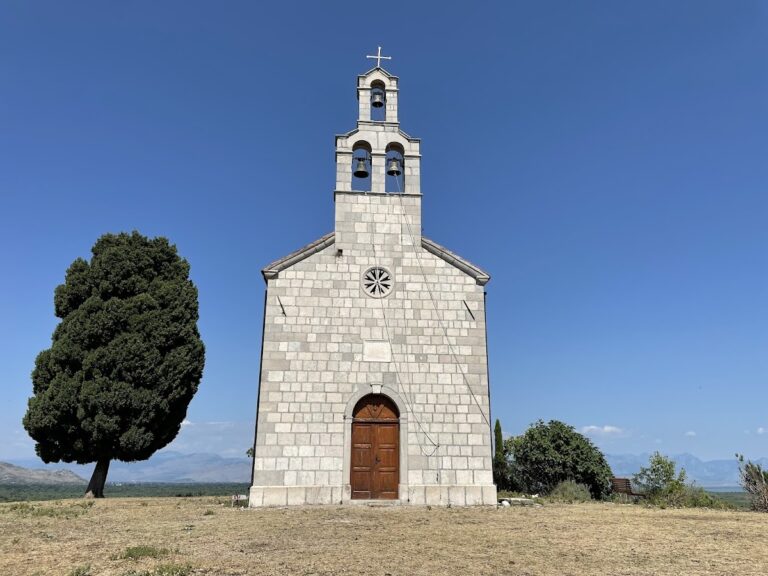
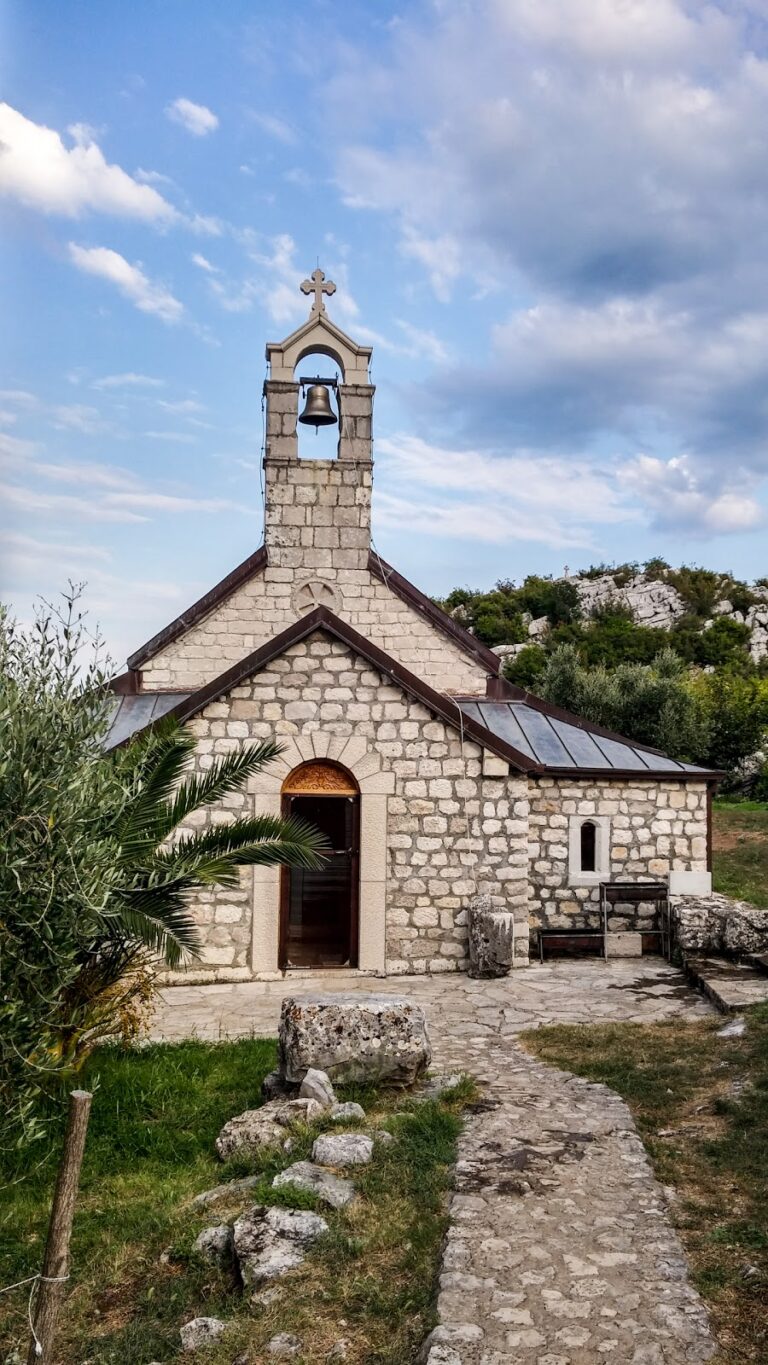
The Church of the Dormition of the Virgin Mary is a single-nave structure that acquired lateral chapels and a spacious wooden porch enclosing them during the mid-fifteenth century. Its fresco decoration was executed in two campaigns, the first around 1470 and the second during the 1580s. The oldest surviving paintings date from the second half of the fifteenth century, and the church is described as the only church on Skadar Lake with preserved frescoes.
Fortifications and monastic buildings
Defensive enclosure
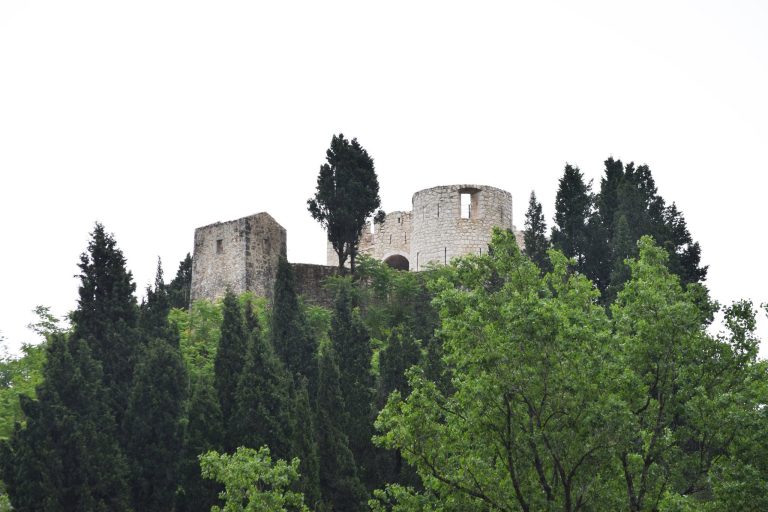
The monastery complex took on the appearance of a fortress at an early date. A defensive wall enclosed the island complex and included two gates, reflecting the need to protect the monastery during the political and military pressures of the Crnojević period.
Monastic lodgings and cultivated land
The principal lodging building stood on the western side of the island, positioned on a rock from which approaching people could be observed. Remains of other monastic lodgings survive beside the church and preserve evidence of the community that once administered the monastery’s surrounding properties. Those properties included vineyards, fields, and grazing areas, with portions of the associated landscape now submerged beneath Skadar Lake.
Crnojević burials
Four members of the Crnojević family are buried at Kom. Among them are Stefan Crnojević and his wife, Mara Kastrioti. These burials give the monastery a physical and religious connection with the funerary foundations established for the ruling families of Zeta.