Đurđevi Stupovi: A Serbian Orthodox Monastery and Episcopal Seat in Montenegro


Site at a Glance
- Rating
- 4.9
- Popularity
- Low
- Country
- Montenegro
- Primary era
- Medieval
- Eras represented
- Medieval
- Civilizations
- Serbian
- Site type
- Religious
- Remains
- Monastery
On this page7 sections
History
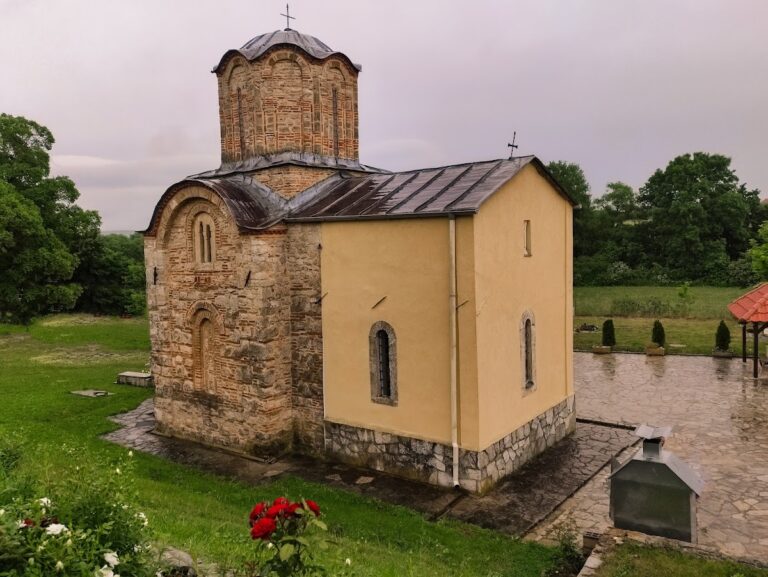
Đurđevi Stupovi is a Serbian Orthodox monastery in Berane, Montenegro, founded in the medieval Serbian period by Stefan Prvoslav. Its church was completed in 1213, although architectural comparisons with churches of the later twelfth century have led some interpretations to place its construction in the 1180s or 1190s. The church is dedicated to Saint George the Great Martyr, and Stefan Prvoslav, its founder and ktitor (principal founder or patron), was buried inside the monastery.
Foundation and episcopal seat
At the time of its foundation, Đurđevi Stupovi stood in Budimlja, a medieval župa or territorial district governed by a župan, and the area belonged to the old Raška bishopric. In 1219, Saint Sava, the first Serbian archbishop, organized the independent Serbian Church and established the Budimlja bishopric. He enthroned its first bishop, Jakov, in the monastery church, making Đurđevi Stupovi the seat of the new bishopric.
After the Serbian Church became a patriarchate in 1346, the bishops of Budimlja received the honorary title of metropolitan. The monastery continued as the seat of the bishopric until the see was probably transferred to Nikoljac around 1552. The bishopric was abolished in the seventeenth century, when the Budimlja area was returned to the Raška bishopric.
Ottoman-period destruction and monastic leadership
Ottoman forces plundered and burned the monastery in 1738, 1825, 1862, and 1875. A further fire affected it in 1912. Several religious leaders became associated with its later history, including Abbot Nićifor and Abbot Mojsije Zečević. Mojsije Zečević served as a spiritual leader of the Vasojevići during their struggle against the Ottoman Empire. Danilo Radulović, an archimandrite or senior monastic, and later abbot, was also regarded as one of the monastery’s notable leaders.
War, abolition, and revival
During the First World War, Austro-Hungarian forces used the monastery buildings first as a stable and later as a dining hall and barracks. The monastery was restored after the war. It was abolished after the Second World War, while the church underwent restoration in the 1970s.
In May 2001, the Serbian Orthodox Church re-established the Budimlja-Nikšić bishopric with its seat at the revived monastery. On 4 May 2002, Joanikije Mićović was enthroned there as bishop of Budimlja-Nikšić. Đurđevi Stupovi is a male monastic community governed by a cenobitic rule, under which monks live communally according to shared discipline. In August 2013, the monastery marked 800 years of existence with a ceremonial academy on 3 August and a liturgy on 4 August.
Remains
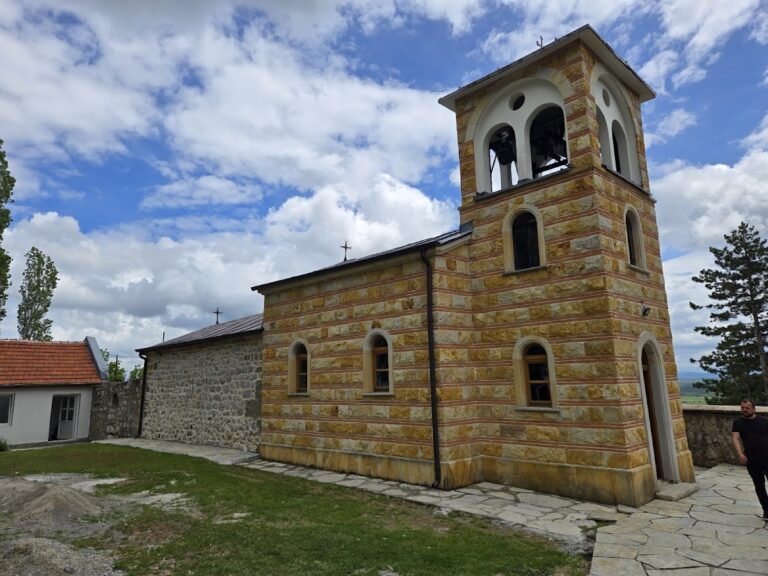
The surviving complex centers on the church of Saint George the Great Martyr. Its name, Đurđevi Stupovi, refers to towers traditionally erected beside churches and monasteries. These towers, sometimes called pirgs, served primarily as bell towers and could also provide defensive functions, linking the monastery’s name with both worship and protection.
Church interior and founder’s tomb
Stefan Prvoslav’s grave lies near the southern wall of the naos, the principal central space of an Orthodox church. An inscription beside the tomb identifies him as the župan Prvoslav, son of the grand župan Tihomir, nephew of Simeon Nemanja, and founder and ktitor of the site. Researchers date the inscription to around 1220, while its present form may reflect renewal in the sixteenth century.
Parts of the church’s early wall painting survive. The frescoes in the altar area belong to the Nemanjić period, the era associated with the medieval Serbian ruling dynasty founded by Stefan Nemanja. Recent research places the frescoes in the outer narthex, or entrance vestibule, in the time of Emperor Dušan, the fourteenth-century Serbian ruler under whose reign the Serbian Empire reached its greatest extent.
Oak associated with the monastery
An old hollow oak stood near the monastery into the 1930s. Local belief held that it had been planted during the Nemanjić period, giving the tree a traditional association with the medieval history of Đurđevi Stupovi.
Nearby sites