Castell de Claramunt: A Medieval Romanesque Castle in Catalonia


Site at a Glance
- Rating
- 4.3
- Popularity
- Low
- Country
- Spain
- Primary era
- Medieval
- External website
- Open
- Eras represented
- Medieval
- Civilizations
- Crown of Aragon
- Site type
- Military
- Remains
- Castle
On this page8 sections
History
Castell de Claramunt is a medieval Romanesque castle in Spain, built in the tenth century above La Pobla de Claramunt in Catalonia. Associated with the House of Claramunt, it stands in the Sierra de la Guardia above the right bank of the Noya River, at the entrance to the Capellades gorge and the Òdena Basin. During the tenth century, it formed part of the County of Barcelona and became the center of an extensive jurisdictional territory.
Origins and the House of Claramunt
The earliest surviving reference connected with the castle’s district is a papal bull issued by Pope Benedict VII on 25 February 978. It mentions the castles of Montbui and Tous in territories bordering the districts of Jorba, Claramunt, Orpí, Miralles, and La Roqueta. A royal confirmation of 986 granted the monastery of Sant Cugat del Vallès possession of several properties, including Santa Maria Church attached to the castle of La Pobla de Claramunt. The confirmation also recognized the church’s immunity and the free election of its abbot. A document dated 24 July 990 refers to Santa Maria de Claramunt.
From the tenth to the fourteenth century, the castle belonged to the Claramunt knightly family. In the eleventh century, Deodato of Claramunt, son of Bernardo I of Claramunt, married Ermesenda of Cardona, daughter of Ramon Folc I of Cardona, the first Viscount of Cardona. Ermesenda died in 1090 while giving birth to her first son, Bernat Amat II of Claramunt, who later became the second Viscount of Cardona.
Deodato’s later marriage and his transfer of the castles of Claramunt, Espadas, and Esparreguera to his wife prevented the district from being incorporated into the Viscounty of Cardona at that time. In 1306, Berenguer of Claramunt sold the jurisdiction to the Cardona viscounts, then represented by Ramon Folc V. The Claramunt knights consequently moved permanently to their castle at Torre de Claramunt.
Cardona jurisdiction and the later medieval period
The castle’s jurisdictional territory became the largest Cardona domain in the Anoia region. Covering 163 square kilometres, it included Capellades, Carme, Castellolí, Òdena, La Pobla de Claramunt, Torre de Claramunt, Santa Margarida de Montbui, and Vilanova del Camí. The churches in these districts were suffragan churches, meaning that they stood under the ecclesiastical authority of Santa Maria at the castle.
The original settlement of La Pobla de Claramunt was completely destroyed by floods in 1344. A new settlement charter was later granted, creating the town that exists today. In 1463, during the Catalan Civil War, the Generalitat of Catalonia ordered the castle demolished because it regarded the fortress as a threat after the counts of Cardona supported King John II of Aragon. Joan Ramon Folc, fourth Count of Cardona, ordered its reconstruction in 1484. The castle later passed to the Dukes of Medinaceli.
Justice, war, and the end of lordship
Castell de Claramunt housed the court of justice for the barony of the Òdena Basin, a territorial lordship governed by a feudal authority. Between 1575 and 1628, the court sentenced 18 people to hanging, 13 to the galleys, and two to exile. Ten people were flogged, while several others received prison sentences.
In September 1714, during the War of the Spanish Succession, troops of King Philip V of Spain occupied the castle. The population also endured several sackings during the Spanish War of Independence, Spain’s early-nineteenth-century conflict against Napoleonic French occupation.
The constitutional assembly known as the Cortes of Cádiz, together with later disentailment laws, introduced measures that abolished jurisdictional lordships. The Dukes of Medinaceli, related to the Dukes of Cardona since 1697, challenged the changes in court and continued collecting tributes until 1898, thirty years after the end of the lordships. Castell de Claramunt was declared an Asset of Cultural Interest on 8 November 1988 and is owned by the Generalitat of Catalonia, the region’s governing institution.
Remains
Enclosures and defensive walls
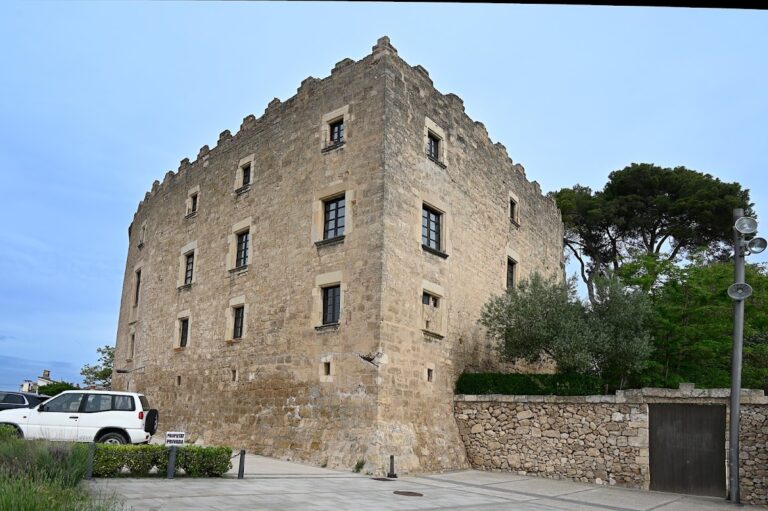
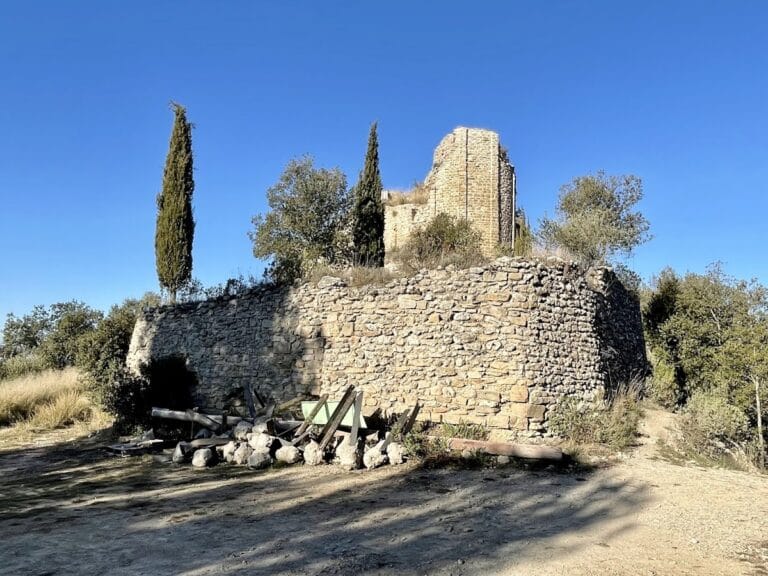
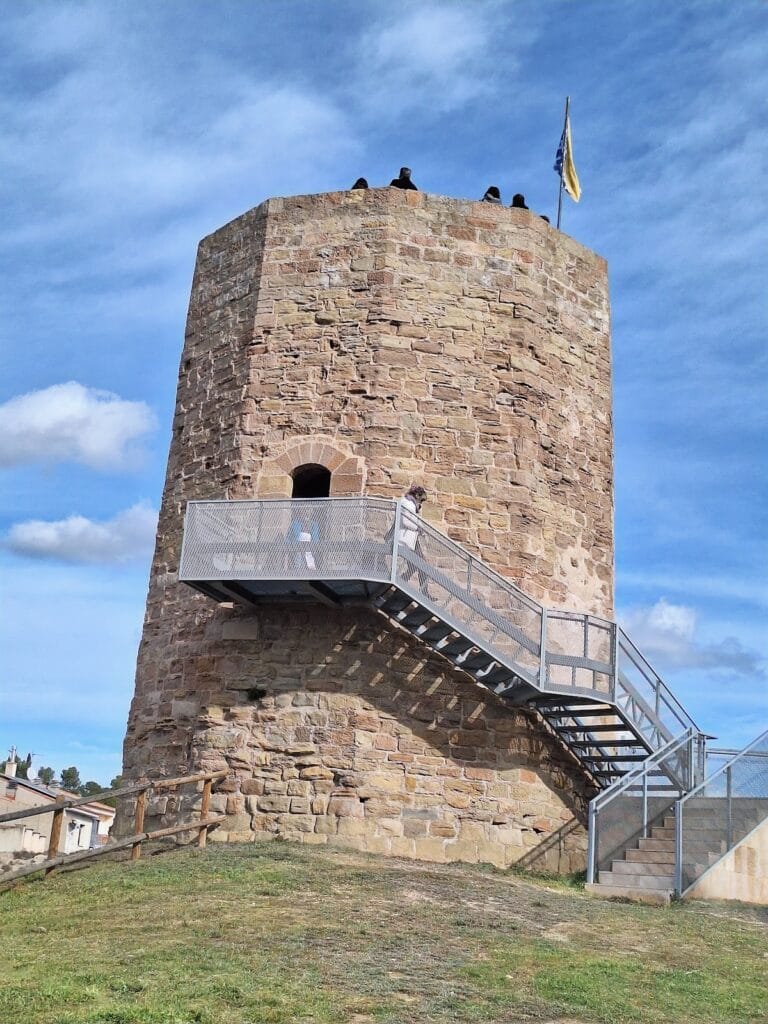
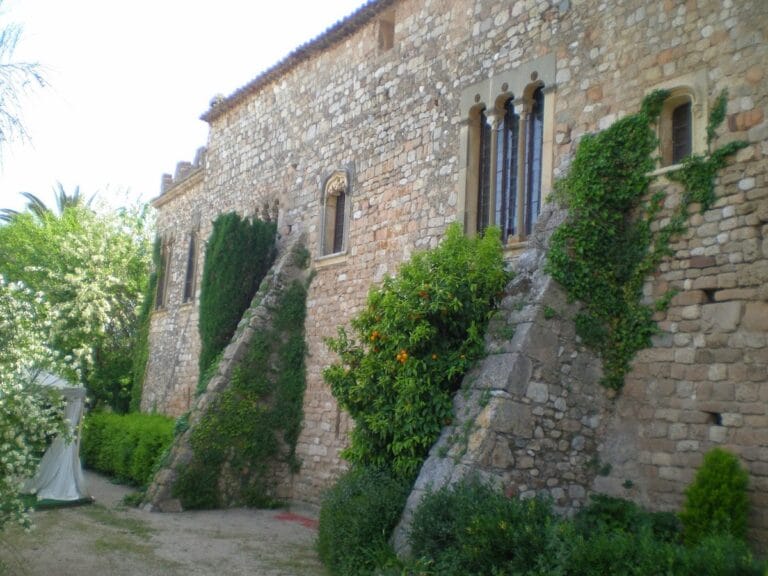
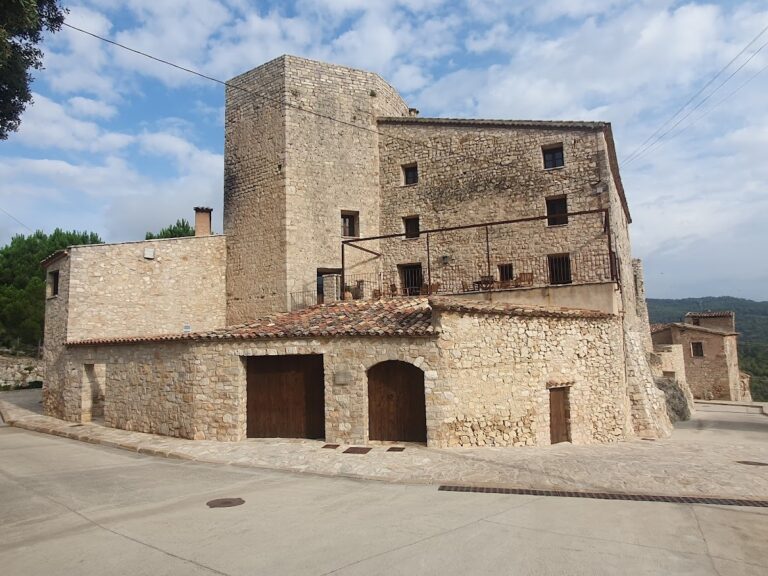
The castle occupies 5,400 square metres on a hill 453 metres above sea level. Three enclosures are arranged within stepped defensive walls. The sovereign enclosure covers 1,240 square metres and contains the keep, various buildings, and the Santa Maria and Santa Margarida churches. The remaining 4,160 square metres consist of courtyards and bastions. A prominent polygonal-based tower survives in very good condition, with square-based towers and walls attached to it. These walls formed the sides of rooms covered by Gothic vaults.
Churches and internal structures
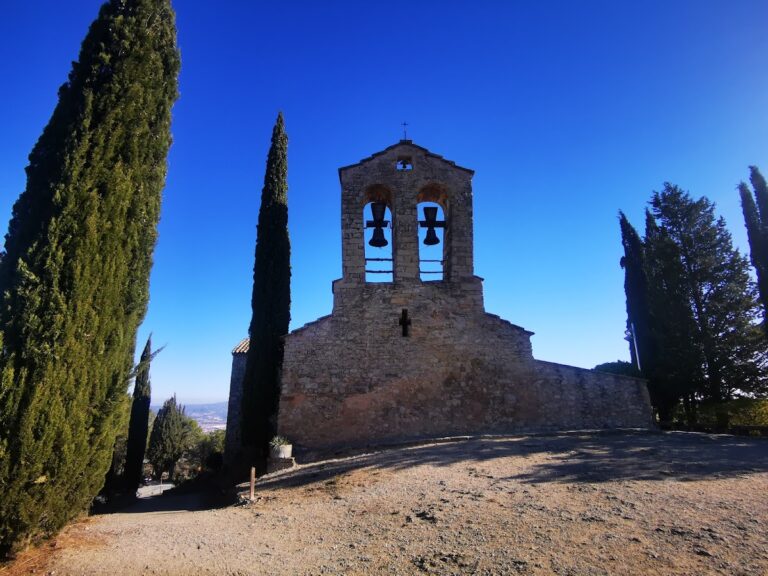
The sovereign enclosure contains the Romanesque Santa Maria Church and the Gothic Santa Margarida Church. The principal fortified tower is the keep, the castle’s main defensive and residential structure. In the lowest part of the enclosure, a cistern, a built reservoir for storing water, stands among several additional towers. Together, these surviving elements define the castle’s internal arrangement of religious buildings, fortified spaces, courtyards, and service structures.
Hilltop setting
Castell de Claramunt stands above the right bank of the Noya River, where the river forms the entrance to the Capellades gorge. Its hilltop position overlooks La Pobla de Claramunt and the entrance to the Òdena Basin, placing the surviving enclosures and towers within the landscape that shaped the castle’s historical jurisdiction.